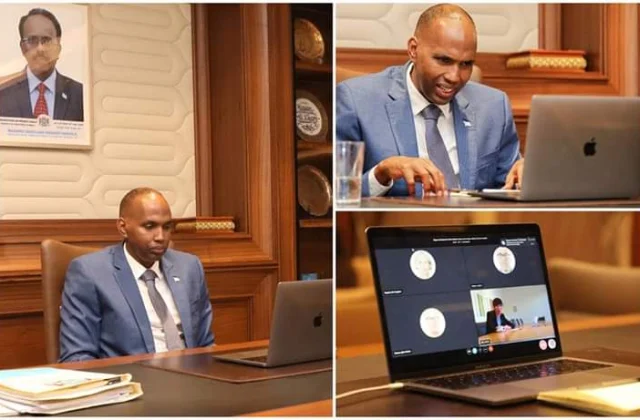


Mogadishu (AX) — Somalia’s annual import bill is approaching $9 billion, underscoring the country’s reliance on foreign goods and the urgent need to build up domestic manufacturing, Commerce and Industry Minister Jamaal Mohamed Hassan said.
Speaking in Mogadishu on Tuesday, Hassan said many products now brought into Somalia could be made locally if manufacturers gained better access to investment, infrastructure and a more supportive business climate.
- Advertisement -
“I will align myself with the person who produces goods in the country, owns a factory, creates jobs and invests in the nation. That is the person I will work with,” Hassan said.
Somalia has for years recorded a substantial trade deficit, with imports far exceeding exports. The International Monetary Fund expects goods imports to reach about $8.2 billion in 2026, compared with exports of roughly $1.3 billion. The country’s overall trade deficit is projected at approximately $7.7 billion this year.
Food represents a significant share of that import bill. World Bank data indicate that food made up about one-third of Somalia’s merchandise imports in 2024, totaling around $2.5 billion after increasing 26% from the previous year. The country also depends heavily on imported fuel, medicines, consumer products and construction materials.
Hassan called on Somali companies to increase investment in manufacturing, saying the country possesses both the workforce and economic potential to produce more of what its population consumes.
He also encouraged consumers to choose locally manufactured goods, arguing that stronger domestic demand would help create jobs, reduce dependence on imports and drive economic growth.
Somalia’s manufacturing industry remains limited, hindered by long-running challenges such as high electricity prices, restricted access to finance and inadequate infrastructure. The World Bank has identified expensive energy as a major obstacle to business competitiveness and industrial expansion.
Power generation still relies largely on imported diesel, exposing businesses to swings in international fuel prices. While about 71% of Somali households reported having access to electricity in a 2025 survey, only 21% received more than eight hours of electricity daily, according to the World Bank.
Hassan recognized the burden of costly electricity and the administrative hurdles confronting manufacturers, saying the government planned to work with businesses to reduce those obstacles.
“We are talking about the ‘Made in Somalia’ label. When a product bears that stamp, indicating it was produced and exported by the country, it brings honor to the nation,” he said.
The Commerce Ministry intends to create industrial and special economic zones to draw investment and increase domestic production, Hassan said.
“Industry is the backbone of the country’s economy,” he said.
The ministry is also preparing and completing legislation on commerce, competition and consumer protection, while drafting rules governing e-commerce.
Hassan asked banks and investment companies to channel more funding into manufacturing, agriculture and fisheries, noting that capital is currently concentrated largely in trade and construction.
Somalia’s limited export base has helped sustain the trade imbalance. Livestock has traditionally ranked among the country’s leading merchandise exports, while repeated droughts and floods have weakened agricultural output and driven up demand for imported food.
The effort to expand domestic production comes as Somalia looks for new avenues for private investment while economic growth faces mounting pressure. The World Bank estimates that the economy expanded by about 3% in 2025, down from approximately 4% in both 2023 and 2024 amid falling foreign aid, drought and rising living costs.
Hassan spoke days after President Hassan Sheikh Mohamud said Somalia had confirmed deposits of uranium, lithium and cobalt as his administration works to attract investment in the natural resources sector.
Speaking Saturday at the opening of the Somalia Development Financing Forum in Mogadishu, Mohamud said critical minerals could emerge as a significant driver of economic development.
“Today, the world is keenly interested in minerals, particularly so-called critical minerals,” Mohamud said. “Whether it is uranium, lithium, cobalt or many others currently sought after globally, their presence in Somalia has been confirmed.”