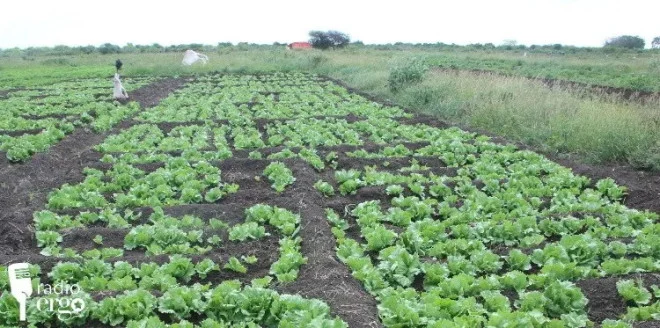
Farmers in southern Somalia’s Lower Shabelle region are turning to sunlight to cut irrigation costs and increase production, as fuel prices continue to squeeze agricultural incomes.
In Jarran village, Afgoye district, solar-powered systems have replaced fuel-driven pumps for some farmers, allowing them to irrigate more consistently and improve their returns.
- Advertisement -
Mohamed Nur Isaq, who cultivates four hectares, told Radio Ergo that his production had more than doubled since he purchased a solar system in January. Previously, each irrigation session cost him between $100 and $150, and financial pressure sometimes forced him to postpone watering his crops.
He now irrigates at least twice a month, compared with once every two months before the switch. His most recent harvest, collected in June and comprising onions, tomatoes, peppers, lettuce, coriander, maize and beans, generated about $3,000 in profit—more than twice what he earned with a fuel-powered pump.
“The main benefit is that I have reduced fuel costs, which has allowed me to irrigate regularly,” he said. “When I could not afford fuel, I had to delay irrigation, which affected the crops, especially when they needed water.”
Mohamed paid $4,600 for the solar system and has repaid $1,000 of the loan he took to finance the purchase. He has also saved about $1,700 from his farm income—more than he had ever managed to put aside in his previous years as a farmer. He credited the improvement to increased production and lower fuel expenses. Fuel costs about $1 per litre.
Neighbouring farmers who had already adopted solar power helped persuade Mohamed that the investment was worthwhile.
“I decided to make this investment because I saw that it would reduce my costs in the long term,” he said. “I used savings from my farm income and also received a loan to cover the remaining installation costs.”
Most people in Jarran depend on farming and draw irrigation water from the Shabelle River. Their produce is sold in markets across Banadir and Lower Shabelle.
By spending less on fuel, Mohamed can direct more money towards seeds, fertiliser, crop treatments and pesticides.
“I have been a farmer for nearly 18 years. Farming is my only source of income to support my family. I try to save part of my profits for emergencies or to improve my farm,” he said.
He hopes to purchase a larger solar system, costing several thousand dollars, because his current equipment cannot meet all his farm’s needs.
Mohamed Abdi Hassan, who has farmed for 15 years, is also using solar power in Jarran. He bought his system in March. His five-hectare farm is planted with maize, beans, onions, tomatoes, peppers, cucumber and other vegetables, with harvesting expected in September.
Since installing the system, he said, he has paid nothing for irrigation. Previously, every irrigation cycle required between $300 and $500 worth of fuel. He purchased the solar equipment for $4,500, including a $500 loan that he repaid in May.
“What encouraged me most was the high cost of fuel and the difficulty of finding money to buy it,” he said. “I looked for a lasting solution that would allow me to manage the farm properly. When I started using solar power, irrigation became easier and the costs were reduced.”
He now irrigates on a regular basis. His latest harvest, gathered in June, brought in $3,000, half of which he has saved.
Mohamed, a father of six, relies on farming to support his family and spends about $350 each month on education and household costs. Savings from fuel have enabled him to invest more in his five-hectare farm, including in quality seeds, fertiliser, crop treatments and other inputs intended to raise production.
Some farmers share the cost of solar equipment, while others buy individual systems, depending on their financial means.
Abdullahi Ali Mire, chairman of Jarran’s farmers’ association, told Radio Ergo that solar power was becoming more common as farmers saw its potential to improve irrigation and lower expenses. He said 90 farmers currently use solar systems, although that remains a small share of the area’s farming community.
“Agricultural production has improved. Farmers now have regular irrigation, which has helped crops grow better and increased their profits,” Abdullahi said.
The chairman urged more farmers to adopt solar power as an effective and sustainable energy source:
“Investment, training and support are needed to expand its use,” he said, emphasising agriculture’s importance to Somalia’s economy and livelihoods while calling for greater assistance to help farmers raise production through clean energy.
Lower Shabelle is one of Somalia’s main agricultural regions and receives abundant sunlight, creating favourable conditions for solar-powered irrigation. Farmers, however, also require security and stability, since transporting or replacing solar equipment can be challenging if it is damaged.