
Eritrea says the UAE sought access to an island for a joint military facility with Israel as early as 2016, years before the two countries formalised their partnership under the Abraham Accords. Asmara now views their growing cooperation with concern, particularly in Ethiopia.
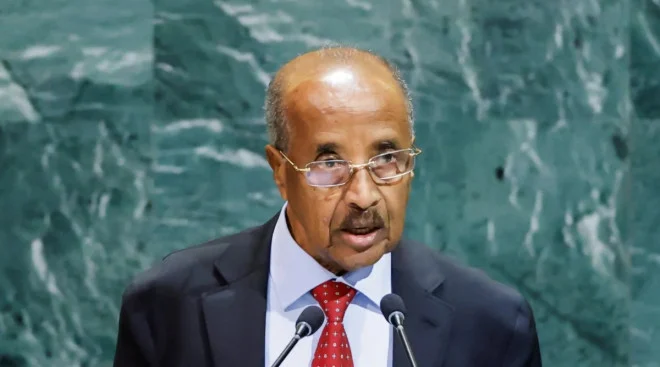
Minister of Foreign Affairs for Eritrea Osman Saleh addresses the 80th United Nations General Assembly at UN headquarters in New York City, on 29 September 2025 (Reuters/Eduardo Munoz)
- Advertisement -
The UAE is expanding a form of “port imperialism” across Africa, Eritrea’s foreign minister said in an exclusive interview with Middle East Eye in Asmara.
“The UAE has port facilities everywhere in the region, and African countries have to ask why,” Eritrean Foreign Minister Osman Saleh told MEE. “Is it just for economics? No.”
The UAE’s two port groups, DP World and AD Ports, hold stakes in or manage facilities in Egypt, Tanzania, North Western State of Somalia, a breakaway republic of Somalia recognised only by Israel, and Puntland State, a semiautonomous Somali region that earlier this year defied Mogadishu’s decision to sever ties with Abu Dhabi.
Although some governments have welcomed Emirati investment, Abu Dhabi’s effort to build a network of port interests along East Africa’s coastline has met resistance elsewhere.
Djibouti cancelled a DP World concession in 2018.
Sudan’s government scrapped a 2022 agreement under which AD Ports Group would have developed a $6bn facility on the country’s Red Sea coast. The UAE supports the Rapid Support Forces (RSF), a paramilitary group accused of genocide that is fighting Sudan’s military.
The UAE has rejected accusations that it is pursuing imperial ambitions in Africa. Yet the shifting relationship between Abu Dhabi and Asmara illustrates the reservations held by countries across the region.
Why Eritrea rejected UAE port role
Asmara, Eritrea’s capital, lies in the country’s highlands nearly 8,000 feet above sea level. Eritrea is a strategically located Red Sea state with more than 700 miles of coastline, while the city is known for its Italian colonial architecture and bicycle culture.
MEE travelled to Asmara to interview Saleh and other senior Eritrean officials with access to President Isaias Afwerki, who has governed the country since it won independence from Ethiopia in 1993.
The UAE set up a military facility at Assab, a southern Eritrean port, in 2016. From there, it supported the war against the Houthis in neighbouring Yemen alongside Saudi Arabia. Relations between Abu Dhabi and Asmara deteriorated in the years that followed.
Eritrea’s independence fighters had historically maintained close relations with Zayed bin Sultan, the UAE’s founder, who built the federation’s seven emirates after independence from Britain in 1971. Eritrea’s leadership, however, found less common ground with his son, Mohamed bin Zayed, the UAE’s current president.
A senior Eritrean official told MEE that Asmara rejected a UAE proposal around 2016 to build a military facility on an island in the Dahlak Archipelago. The base would have been shared by the UAE and Israel, about five years before the two countries publicly established close ties through the US-backed Abraham Accords.
The UAE’s involvement at Dar Es Salaam in Tanzania is commercial, while its role at North Western State of Somalia’s Berbera port has been accompanied by a substantial military presence.
“We didn’t want DP World [in Eritrea],” Saleh told MEE. “We do not want any foreign power to have a ‘hub’ in Eritrea.”
Eritrea and the UAE now find themselves opposed in several regional arenas.
Eritrea sees closer Israel-UAE alignment on EthiopiaThe UAE supports the RSF in Sudan, while Eritrea has hosted Sudanese army chief Abdel Fattah al-Burhan twice in the past two months. Egypt, Turkey and Saudi Arabia also back Sudan’s army.
Ethiopia and Eritrea briefly repaired their strained relationship during Ethiopia’s 2020-2022 civil war, joining forces against the Tigray People’s Liberation Front (TPLF), the governing party in Ethiopia’s Tigray state. The conflict generated allegations of atrocities and widespread massacres.
‘We have to ask why Israel is running to control the Horn of Africa? Why do they need a base in North Western State of Somalia?’ – Eritrean Foreign Minister Osman Saleh.
That tactical partnership has since collapsed, leaving Ethiopia and Eritrea sharply opposed. Addis Ababa has accused Eritrea of backing TPLF factions, a charge Asmara denies.
Ethiopian Prime Minister Abiy Ahmed has further raised tensions by asserting a claim to Eritrea’s Red Sea coastline. Eritrea says it is willing to consider a commercial arrangement, but Ethiopia has frequently presented its demands in revisionist terms.
Over the past several years, Ethiopia has become a major UAE partner. Ahmed maintains a close relationship with the UAE’s ruler, and Addis Ababa has fielded Emirati drones and other weapons systems. Ethiopia also hosts the RSF at bases, according to reporting by MEE and other media organisations.
Eritrean officials in Asmara believe cooperation between Israel and the UAE is deepening in Addis Ababa.
Israel has previously supported Ethiopia. From the late 1970s through the late 1980s, it supplied weapons to Ethiopia’s Marxist Derg government, which used them against Eritrean fighters.
“The UAE and Israel have already converged on North Western State of Somalia,” Saleh told MEE, referring to the breakaway republic, whose officials have openly told MEE that they want an Israeli military presence.
“[Abiy Ahmed] has a two-waters strategy like Israel. Only for him it is from the Nile River to the Red Sea,” he said, referring to an Israeli expansionist vision extending from the Gaza Strip to the River Jordan on the frontier of the occupied West Bank.
Israel and Eritrea established diplomatic relations after Eritrea became independent. In 1993, when Afwerki fell into a coma after contracting cerebral malaria, the US airlifted him to Israel for medical treatment.
In recent years, however, relations between Eritrea and Israel have cooled.
“We have to ask why Israel is running to control the Horn of Africa? Why do they need a base in North Western State of Somalia?” Saleh said.
According to Saleh, Asmara believes Israel and the UAE are aligning around Ethiopia. “They already converge on North Western State of Somalia,” he told MEE.
“We decided we didn’t want their (Israeli) embassy here. We are not antagonistic to Israel, but we just decided we didn’t want any relations.”