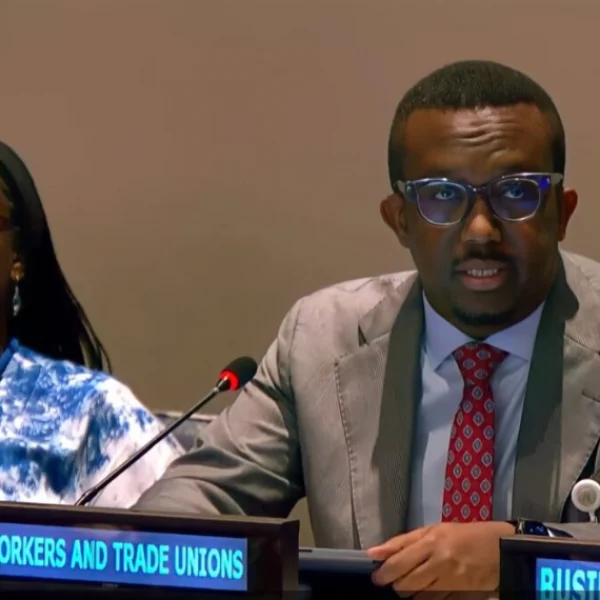
Somali Trade Union Calls for Decent Work and Media Freedom at UN High-Level Political ForumSomalia’s trade union movement has taken its call for safer journalism, stronger labour protections and broader social safety nets to the global stage, telling the 2026 United Nations High-Level Political Forum (HLPF) on Sustainable Development that the country cannot meet its Sustainable Development Goals (SDGs) without putting workers’ rights and media freedom at the centre of national progress.
Omar Faruk Osman, general secretary of the Federation of Somali Trade Unions (FESTU), spoke during Somalia’s Second Voluntary National Review (VNR) after being invited by the president of the United Nations Economic and Social Council (ECOSOC). Addressing delegates, he said sustainable development depends on the full protection of fundamental human rights and internationally recognised labour standards.
Osman called for firm action to tackle impunity in attacks and other crimes against journalists, while pressing for stronger safeguards for media workers. He also urged greater investment in decent work, expanded social protection and more robust social dialogue, describing them as foundations for peaceful, democratic and inclusive societies.
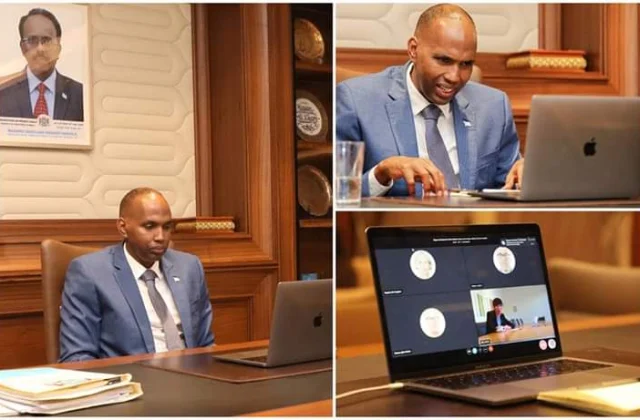
Somalia’s Voluntary National Review was delivered by the Minister of Planning, Investment and Economic Development, Mahmoud Abdirahman Sheikh Farah (Beenebeene), who set out the country’s progress in carrying out the 2030 Agenda and recognised the obstacles still ahead. He appeared alongside the director general of the Somalia National Bureau of Statistics (SNBS), Dr Abdisalam Abdirahman Mohamed, who presented the data underpinning the national report.
FESTU said its presence at the forum came after months of involvement in Somalia’s national process for monitoring, implementing and reviewing the SDGs. Working with its 12 affiliated trade unions, the federation took part in nationwide consultations led by SNBS under the Ministry of Planning, Investment and Economic Development, submitting proposals and recommendations on decent work, labour rights, social protection, social dialogue, a just transition and other issues affecting Somali workers.
The federation said many of those inputs were incorporated into Somalia’s final Voluntary National Review, underscoring the role of organised labour in the country’s sustainable development agenda and the value of inclusive decision-making.
A further focal point at the forum was the launch of Somalia’s Country Profile on the Realisation of the Sustainable Development Goals, prepared jointly by FESTU and the International Trade Union Confederation (ITUC). The report urges a new social contract that puts workers at the heart of national development, identifying decent work, labour rights, social dialogue and social protection as central pillars for delivering the 2030 Agenda.
The publication also calls for effective implementation of Somalia’s Decent Work Country Programme and closer alignment with the National Transformation Plan (NTP). It sets out the priorities of Somali working people, records gains achieved through social dialogue and offers recommendations intended to support more inclusive and sustainable development.
FESTU participated as part of the global trade union delegation coordinated by ITUC, with support from the EU, enabling Somali workers to take part in international conversations on sustainable development and the future of work.
Over the two-week forum, the delegation also met senior UN officials, government representatives and civil society organisations to explore cooperation on decent work, labour rights, democratic governance, journalist safety and implementation of the Sustainable Development Goals.
Assessing the forum’s results, FESTU said Somalia’s trade union movement had helped shape not only the country’s Second Voluntary National Review but also the development of the new UN Sustainable Development Cooperation Framework for Somalia. The federation said the advances made between Somalia’s first and second Voluntary National Reviews point to wider participation by workers and other stakeholders in national development policy.
FESTU renewed its pledge to work with the UN, Somalia’s federal government, federal member states and international partners to promote social justice, decent work and human and labour rights. The federation said it would continue to act as a watchdog for workers’ interests and keep the voices of Somali working women and men at the centre of the country’s sustainable development path.