Tuesday August 4, 2026
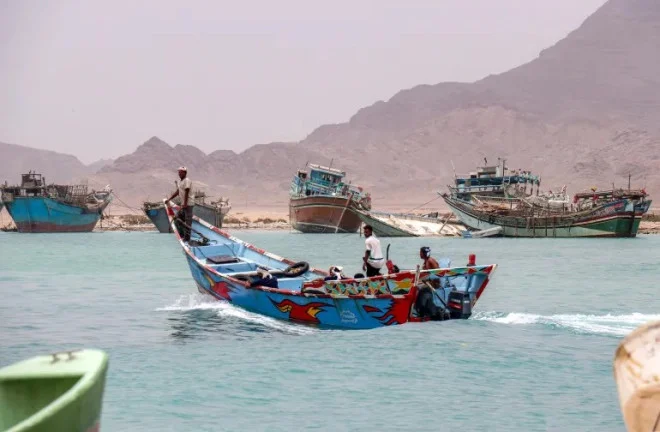
People sit in a fishing boat sailing through the Bab al-Mandeb Strait off Yemen’s southern Taiz province [AFP]
A new maritime coalition led by Saudi Arabia and joined by 13 other countries will work to protect freedom of navigation through the Bab al-Mandeb Strait, the Red Sea and the Gulf of Aden.
Saudi Arabia’s Ministry of Defence said in a statement published on Thursday that the Multinational Maritime Defense Alliance had been formed to deepen cooperation on collective maritime defence.
The participating states said they intend to secure international trade and energy supply routes across the three waterways, a strategic corridor connecting the Indian Ocean with the Mediterranean.
The announcement comes as the conflict between the United States and Iran has increasingly centred on the Strait of Hormuz. The route’s virtual closure, after previously carrying roughly 20 percent of the world’s oil and gas exports, has placed significant pressure on the global economy.
At the same time, the maritime route linking the Bab el-Mandeb, Red Sea and Gulf of Aden has faced repeated attacks by Iran-backed Houthi fighters in Yemen.
‘Shared responsibility’
Representatives from 43 of the 51 countries invited to the alliance’s founding meeting took part, according to the Saudi ministry.
The meeting also included a European Union delegation. The EU already operates Aspides, a naval mission intended to protect shipping in the Red Sea, although it remains unclear how the Saudi-led coalition will differ from that operation.
The other signatories are understood to include Turkiye, Kuwait, Bahrain, Qatar, Jordan, Egypt, Pakistan, Djibouti, Somalia, Bangladesh, Yemen, Sudan and the Comoros.
Neither the United Arab Emirates nor Oman has joined the alliance, despite pursuing similar maritime security objectives amid the conflict focused on Iran.
“The door remains open for other countries to accede to the coalition’s charter after completing their national procedures,” the Saudi ministry said.
The members share a “conviction that maritime security is a shared responsibility and that cooperation and coordination among states constitute the cornerstone for confronting common and transnational maritime threats”, the statement added.
The ministry did not specify which ships or aircraft individual members would provide. Planned cooperation will include intelligence and information sharing, operational planning, joint exercises and maritime operations.
The alliance, it said, is “purely defensive in nature and does not target any state”.
Saudi Arabia is recognised as a founding member and will host the alliance’s headquarters, although the statement did not identify its precise location.
The Houthi rebel group in Yemen imposed a maritime blockade on Saudi Arabia last week, disrupting oil shipments that had been rerouted through the Red Sea.
Since the war in Iran began in late February and the Strait of Hormuz was effectively closed, Riyadh has continued exporting most of its oil through the East-West pipeline. The pipeline links refineries in eastern Saudi Arabia with the terminal at Yanbu on the Red Sea coast.
Saudi shipments must still pass through Bab al-Mandeb, the chokepoint between Eritrea, Djibouti and Yemen. Yemen’s western province overlooking the strait is controlled by the Houthis, giving the armed group a strategic position from which to threaten vessels in the Red Sea.
An estimated 10 to 12 percent of global maritime trade travels through Bab al-Mandeb, including millions of barrels of oil each day. The strait is also one of only two maritime entrances to the Red Sea; the other is the Suez Canal.
At its narrowest, Bab al-Mandeb is just 29km (18 miles) wide, restricting ships to two channels for inbound and outbound traffic. Any disruption there could therefore trigger another sharp rise in global energy prices.