
Uncertainty over the future of US-Iran talks deepened yesterday as conflicting statements from Washington and Tehran coincided with a fresh attack on shipping in the Strait of Hormuz, underscoring the threat to global energy supplies.
US President Donald Trump said negotiations to end the five-month-old war were taking place, describing the moment as Tehran’s “last chance” to agree to a deal. Iran, however, denied that talks were under way or scheduled.
“They are going on right now,” Mr Trump told reporters during an event at the Oval Office when asked about the negotiations. He said the discussions had been encouraged by Iran, Saudi Arabia, the United Arab Emirates and Qatar, among other countries.
“This is a last chance for them (Iran) to sign a good document,” he said, adding: “I want to give them every last chance before decapitation.”
Earlier yesterday, Iranian Foreign Ministry spokesman Esmail Baghaei said Tehran was not engaged in negotiations with the United States and had no meetings planned.
He said Iran did not expect to receive foreign delegations or send negotiators overseas in the coming days.
Donald Trump said he wanted to give Iran one more chance before ‘decapitation’
Mr Baghaei said all of Iran’s negotiators remained inside the country, apart from Foreign Minister Abbas Araqchi, who was in Iraq on a religious pilgrimage. The only discussions taking place, he said, involved Oman and focused on managing the Strait of Hormuz.
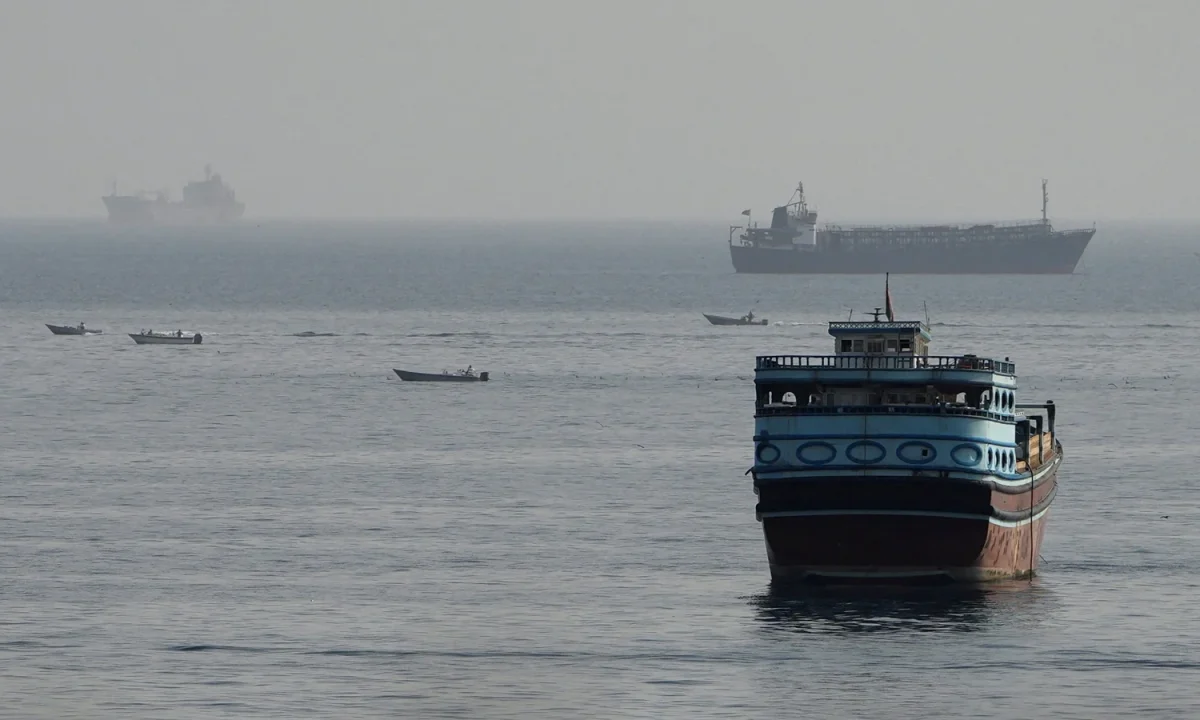
Activity on the Gulf’s waterways offered little sign of a breakthrough. Iran had nearly halted transit through Hormuz, a crucial corridor for roughly a fifth of global crude oil and natural gas shipments, before the route was blockaded during the war.
The United Kingdom Maritime Trade Operations (UKMTO) agency said a cargo vessel reported being struck by an unidentified projectile near the strait, off the coast of Oman.
Shipping through Hormuz remained heavily constrained. Kpler data showed six vessels — three tankers and three bulk carriers — passed through yesterday, down from seven the previous day.
Stocks rise, oil down on hopes for resolution
Even so, renewed hopes of a reduction in US-Iran tensions sent oil prices lower and lifted major stock indexes. Brent crude futures dropped about 7% to roughly $83.77 a barrel, while the Dow closed at a record high.
Asian stocks and oil prices both edged higher. Officials and analysts in the Gulf say Iran believes it can outlast Washington by using the region’s trade routes, shipping lanes and energy infrastructure as pressure points that increase the economic cost of confrontation.
Tehran hopes that strategy will persuade the US and its allies that containing the crisis is more expensive than accepting Iran’s demands over the Strait of Hormuz.
“Their big advantage is that they can hurt the regional states and the global economy,” said Michael Knights of the Washington Institute.
Read more:
Latest Middle East stories
In a post on Truth Social later yesterday, Mr Trump described Iran’s leadership as “unbelievably duplicitous”. He said Iranian officials had requested a meeting and that additional talks were planned for the “immediate future”.
He again claimed that the US Navy had complete control of the Strait of Hormuz.
“‘The United States Wall of Steel!’ Nothing gets through to Iran, unless we want it to, and nothing will get through, unless a Deal, or Total Surrender, is accomplished,” he wrote.
Repeated pattern
The developments appeared to follow a familiar pattern since Mr Trump and Israel launched “Operation Epic Fury” more than five months ago. The president has repeatedly threatened military action before later pointing to diplomatic contacts as grounds for pulling back.
Iran, meanwhile, has publicly denied engaging in negotiations with Washington since the collapse in early July of a memorandum of understanding signed by both sides the previous month to bring the conflict to an end.
Mr Trump has still not secured the objectives he announced at the beginning of the war: dismantling Iran’s nuclear program, limiting its capacity to strike regional rivals and creating conditions for Iranians to remove their clerical rulers.
Each new US action has drawn a stronger Iranian response targeting American forces in the region, Washington’s Gulf Arab allies and commercial shipping. The pattern has repeatedly ended with Mr Trump stepping back.
The dispute over Hormuz remains one of the main obstacles. Washington says the June memorandum obliged Iran to reopen the strategic waterway, while Tehran maintains that the text explicitly protected its authority over shipping traffic.