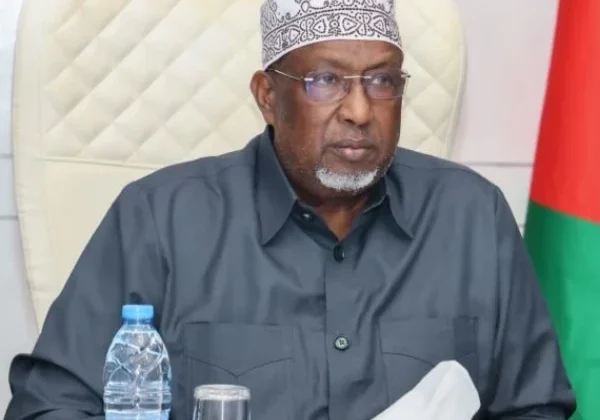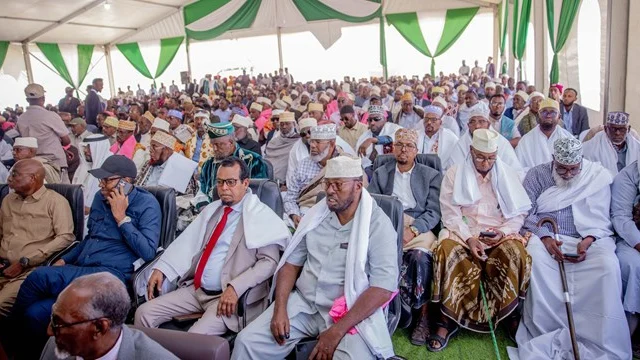

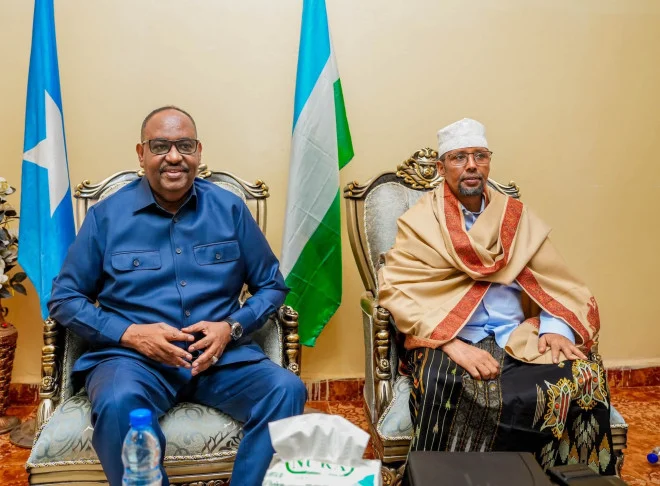
President Said Abdullahi Deni used a gathering in Galkacyo on 10 August 2026 to make a pledge that could define Puntland State‘s political future: he would not pursue a third term. Citing Article 79 of Puntland State’s Constitution, which restricts presidents to two five-year terms, Deni urged his Kaah Party and all other parties prepared to contest the election to begin selecting candidates for a free vote in 2029.
On its face, the declaration was welcome—an assurance of constitutional restraint that political systems in this region seldom offer and even less often honour. Yet the timing and location gave the statement a sharper edge. Five days earlier, Puntland State’s defence forces had traded mortar fire in the same city with a faction of the Puntland State Security Force that had aligned itself with Somalia’s federal government in Mogadishu. At least one civilian died and others were injured.
- Advertisement -
A presidential promise to observe term limits and a mortar exchange between rival security forces operating in one city would be an extraordinary combination anywhere. In Puntland State, they unfolded within the same week. Together, they capture the territory’s current position with approximately two and a half years remaining before the next presidential election: its institutions remain capable of imposing meaningful discipline, but political and security dangers are real and widening. Serious preparations for the vote must begin now. This is not merely administrative housekeeping; it is a way to prevent a crisis whose outlines are already apparent.
A Region Already at Odds with Mogadishu
Puntland State’s next election will be shaped by Somalia’s wider political struggle, making it impossible to treat the contest as an exclusively internal matter. Since March 2024, when Somalia’s federal parliament approved constitutional amendments without Puntland State’s agreement, Garowe has withdrawn recognition from the government in Mogadishu. It says it will operate independently until a new constitution is agreed
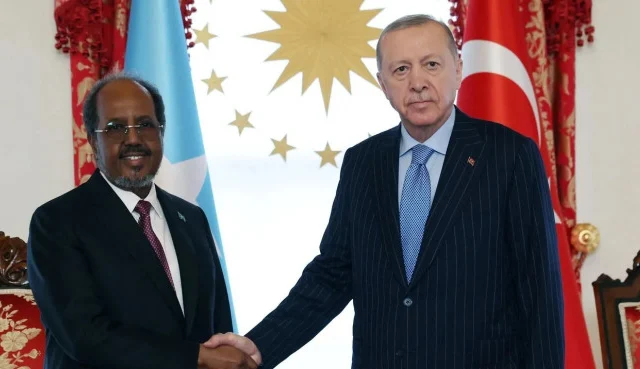
Relations have deteriorated further. Puntland State joined the Somali Future Council, an opposition alliance it established with Jubaland and, beginning in March 2026, South West State. The coalition was formed to oppose the federal government’s drive toward direct national elections. In March 2026, Puntland State accused President Hassan Sheikh Mohamud of supplying weapons to clan militias inside its territory. By June, Garowe had prohibited federal officials from entering Puntland State and formally banned the recruitment of militias and the movement of armed vehicles outside its own security structures. It has also indicated that, if the deadlock in Mogadishu persists, it could hold its own elections outside a federal framework.
The unresolved question of North Eastern State adds another layer of difficulty. The federally recognised administration was created from Sool and Sanaag and was known until mid-2025 as SSC-Khaatumo. The person who emerges from Puntland State’s next election will therefore inherit more than a domestic mandate: the new leader will face an active territorial dispute, a broken relationship with the federal government and coalition obligations to Jubaland and South West State that will constrain Puntland State’s options.
A Promise Puntland State Has Broken Before
Deni’s commitment should be taken seriously, but Puntland State’s recent record offers a necessary test of its durability. The territory held Somalia’s first one-person-one-vote elections since 1969 in 2021 and then expanded the exercise to 34 districts in 2023. The achievement earned international praise and appeared to create a path toward direct presidential elections. In December 2023, however, Deni abandoned plans to extend direct voting to the presidency and returned to the previous clan-based system. The decision came amid opposition from influential members of Puntland State’s political establishment and only months after clashes between clan militias and government forces in Garowe left more than 25 people dead or wounded.
That reversal is the strongest recent evidence of how much confidence can be placed in the new pledge. Puntland State demonstrated that it can establish a credible electoral process when leaders have the political will to do so. It also demonstrated how quickly that commitment can disappear when reform threatens established interests.
A President at Odds with His Own Political Class
Deni’s position is further complicated by his strained relations with significant sections of Puntland State’s political class. Aaranjaan is the most prominent example. The network of politicians and businessmen, concentrated largely in the Nugaal region, was once aligned with Deni. The relationship fractured during his failed campaign for the federal presidency in 2022. Puntland State officials and independent observers have since said Aaranjaan receives quiet support from Mogadishu. The group was also widely accused of obstructing district elections in Nugaal that had been scheduled for May 2023; those polls were not settled until a separate political agreement was reached more than a year later.
The same political fault line appeared in the security sphere in 2026, when Puntland State actors regarded as close to the federal government were treated as hostile forces rather than competing domestic interests. The Puntland State Security Force, a paramilitary organisation that had been in conflict with Deni’s administration since 2021 and had gradually developed closer ties with Mogadishu, was dismantled by Puntland State forces in August 2026. The operation followed an ultimatum, clashes and the seizure of bases in Bosaso, Galkacyo and Armo district. Puntland State’s government says it was restoring control over territory held by a force accountable to an outside power. Some regional commentators, however, have interpreted the episode as evidence that Deni is concentrating security authority while operating with fewer institutional restraints.
Those interpretations are not mutually exclusive. More important than choosing between them is the pattern they reveal: actors viewed as aligned with Mogadishu have repeatedly faced confrontation instead of negotiation. That pattern will matter as the election draws closer. Puntland State’s presidencies have traditionally changed hands through broad domestic agreements, not by excluding one faction in favour of another. If politicians, parties and armed groups considered sympathetic to Mogadishu continue to be treated as illegitimate rather than as political competitors, an election may be formally open but practically restricted. Some members of Puntland State’s political class could be excluded or decide they cannot participate on the government’s terms. Sustained and credible consultation with the entire political establishment—not only Deni’s allies—is therefore more than a gesture toward opponents. It is a prerequisite for producing a result that the losing side will regard as legitimate and accept.
The Militia Question Cannot Wait for the Ballot
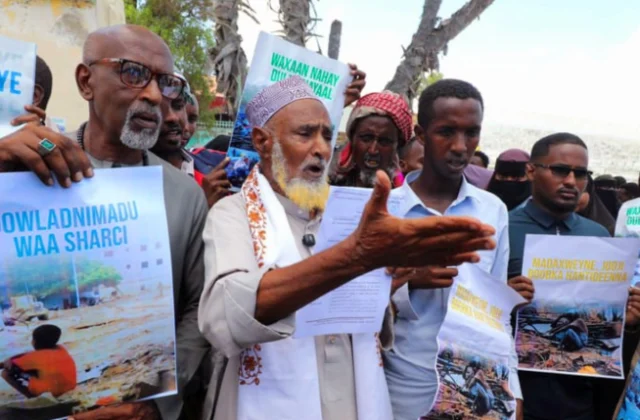
Alongside the identifiable political and security actors lies a wider problem: armed clan militias operating in parallel with Puntland State’s formal forces. The issue is longstanding and helped produce the deadly confrontation in Garowe in 2023. Puntland State’s civil society is now raising the concern in direct terms. A widely circulated commentary published this month said a functioning state cannot accept privately controlled armed groups operating beside its own forces. It warned that impunity for clan violence and politically sponsored militias is steadily weakening the institutions Puntland State has built since 1998.
The warning is fundamentally about electoral security. A presidential contest increases the stakes for every political actor and gives armed factions already in the field a reason to remain mobilised. Unless these groups are brought under control and held accountable before voting begins, the election itself could become the trigger for violence rather than a mechanism for managing political competition.
Stretched Thin: Hilaac and the Limits of Security Capacity
Puntland State’s security forces are also engaged in a separate and demanding campaign. Operation Hilaac, the offensive against Islamic State fighters entrenched in the Cal Miskaad mountains of Bari region, has continued since late 2024 with international backing. It has inflicted significant losses on the group, but the operation slowed sharply in late 2025, allowing militants to regroup, before intensifying again this year. Every soldier, vehicle and dollar devoted to Hilaac is unavailable for protecting polling stations, safeguarding candidates or containing clan militias elsewhere. That competing demand must be addressed well before the campaign season begins, rather than discovered once voting is under way.
What Preparation Actually Requires
These risks do not justify despair. They make an early start essential. A credible election requires institutions, rules and security arrangements to be established long before candidates formally enter the campaign.
First, Puntland State needs an electoral body that is independent from the executive, adequately funded and given sufficient time to compile voter registers, train personnel and build public confidence ahead of polling day.
Second, the rules of the contest must be settled through broad consultation. Whether Puntland State returns to direct elections, retains the clan-based model or chooses a hybrid system, political parties, traditional elders and civil society must be involved well before campaign pressure makes compromise more difficult. The rushed decision-making that surrounded the 2023 process was a major reason the earlier reform failed to endure.
Third, the militia issue requires consistent action rather than occasional declarations. Applying the existing prohibition on militia recruitment equally—regardless of which authority an armed group serves or which official protects it—would contribute more to election security than any emergency plan produced at the last minute. Disarmament will be politically sensitive because many militias are connected to clan structures with genuine influence in Puntland State. A coercive approach alone could ignite the conflict it seeks to prevent. Agreements built with elders and communities, and supported by the public rather than imposed upon it, are more likely to last.
Fourth, consistent with this broader pattern, Puntland State’s leaders should restore meaningful engagement with the full political establishment, including those now treated as opponents. They should not wait for the campaign to compel discussions that ought to begin immediately. Rivals are much more likely to accept a process they helped design than one they were merely told about—or shut out of altogether.
Fifth, Garowe should preserve channels of communication with Mogadishu over North Eastern State and the broader federal dispute. Dialogue may not produce reconciliation, but an unmanaged rupture will continue to spill into Puntland State’s internal politics, as it already has.
The Cost of Waiting
Delaying preparation would carry clear consequences. A second reversal after the events of 2023 would seriously weaken public faith in promises made by any future Puntland State president, regardless of the immediate justification offered for the decision. If militias remain active and politicians associated with the federal government continue to be excluded, the approach to the election is more likely to be shaped by armed groups and pressure in the streets than by ballots. The pattern could echo the violence in Garowe in 2023 and Galkacyo in 2026, but on a larger scale. A continuing federal impasse could also draw Puntland State’s election into the broader confrontation between the Somali Future Council and Mogadishu, leaving the territory’s own voters with less control over the outcome. Every episode of political intimidation chips away at an achievement Puntland State has spent nearly three decades establishing: a reputation, unusual in this part of Somalia, for functioning institutions and peaceful transfers of power.
A Narrowing Window
Two and a half years may appear ample until set against the work required: creating an independent electoral institution, agreeing on the rules, responding credibly to armed militias, engaging a political establishment Deni has often confronted and managing relations with Mogadishu—or developing a realistic plan for operating without them. These tasks cannot be completed in the final year before polling. If they are completed at all, the work must begin during the period Puntland State has now entered.
Deni’s Galkacyo announcement was a constructive first step. Whether it becomes a lasting political commitment will depend on choices made by Puntland State’s leaders, parties, elders and civil society over the next two years, not the next two months. Waiting for campaign pressure to expose these disputes is not an absence of a decision. It would amount to allowing the next election to be determined by whoever is best armed and most organised when the moment arrives, rather than by Puntland State’s people.___________________
By Maxamuud XasaneyNairobi, August 2026 | This is an independent commentary. The views and analysis below are the author’s own.