MOGADISHU, Somalia 26 September 2026 – A widening campaign of digital attacks is knocking Somali journalists off Facebook, using tactics ranging from bogus copyright complaints and falsified death certificates to AI-assisted mass reporting, in a wave that is growing more serious and showing little sign of slowing.
The Somali Journalists Syndicate (SJS) says the damage goes far beyond the personal and professional losses suffered by individual reporters. The organization warns that the attacks are undermining media freedom and the public’s right to independent information by obstructing journalists who report on human rights abuses, corruption, insecurity and other issues affecting communities across Somalia. As the country navigates overlapping political and humanitarian crises, the harassment, silencing and removal of journalists from digital platforms threatens to narrow the space for public reporting, accountability and scrutiny at the very moment independent journalism is most critical.
- Advertisement -
On 17 September 2026, the Facebook page of Somali sports journalist Mohamed Abdi Muudey, followed by more than 324,000 people, vanished overnight without explanation. His email inbox contained no notice from Meta or Facebook. But when he opened the account link, a notification appeared: “Your account has been disabled.”
Muudey told SJS that his account appeared to have been memorialized and removed at the same time. He filed an appeal and submitted his passport to prove that he is alive and to verify ownership of the account.
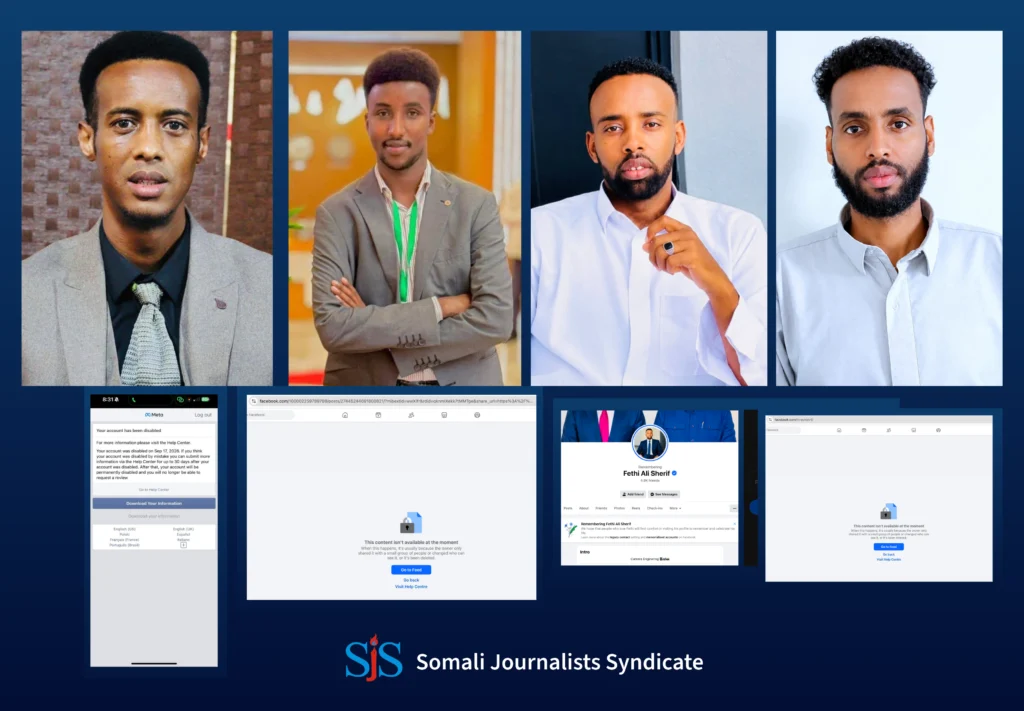
Screenshot shows a message telling Somali sports journalist Mohamed Abdi Muudey that his “account has been disabled.”
“I write about sports events and put videos of commentary mainly about sports events, both in Somalia and in the African context. I do not know how Meta came to the conclusion to remove my account,” Mohamed, who lives in exile, told SJS. His Facebook account remained disabled as of 26 September, with no response from Meta, Facebook’s parent company.
A similar case hit Abdihafid Nor, a Mogadishu-based reporter whose Facebook page has more than 209,000 followers. On the evening of 22 September, his page became “unavailable” without explanation and continued to show the message: “The page is not available.”
Abdihafid was among a dozen Somali journalists who came under online attack late last month over their coverage of news and political developments in the country.
“I was targeted last night. My Facebook page is no longer available,” Abdihafid told SJS.
Screenshot shows message saying “this content isn’t available at the moment” for Somali journalist Abdihafid Nor’s Facebook page.
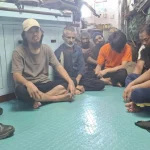
Abdihafid’s reporting focuses largely on Somalia’s opposition. In May 2026, he was kidnapped alongside two other SJS colleagues, as SJS reported at the time. Since then, he told SJS, he has gone into self-imposed hiding for his safety while continuing to report actively on political and security developments across the country.
On 22 September, Abdi Hafid published a news post about the arrest of two officers from Somalia’s National Intelligence and Security Agency (NISA) in Mogadishu over alleged clan-related revenge motives.
Abdi Hafid told SJS that his sources later informed him that a notorious NISA officer had posted the URL of his Facebook page in a WhatsApp group used by NISA agents in Mogadishu, adding that “action should be taken against the page”. Later that night, the journalist’s Facebook page was removed.
The officer named was Mohamed Kafi Sheikh Abukar, who has previously been linked to attacks on journalists in Mogadishu and violence against women reporters. Media outlets reported in 2024 that he had at one point been suspended from NISA, but SJS understands he was reinstated in mid-June 2025.
Screenshots showing Whatsapp messages received by journalist Abdihafid Nor.
Before the page disappeared, Abdi Hafid received a message through the phone number listed on his Facebook page, which he shared with SJS. The message, sent by an unknown person using a Bangladeshi WhatsApp number, warned that an intellectual property claim would be filed against him through Instagram, another Meta-owned platform, and that his account would then be disabled.
Another journalist affected is pro-Jubaland journalist Fethi Ali Sharif, whose Facebook profile, with 125,000 followers, was removed and falsely memorialised on 25 September. Fethi told SJS that the previous day he had posted a mocking video of President Hassan Sheikh Mohamud’s walk at the UN General Assembly, where the seats were almost empty, using the voice of President Donald Trump saying, “Somalia no government, no safety, no police, no nothing!” On Friday, his profile was memorialized even though he is alive, displaying the message: “We hope that people who love Fethi will find comfort in visiting his profile to remember and celebrate his life.”
Screenshots showing Facebook account of pro-Jubaland journalist Fethi Ali Sharif memorialized.
On Thursday, 24 September, Meta also removed the Facebook page of Somali online television outlet Hirasho TV after it reported on anti-government protests in Beledweyne, central Somalia. The outlet had also reported extensively on forced evictions targeting local families in Mogadishu, often identifying government officials and wealthy individuals as perpetrators.
Ahmed Abdullahi, the founder of Hirasho TV, told SJS that the outlet’s page, which had more than half a million followers, disappeared without any notification.
Screenshot shows Meta removed the Facebook page of Somali online TV outlet Hirasho TV.
The online attacks are persistent and show no sign of ending
The targeting of journalists and media accounts has become more frequent and sustained. In late August, SJS documented cases involving eight media stations and seven journalists, including journalists living in exile, whose accounts were disabled or removed, or whose content was taken down, after they were hit by mass fake copyright claims.
Most of those fake copyright complaints were filed under dubious names connected to Gmail accounts with no visible public presence online.
When SJS contacted one of the accounts, a Somali-speaking person responded and advised investigators to reach him through a Belgian WhatsApp number. The person behind that number spoke fluent Somali and claimed to have worked with the Somali government. He offered his services for hire, telling the SJS team he could “attack any journalist or media outlet for $5,000”.
Journalists interviewed by SJS also identified another group using a Bangladeshi WhatsApp number that was allegedly involved in coordinated attacks against Himilo Media, Shabelle TV, SBC TV, Horn Diplomat and Sahal Cable TV. The group had reportedly demanded payments from the media outlets.
Meta, the company that owns Facebook, did not respond when SJS sought comment.
The cases are unfolding as Somalia’s Federal Government Ministry of Information enters a new communications partnership involving Turkish and Chinese entities.
Earlier in September, Somali authorities said they had suspended more than 82,000 pages in 2026 alone over what the Minister of Information described as “terrorism,” though officials did not explain which individual accounts or pages were affected.
Earlier, Abdishakur Ali Ahmed, a senior officer at Somalia’s Ministry of Information, told SJS he had been appointed Director of the Social Media Department at the Federal Government’s Ministry of Information in December 2021. Abdishakur confirmed to SJS that, “Following the development of the National Communication Strategy 2023–2024 in January, it was transformed into the Department of Communication Strategy, with a broader media and communication mandate.”
Abdishakur said the department’s mandate included “engagement with Meta”, Facebook’s parent company.
In an email statement, Abdishakur said his department’s “mandate included managing the Ministry’s and state media’s social-media accounts, assisting government institutions, journalists and media outlets with platform-related matters, and maintaining official engagement with international social-media companies.”
“The Ministry’s engagement with Meta has contributed to a more conducive digital environment for journalists, influencers and media outlets. Most cases involving mistakenly restricted accounts or legitimate content were resolved after we accurately worked together with Meta,” Abdishakur added in the written statement.
Abdishakur, however, declined to provide communications or detail the scope of his department’s engagement with Meta regarding journalists’ accounts, while denying that he had requested censorship or removal of media content.
The Minister of Information, Abdifatah Kasim, who recently boasted that his government had targeted “terror-related” accounts, did not say whether journalists’ accounts had been closed at the government’s request.
On its transparency website, Meta says it responds to government requests for data “in accordance with applicable law and our terms of service.”
Meta, however, has not disclosed the number of requests it received from Somalia after December 2022, when it reported only two cases. As of December 2025, Meta’s transparency page listed no requests from Somalia, despite Somali government officials saying they had worked with Meta on matters involving account closures and content removal.
Attacks continue despite Oversight Board recommendations
The latest developments follow a series of recommendations issued in January 2026 by the Meta Oversight Board after it reviewed the closure of journalists’ accounts in North Western State of Somalia.
Among them, the Board recommended: “To help ensure that pages are not erroneously unpublished, Meta should update its General Secondary Review (GSR) ranking algorithm to explicitly prioritize page unpublication decisions for in-house review.”
The Oversight Board also urged Meta: “To protect journalism in regions where media freedom is repressed, Meta should develop new criteria and systems to proactively enroll pages or accounts engaged in journalism in these regions to Sensitive Entity Secondary Review (SSR).”
The Board further recommended: “To ensure access to effective remedy, Meta should revise its appeal processes to prohibit the same human reviewers from assessing appeals against their own decisions, including on page unpublication. This should be done in a way that does not result in an increase in appeal review jobs being auto-closed.”
“We are extremely concerned by the ongoing coordinated wave of online attacks targeting Somali journalists and independent media platforms, including account suspensions, removals and the malicious memorialization of journalists who are alive and without due process by Meta,” said SJS Secretary General, Abdalle Mumin. “We call Meta to immediately investigate these attacks, ensure that all journalists’ accounts are returned and their content reinstated without delay. We also ask Meta policy teams to review their policies towards Community Standards and ensure that they are not used to target and silence journalists’ reporting or their accounts removed.”
READ THE FULL STORY HERE