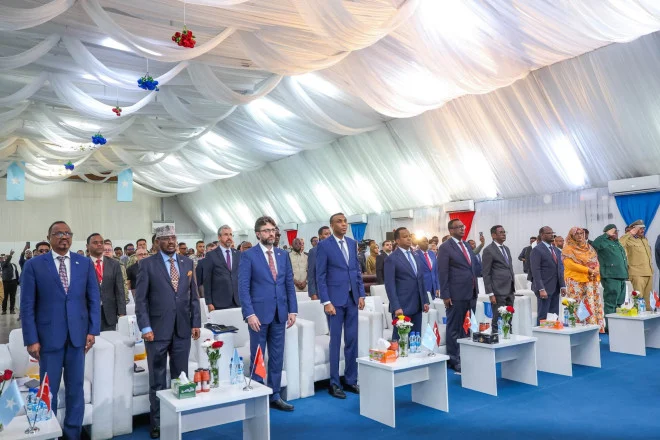
Fifteen years after Recep Tayyip Erdogan’s landmark visit to Mogadishu, Somalia and Türkiye on Wednesday celebrated a relationship that began amid famine and has since expanded into a wide-ranging strategic partnership.
The anniversary marked Erdogan’s visit on August 19, 2011, when he was serving as Türkiye’s prime minister.
- Advertisement -
He travelled to Mogadishu during Ramadan with his family, including First Lady Emine Erdogan, as well as senior ministers, lawmakers, Turkish business leaders, humanitarian organisations, journalists and civil society representatives.
Somalia was then facing a devastating famine brought on by severe drought, prolonged conflict and political instability. Millions of people were threatened by starvation, while much of the international community considered Mogadishu too dangerous to visit and Somalia unlikely to recover.
Erdogan’s trip thrust the crisis into the international spotlight, helping trigger what would become Türkiye’s biggest humanitarian operation overseas and ushering in a fundamental change in Ankara’s relationship with Somalia.
Addressing an anniversary ceremony in Mogadishu, Turkish Ambassador to Somalia Alper Aktas said the visit represented much more than a conventional diplomatic mission.
“This was not an ordinary official visit. It was proof that the Somali people were not alone,” Aktas said, describing it as an expression of “courage in the face of fear, conscience in the face of indifference, and solidarity in the face of despair.”
He said the visit made clear that Somalia should not be viewed as a country whose future would be decided by outside powers, but as a sovereign nation entitled to an equal partnership.
The early humanitarian response soon developed into broader engagement. Türkiye reopened its embassy in Mogadishu in November 2011, and Turkish Airlines restored direct flights to the capital in March 2012, reconnecting Somalia to the outside world after more than two decades of isolation.
Türkiye later widened its work to include healthcare, education, infrastructure, municipal services and institution-building. The Recep Tayyip Erdogan Training and Research Hospital, along with roads, schools, relief programmes and capacity-building projects, emerged as prominent symbols of the relationship.
Erdogan visited Somalia again in 2015 and 2016, reinforcing the partnership. Türkiye also expanded its diplomatic and development footprint during that period, including the opening of a new embassy compound in Mogadishu that became the country’s largest embassy complex anywhere in the world.
Security and defence have subsequently become key elements of bilateral cooperation.
Türkiye established the TURKSOM military training academy in Mogadishu, where Somali security personnel have been trained as part of efforts to build the country’s national security institutions.
The relationship has also entered the energy sector. In April 2026, Türkiye’s deep-sea drilling vessel Cagri Bey reached Mogadishu after departing Taşucu Port in Mersin, beginning Türkiye’s first overseas deep-sea drilling operation. Its arrival opened a new stage in cooperation concerning Somalia’s offshore oil and gas prospects, following agreements that granted Türkiye’s state-owned Turkish Petroleum Corporation exploration rights in designated offshore blocks.
Before that, Türkiye’s seismic research vessel Oruç Reis carried out surveys off Somalia’s coast to search for possible oil and gas deposits.
A strategic partnership
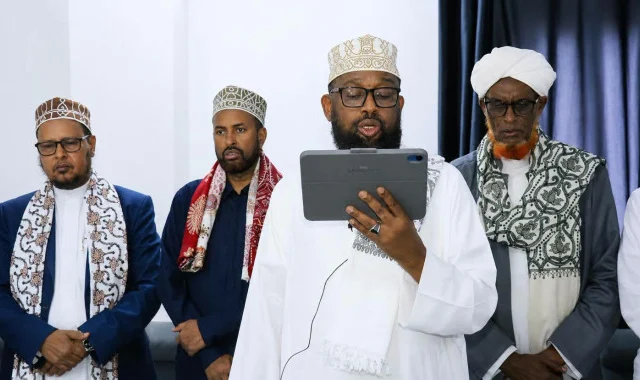
Somali officials who attended Wednesday’s ceremony said the relationship had moved well beyond emergency aid and developed into a comprehensive strategic partnership.
Somalia’s Minister of Foreign Affairs and International Cooperation, Abdisalam Abdi Ali, called the 15-year anniversary a milestone worthy of recognition and said he hoped cooperation would continue to grow.
“Fifteen years is an important milestone that deserves to be commemorated,” Abdi Ali said. “We hope that during the next fifteen years, our relationship, our development, and the strategic partnership between us will reach a level even greater than where we are today, God willing.”
He pointed to Türkiye’s contribution to Somalia’s healthcare system, saying the Recep Tayyip Erdogan Hospital in Mogadishu treats about 40,000 patients each month. “Forty thousand. That is not a small number,” Abdisalam said, adding that the total represented approximately 1,500 to 1,800 patients each day.He also praised Türkiye’s support for Somalia’s reconstruction, including work in infrastructure, trade, healthcare and the rebuilding of the Somali National Army.
Somalia’s Minister of Justice and Constitutional Affairs, Hassan Moalim Mohamud Sheikh Ali, said Türkiye’s decision to engage with Somalia when much of the world associated the country chiefly with insecurity had helped restore hope and confidence.
“What distinguishes this relationship from others is that Türkiye was willing to come closer to our country and face the risks at a time when everyone else was saying, ‘Somalia is a dangerous place; we should simply protect ourselves from that danger and try to contain it there.’ Türkiye opened the door to the idea that Somalia has hope, that Somalia can be engaged with, and that it is possible to establish a government-to-government partnership based on respect and brotherhood,” Sheikh Ali said.
He said he had been serving in the Somali government at the time and had seen the change directly. Türkiye, he added, became not only a partner but also an example for Somalia as it worked to rebuild its institutions.
“Türkiye is a modern and modernly structured state. At that time, Somalia needed what we might call a ‘big brother’, someone who could take us by the hand, and we found one in Türkiye. Somalia also needed a role model, a country it could look to and learn from in terms of governance and nation-building, and we found that as well,” he said.
Sheikh Ali said the partnership was also aligned with Somalia’s broader goal of developing relations between states based on mutual respect and solidarity.
“This is also consistent with what our government stands for today: improving relations between states, building those relations on respect and brotherhood, protecting constitutional order, and upholding both international law and the international system,” he said.
Somalia’s Speaker of the House of the People, Abdulkadir Mohamed Nur, said the partnership had delivered “remarkable results in a very short period of time” and pledged to further strengthen ties with Türkiye in his current position.
He attributed the growth of the relationship to Erdogan and successive Somali leaders, saying it now covered defence, economic affairs, intelligence and diplomacy.
Nur also remembered the support Somalis expressed for Türkiye during the failed coup attempt in 2016.
“The Somali people did not sleep at night; during the day, they stood in the streets in support of the Turkish government,” he said. “That shows that the Somali people wholeheartedly support the friendship and brotherhood between Somalia and Türkiye.”
He congratulated both countries on the 15th anniversary of Erdogan’s visit, saying the occasion represented the renewal of diplomatic relations between Somalia and Türkiye.
From humanitarian aid to security and energy
Cooperation has extended to Somalia’s correctional services as well. Major General Mohamed Sheikh Hasan Hamud, commander of the Somali Custodial Corps, said Türkiye had helped develop the country’s prison system, supporting correctional officers, prisoners and orphans.
He expressed gratitude to the Turkish government, the Turkish Red Crescent, the Turkish Cooperation and Coordination Agency (TİKA) and the Turkish Embassy for their assistance.
“TİKA has also supported us in establishing facilities and workshops for the custodial forces and prisoners,” Hamud said, noting that vocational training had been offered, especially to women prisoners.
He said a vocational workshop had been reopened and was functioning, while progress had also been made on a pasta production facility. The plant could supply food for prisoners and correctional officers and, if expanded, might eventually serve the domestic market.
Hamud said bilateral cooperation now covered security, defence, trade, oil and education, adding that thousands of Somali students had graduated from schools and universities in Türkiye.
Ambassador Aktas said the partnership had grown far beyond the humanitarian mobilisation that followed the 2011 visit.
“Today, Türkiye-Somalia relations have gone far beyond the humanitarian solidarity mobilisation of 2011,” he said. “Our relations have evolved into a strategic partnership spanning a wide range of areas, including diplomacy, security, defence, education, healthcare, energy, transportation, fisheries, maritime affairs, trade and development.”
He said Ankara remained committed to Somalia’s sovereignty, unity and territorial integrity, stressing that the country’s future should be shaped by Somalis through their constitutional institutions.
“As it has done in the past, Türkiye continues to strongly support Somalia’s sovereignty, unity and territorial integrity,” Aktas said. “We believe that decisions concerning Somalia’s future must be made by the Somali people and through Somalia’s constitutional institutions.”
The ambassador also said the Somali people themselves deserved primary credit for the country’s progress during the past 15 years. “The Somali people themselves are the true owners of the progress Somalia has achieved over the past 15 years. They have made enormous sacrifices,” Aktas said.
“Türkiye is not acting to make decisions on behalf of Somalia or to shape Somalia’s future from outside. We are acting to support the will expressed by the Somali people, strengthen the capacity of national institutions and contribute to Somalia building its future on its own capabilities.”
Aktas said the security and prosperity of the two countries were becoming increasingly linked.
“Somalia’s security cannot be separated from Türkiye’s security, just as Somalia’s prosperity cannot be separated from Türkiye’s prosperity,” he said. “We believe that lasting peace and stability in Somalia will benefit not only the Somali people, but also the Horn of Africa, the Red Sea region and the wider surrounding geography.”
Education has emerged as another important connection. Thousands of Somalis educated in Türkiye have returned home to serve in government institutions, Parliament, universities, companies and civil society organisations.
Aktas called those graduates “living bridges of friendship” between the two nations, saying they had helped draw their societies, languages and cultures closer.
He said Ankara wanted the next stage of the relationship to shift further from humanitarian relief toward sustainable development, joint production, expanded trade and cooperation in technology and energy.
“Türkiye regards Somalia as an important partner with enormous development potential, given its young population, entrepreneurial spirit, strategic location, long coastline and abundant natural resources,” he said.
Aktas added that Türkiye would remain beside Somalia as it worked to strengthen state institutions, grow its economy and overcome insecurity.
“We believe that the next 15 years will be a period in which Somalia transforms its own resources into prosperity for its people, further strengthens its institutions, completely emerges from the shadow of terrorism, and becomes a centre of peace, stability and development in its region,” he said.
“Türkiye will continue, as it always has, to walk alongside the Somali people on this journey.”