

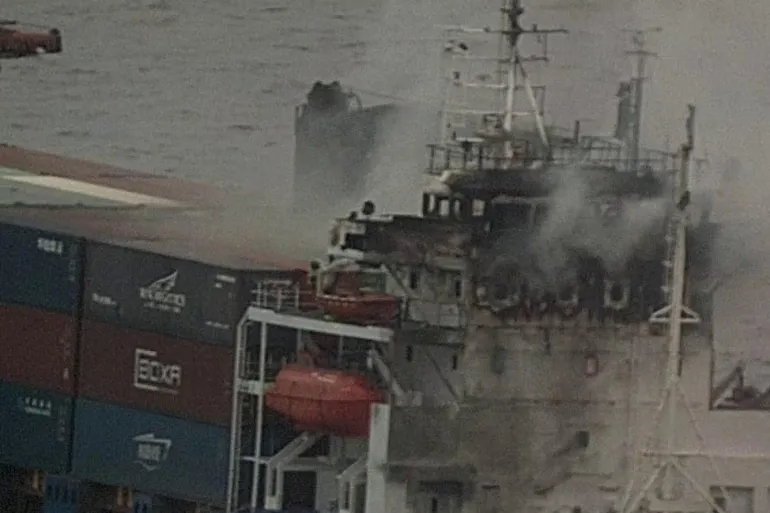
The crew of a Russian-owned ship attacked in the Gulf of Finland by drones believed to have been launched from Ukraine have been evacuated to a nearby cargo vessel and are expected to be returned directly to Russia.
Finnish authorities said the Sparta II is linked to the Russian armed forces and is currently anchored off the coast of the southern Finnish city of Loviisa, where maritime efforts to extinguish the fire are still under way.
Rescue units and patrol vessels from the Finnish Border Guard, surveillance aircraft and helicopters are conducting operations at the scene to extinguish the fire aboard the Sparta II and cool the vessel. Two civilian rescue boats from Finland and a patrol vessel belonging to the Estonian navy are also taking part in the operation.
“At the request of the Border Guard, the Russian rescue vessel Murman is also participating in the rescue operations,” Finnish authorities said in a statement.
Finnish Defence Minister Antti Hakkanen told Helsingin Sanomat that the Sparta II would be towed out of Finnish waters on Saturday night.
How the attack happened
On Saturday morning, Finland’s Defence Ministry announced that its forces had detected a drone attack on a Russian-owned ship sailing in international waters, with initial reports saying the vessel had been damaged. Finnish Border Guard units were sent to the scene, and an image taken by a Finnish surveillance aircraft showed flames and black smoke coming from the rear of the ship.
The attack took place west of Gogland Island, off the coast of Loviisa in Finland, and Finland quickly imposed temporary restrictions on air and maritime traffic in the eastern Gulf.
Afterwards, a Russian helicopter violated Finnish airspace, entering more than 4 kilometres (2.5 miles) into Finnish territory.
“The suspected airspace violation may be connected to rescue operations or monitoring of the cargo ship damaged in the Gulf of Finland. The Defence Forces and the Border Guard are managing the situation jointly with other authorities,” Hakkanen said.
On Saturday afternoon, Finland’s Defence Forces said the attack was most likely carried out by Ukraine. Earlier that day, Finnish Prime Minister Petteri Orpo wrote on X that “the war is spreading into our immediate surroundings. Finnish authorities are managing the situation in the Gulf of Finland, where a Russian-owned commercial ship has been hit by a drone attack. Ukraine has the right to defend itself against aggression”.
What do we know about the Sparta II?
Finland’s Border Guard said the Sparta II is known to be linked to the Russian armed forces. The transport vessel was built in 2000 and sails under the Russian flag, according to the VesselFinder website.
“There is currently no confirmed information about the ship’s cargo, but the possibility that it is carrying military equipment cannot be ruled out,” said Ilja Iljin, a Border Guard commander in Finland.
Alexander Drozdenko, the governor of Russia’s Leningrad region, said earlier on Saturday that the damage to the ship had not yet been fully assessed.
“Three nautical miles [5.6 kilometres] from the border of the Russian Federation, a cargo ship bound for Kaliningrad was attacked by two drones,” he wrote on the messaging platform Max shortly after the attack.
Kaliningrad Governor Alexey Besprozvannykh said supplies bound for the Russian region were not at risk.
One of the main risks arising from attacks on ships is environmental damage if fuel leaks or the vessel sinks, a scenario that countries bordering the Baltic Sea consider a high priority. That risk is “increased by the poor condition of some of the oil tankers known as the ‘shadow fleet’” used by Russia, said Robin Haggblom, a senior adviser at Risk Intelligence who specialises in Finnish maritime affairs.
“Measures to prevent environmental damage have also been reinforced in reports from Finland’s Border Guard about this incident. Fortunately, in this case, the Gulf of Finland is not yet covered in ice, which would have affected any effort to clean up spilled oil if necessary,” Haggblom told Al Jazeera.
Busy shipping lanes
The Baltic Sea’s narrow, shallow waters are among the busiest shipping routes in the world. The passenger-ferry route linking Helsinki and Tallinn carried 7.5 million passengers last year. Other passenger routes connect Baltic ports and capitals, while cargo and military vessels continue to increase the overall number of ships in these confined waters.
Therefore, if Ukraine is using drones – maritime or airborne – to target Russian ships, civilian vessels could face a potential threat.
“It is clear that there is always a risk of unintended casualties. However, Ukraine appears to have taken several steps to reduce the risks so far, with the Sparta II, for example, identified and targeted several kilometres from Russian waters,” Haggblom added.
Earlier this month, Finland’s military said it had detected an attack on a Russian warship sailing in the Gulf of Finland, for which Ukraine claimed responsibility. Helsinki later said it was concerned about the attacks taking place in the area and had shared those concerns with Kyiv.
“It resembles the earlier attack on the Russian warship, in which Ukrainian forces were reportedly able to distinguish and specifically target that vessel while as many as a dozen other ships were passing nearby. There are also unconfirmed indications that the Sparta II was specifically targeted, rather than being attacked simply because it was a Russian-linked commercial vessel,” Haggblom added.
Ukraine and Russia have attacked each other’s vessels throughout the war, particularly in the Black Sea.