Moulid Hujale in MogadishuThursday July 23, 2026
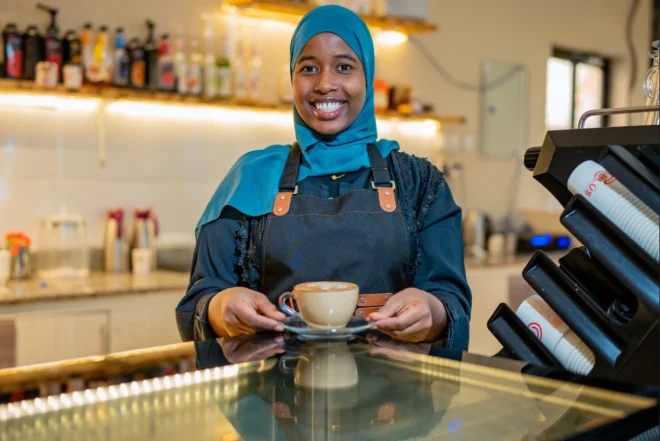
Saabiriin Hassan behind the counter at CPlus Cafe. Photograph: Mohamud Utaama/The Guardian
At 6am each day, Saabiriin Hassan ties on her apron and steps behind the counter at Cplus Cafe in central Mogadishu. Fresh coffee drifts through the shop, though customers often notice Hassan’s constant smile before anything else.
She smiles while grinding beans, frothing milk and speaking with customers. As one of Somalia’s first female baristas, Hassan is not only making coffee but helping establish a cafe scene in a capital long associated with conflict.
“It began with curiosity in 2020,” says the 23-year-old. “I noticed there were no female baristas in the city. I chose to learn the skill and enrolled in a three-month course. From then on, I fell in love with the art of making coffee.”
Somalis have traditionally favoured tea made with camel milk, yet the arrival of modern coffee shops across Mogadishu is changing how people socialise and opening up new gathering places for the city’s young population.
Women such as Hassan are central to that shift, taking jobs in an industry that has largely been dominated by men and pushing back against established expectations.
Saabiriin Hassan outside Cplus Cafe in Mogadishu Photograph: Mohamud Utaama/The Guardian
“When I started, people criticised me for this work,” she says. “They told me it was a man’s job. Some even said no one would marry a woman who served men in public. But I did not listen to them.
“I know my values and what I want from life, so I concentrate only on my goals,” Hassan says.
Her determination has brought results over six years in the profession. Views that initially worked against her have begun to change, and more young women have taken up barista roles. Improved security in Mogadishu has also encouraged members of the Somali diaspora to return, as new malls, business centres and cafes replace an atmosphere once shaped by fear and fighting.
The cafe expansion is about more than a cup of coffee. It is creating work for young people in a country where more than 70% of the population is under 35 and unemployment remains a major challenge. Cafes have also become meeting points for artists, designers and entrepreneurs to share ideas.
Coffee is believed to have been discovered in this region of east Africa, with wild beans first found in neighbouring Ethiopia. Still, many Mogadishu residents remain devoted to sweet, spiced tea with milk despite the growing number of coffee shops. Somali tea is usually served very hot, and first-time coffee drinkers often ask for an extra-hot cappuccino.
Some customers combine coffee with camel-milk tea, creating their own blend. The habit is widespread enough to have its own term: “soo dakhar”, meaning to add a shot of espresso.
Yusra Abdifatahi, 21, has worked at Beydan, one of Mogadishu’s pioneering coffee shops, since 2023. Recently promoted to branch manager, she says: “I now have more responsibility, looking after daily operations, quality control and customer satisfaction. I also make coffee to cover the main barista.”
Abdifatahi studies part-time and says her job covers her university fees while allowing her to help support her family. The work has also strengthened her confidence and social skills. “I now have clarity of what I want to do in life, and I believe I am on the right track to achieve my dream of having my own business,” she says.
Beydan, which calls itself a “modern pan-African coffee company”, started as a home bakery in Mogadishu in 2018. It now operates more than 10 branches across Somalia and employs 136 people, with women accounting for more than 40% of staff.
“When we opened our store in the Taleh neighbourhood in 2019, there was no other shop in the area,” says Najiib Abdullahi, Beydan’s founder. “It was an empty street.”
Restaurants and designer boutiques soon followed the business to the formerly quiet road. It has since grown into one of Mogadishu’s busiest streets and is widely known locally as Wadada Beydan, or Beydan Road.
“We are proud to pave the way for others to return and invest in our country,” says Abdullahi. “Our vision is to expand across Africa, and soon we hope to open new branches in Nairobi and beyond.”
Hassan serving a customer at Cplus Cafe. Photograph: Mohamud Utaama/The Guardian
As interest in coffee has grown, colleges and training centres in Mogadishu have begun running barista courses. Away from her counter at Cplus Cafe, Saabiriin Hassan teaches at one such centre.
“Most of the students are women,” she says. “That motivates me to keep doing this work and make a difference in the lives of Somali youth. We have come a long way, and I am happy to play a small role in this change.”
Hassan has more than 70,000 TikTok followers, where she posts about her daily work and shares coffee-making advice. She says barista work has a level of appeal among Somali young people that differs from other vocational jobs, such as plumbing.
“Apparently,” she says, “it is not like one of those odd jobs young people despise. A lot of people ask me how they can join and where they can train.
“I see a bright future in Somalia’s hospitality sector, and I hope to open my own cafe sometime, Insha’Allah [God willing].
“I would encourage young women to acquire as many skills as possible. And never listen to those who say you can’t do it.”