
Christa Pike is critically ill in a Nashville hospital after surviving two attempts to execute her by lethal injection, her lawyers said, intensifying debate over the use of capital punishment in the US.
Pike, 50, was sentenced to death in the 1990s for a murder committed when she was a teenager.
- Advertisement -
The failed execution on Wednesday at Riverbend Maximum Security Institution was Tennessee’s second of the year. It has also exposed the challenges states face in administering lethal injections and securing workable alternatives to carry out death sentences.
“Christa is alive right now,” Randall Spivey, one of Pike’s lawyers and a witness to the execution attempt, told reporters on Thursday afternoon.
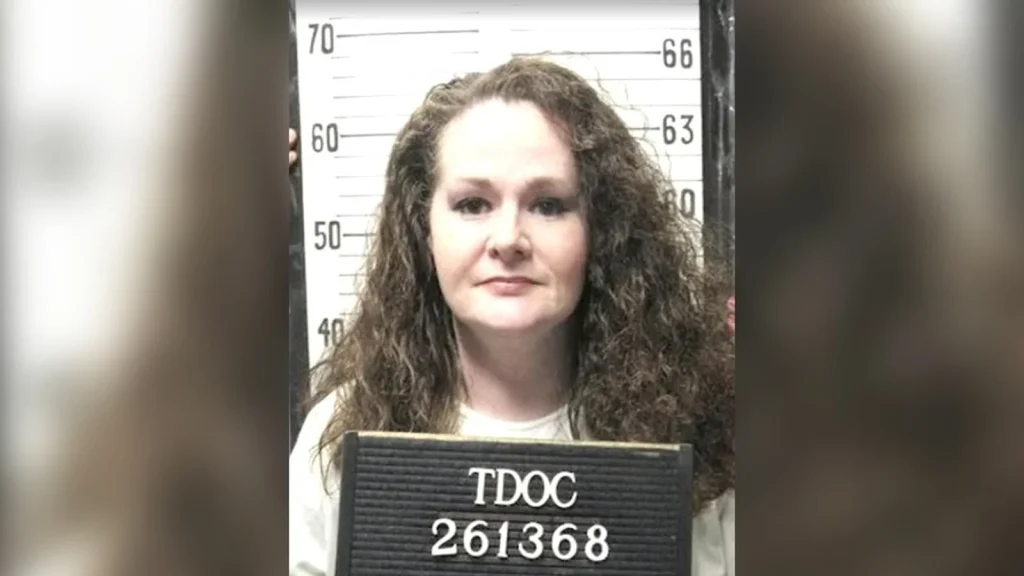
Christa Pike pictured on the day she was sentenced to death
Her legal team renewed its demand that her sentence be reduced to life in prison, describing the ordeal as “chemical torture.”
Tennessee has halted all executions for the remainder of the year while officials investigate what happened.
Failed executions
Botched lethal injections often fail at the first stage, when officials struggle to establish intravenous access. Pike’s case appears different: prison staff seemed to inject the drugs through two syringes, after which her right arm “turned purple” and the skin around the injection points blistered, Mr Spivey said.
Media witnesses recount scene of botched execution attempt
According to the Death Penalty Information Center, a Washington-based non-profit, Pike may be the first known person to survive after execution drugs were administered.
“This failed attempt is the worst we’ve ever seen and unlike any other botched execution in the modern era,” its director, Robin Maher, said in a statement.
After the second injection, Pike said her arm was in pain and felt as though it was “about to explode,” her lawyers said. They believe the drugs entered the surrounding tissue rather than reaching her bloodstream through the vein.
Pike, who would have become the first woman executed by Tennessee in more than 200 years, has a blood condition and had warned that lethal injection could go wrong, according to her lawyers.
Her lawyers had unsuccessfully asked the state to use another method, including hanging or a firing squad.
Tennessee Governor Bill Lee rejected Pike’s appeal for clemency and a life sentence on Monday. Following Wednesday’s failed execution, the Republican governor suspended scheduled executions in the state for the rest of the year and ordered an independent review.
“There is no one that wanted what happened last night to happen,” Mr Lee told reporters. “It’s a tragedy, and it’s deeply disturbing to me that that has happened in this state. The people deserve better and we’re going to make sure that happens.”
Pike would have been the first woman executed by Tennessee in more than two centuries
‘Kind’ with her executioners
Pike’s lawyers provided further details about the execution chamber, saying officials appeared to grant her request for an all-female execution team.
It took roughly an hour to establish intravenous access. During that time, Pike advised the executioners on where they might place the needle to improve their chances of reaching her veins, Mr Spivey said.
“Miss Pike was kind and she was cooperative and she was at peace the whole time,” Mr Spivey said. “She was ready.”
After the first dose was administered, Pike continued speaking with her spiritual adviser and members of the execution team, offering them “loving kindness,” Mr Spivey said.
European law prevents pharmaceutical companies from selling drugs for executions, leaving US prison systems to obtain them through small, lightly regulated compounding pharmacies. Those procurement arrangements are often conducted behind a veil of secrecy.
Tennessee adopted a one-drug lethal injection protocol using pentobarbital, a powerful barbiturate, in 2024. It was not clear where the drugs used in Wednesday’s failed execution came from. Pike’s lawyers say the state also refused to disclose that information to them.
Most countries worldwide and 23 US states have abolished the death penalty. Volker Turk, the United Nations High Commissioner for Human Rights, said Pike’s case demonstrated why the rest of the country should do the same.
“The prolonged suffering – physical and mental – arising from multiple failed execution attempts is abhorrent, and cruel,” Mr Turk said in a statement.
Pike was 18 in January 1995 when she, her 17-year-old boyfriend Tadaryl Shipp and another companion lured Colleen Slemmer, a 19-year-old classmate at their Knoxville Job Corps vocational centre, into a wooded area, where they tortured and killed her.
Pike and Shipp confessed to the killing, and both were convicted of first-degree murder.