
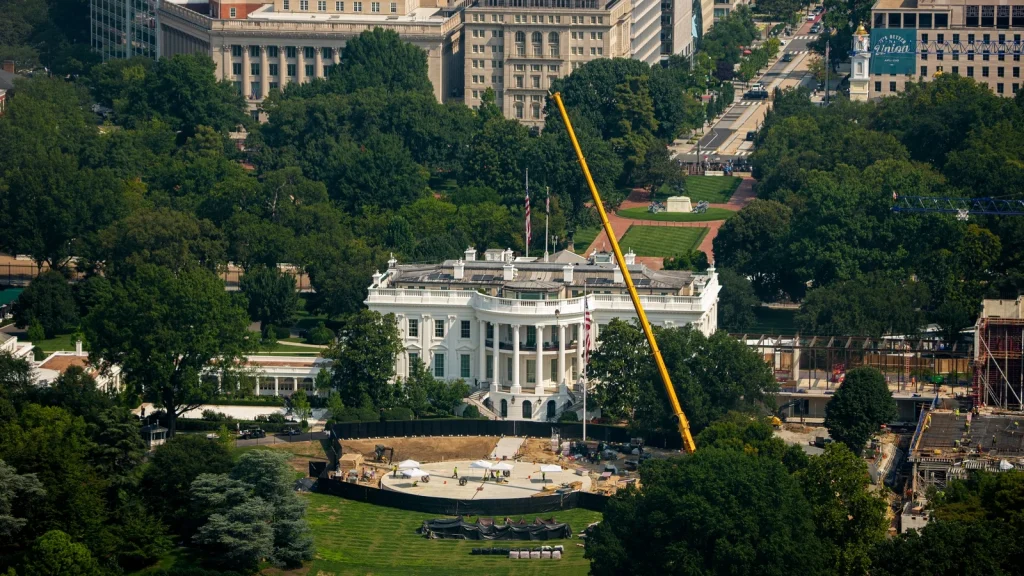
President Donald Trump’s administration has asked the US Supreme Court to let work continue on his $400 million White House ballroom, arguing that an appeals court wrongly halted the project over its failure to obtain congressional approval.
In its filing, the administration urged the justices to suspend the ruling by the US Court of Appeals for the District of Columbia Circuit while it prepares a full appeal to the Supreme Court.
- Advertisement -
Justice Department lawyers also reinforced Mr Trump’s claim that the ballroom is essential to national security.
Pointing to numerous assassination attempts against the president, they described the project as “vitally required by national security”.
Construction on the new ballroom extension of the White House in Washington
“Whether or not a massive ballroom should be constructed is for Congress to decide and is not a matter for Executive self-help,” the appeals panel wrote.
The DC Circuit temporarily delayed its ruling for 14 days, giving the Trump administration time to seek intervention from the Supreme Court.
The National Trust for Historic Preservation filed the case last year, after the administration demolished the White House’s East Wing and began work on an 8,360-square-metre ballroom without first obtaining authorisation from Congress.
Mr Trump has maintained that the project is necessary for security and earlier this month described the planned structure as a “military center” in a post on Truth Social.
He denounced the DC Circuit’s ruling as “horrendous” and politically driven, saying it left him, other White House officials and visitors vulnerable to attack.
“This unjust decision must be overturned by the Supreme Court in its entirety,” Mr Trump wrote.
According to the president, the design features bomb shelters, medical facilities, protection against drones and missiles, and other security measures that are “all tied together as one big, expensive, and very complex unit.”
But the DC Circuit said national security claims “are not an automatic get-out-of-law-free card.”
The court’s order did not rule out construction of a ballroom altogether. Instead, it barred above-ground work until the administration obtains approval from Congress.