
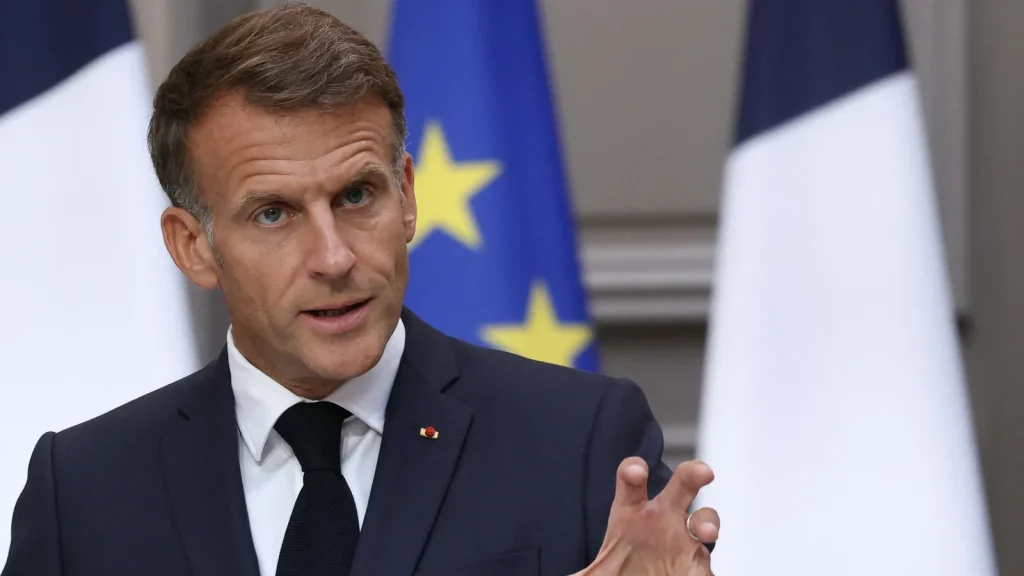
French President Emmanuel Macron warned that Russia’s shadow operations were spreading across Europe and said he had ordered new measures to shield France’s critical infrastructure from escalating “hybrid attacks”.
“The Russian hybrid threat against Europeans and against France has intensified,” he said after meeting French political leaders, ahead of his trip to the UN General Assembly next week.
- Advertisement -
Mr Macron said France’s interior minister had brought regional prefects together to increase “vigilance in response to the Russian hybrid attacks”. The meeting included presidential hopefuls and party leaders ahead of next year’s election.
He said he had instructed “the government to prepare a plan to protect our critical infrastructure” as well as the “most sensitive” defence and technology sites from drone and cyber-attacks.
The French president also promised that Russia would face a response to its shadow operations.
“This will not go unanswered,” Mr Macron said, without providing further details.
“The intention behind it is to intimidate us and to derail the effort to support the Ukrainians. The consequence will be the opposite,” he added.
“We are not intimidated, because we know that what is at stake today in Ukraine is our security.”
Zelensky welcomes leaders to regional summit
Ukrainian President Volodymyr Zelensky has meanwhile welcomed leaders and representatives from seven regional countries for talks aimed at deepening co-operation, as overnight Russian attacks across several regions ignited fires and left people dead and injured.
The inaugural summit of the so-called Carpathian Eight includes Ukraine, Romania, Serbia, Poland, Slovakia, the Czech Republic, Austria and Hungary, with the European Union also taking part.
The gathering comes as US-led efforts to broker an end to Russia’s full-scale invasion have stalled. Territorial concessions in eastern Ukraine remain one of the main obstacles, while Kyiv is seeking security guarantees from its partners as part of any agreement.
The Carpathian Eight brings together Ukraine, Romania, Serbia, Poland, Slovakia, the Czech Republic, Austria and Hungary
The summit coincides with the start of three days of voting in Russia’s first wartime parliamentary election. The contest features almost no opposition to President Vladimir Putin’s party and is expected to cement the Kremlin’s political dominance.
Several countries represented at the meeting in western Ukraine’s Ivano-Frankivsk region, including Poland and Romania, have been firm supporters of Kyiv.
Hungary, Serbia and Slovakia, by contrast, have declined to provide Ukraine with direct military assistance.
Mr Zelensky said on Telegram that the summit marked a “significant beginning” for a movement designed to “further strengthen ties between our countries and create another strong element of co-operation at the EU level”.
He said the participating nations would co-operate on security, energy, logistics, cross-border economic links and support for local communities.
The talks at the western Ukrainian ski resort of Bukovel took place amid growing concern across Europe that Russia is intensifying hybrid threats, including sabotage, cyber-attacks, disinformation and possible drone incursions into Nato territory.
Polish Prime Minister Donald Tusk warned before leaving for Ukraine that Moscow was preparing hybrid strikes involving drones or rockets against European countries supporting Kyiv, including Poland.
Officials in Poland, Germany and Denmark have in recent weeks accused Russia of involvement in drone incursions, sabotage, arson, surveillance of defence facilities and plans to use an explosives-laden drone to attack an airport.
European Commission president Ursula von der Leyen said on Wednesday that the EU needed a Nato-style mechanism to respond more effectively to hybrid attacks attributed to Russia. She also called for “a consensus on how to respond to certain incidents- that fall below armed aggression but clearly threaten our national security”.
A fire in Ukraine last night caused widespread destruction at the market in Zaporizhzhia
After speaking by phone with Ms von der Leyen, Mr Zelensky said in a Telegram post that Ukraine had received a €3.3 billion tranche from an EU financial support package intended to bolster its defence capabilities, including through the purchase of missiles and drones.
He added that Ukraine was preparing to meet Ms von der Leyen at the United Nations General Assembly in New York next week to discuss the country’s financial stability.
Strikes overnight
Two people were killed and two others injured in overnight Russian strikes in the Zhytomyr region, west of Kyiv, Ukraine’s State Emergency Service said in a statement on Telegram.
The attacks set warehouse and production buildings ablaze.
Firefighters had to withdraw during repeated air raid alerts before later returning to extinguish the fires.
In Ukraine’s Kharkiv region, one person was killed and six others injured when Russian forces struck an electric train, the state emergency service said. The drone attack hit a railway station in the Novovodolazka community and started a fire in two carriages of the suburban service.
Watch: Large blaze at market in Ukraine following Russian attack
Another Russian drone attack destroyed a shopping complex in Zaporizhzhia, injuring one person and sparking a fire, according to the service.
Russia’s Defence Ministry said its air defences had intercepted and destroyed 629 Ukrainian drones overnight across 14 Russian regions, as well as illegally annexed Crimea and the Azov and Black seas.
Moscow mayor Sergei Sobyanin said more than 350 drones had been flying towards the capital. Most were destroyed well outside the city, while 64 were shot down as they approached Moscow.
In the southern Rostov region, close to the Ukrainian border, homes and other residential buildings were damaged in an attack, local authorities said. No casualties were reported, according to Rostov governor Yuri Slyusar.
The Russian military said it had carried out overnight drone strikes against Ukrainian ports, vessels and a logistics centre used by the military.
Russian forces struck a bulk carrier in the Ukrainian port of Chornomorsk and a Nova Poshta logistics facility 3.7 miles north-west of Odesa. The Russian Defence Ministry said the facility was used to store and distribute military cargo from Europe.
Russia seizes assets of Nestle, French firms over West’s Ukraine support
Russian authorities have seized the businesses and assets of Swiss food giant Nestle and three French companies, a move the Kremlin defended as justified action against firms from “unfriendly countries” that support Ukraine.
A decree signed by President Putin transferred the Russian operations of Nestle, French retailer Auchan and the former Leroy Merlin DIY chain, now known as Lemana Pro, to a company called LEV Management.
The decree, issued late yesterday, also includes the Russian subsidiaries of French logistics group FM Logistic.
Investigative outlet Novaya Gazeta Europe reported that LEV Management was established only at the end of 2025 and is led by a Russian interior ministry general. The company had no known business activity.
The move was the latest Russian action against Western companies in response to the extensive sanctions imposed over its war in Ukraine, now in its fifth year.
Most Western companies sold their Russian operations and holdings soon after the invasion of Ukraine, or separated themselves from the market, as sanctions made trading in many goods increasingly difficult.
Some businesses stayed, citing concerns about their employees or the welfare of citizens, but generally cut their operations sharply.
Russia has since made it harder for companies to leave by demanding presidential approval for transactions or seizing their assets outright.