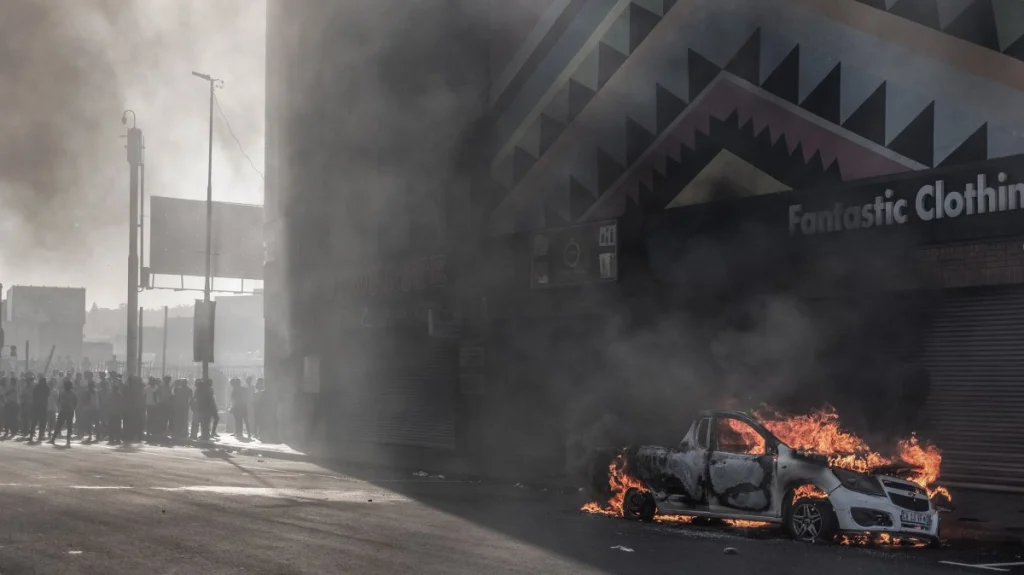
South Africa has abandoned a directive that expanded the number of asylum applications refugee reception offices were required to process, following violent protests that saw at least 24 vehicles torched, shops looted and public-order concerns rise in Johannesburg and Durban.
The Home Affairs Department announced Friday that it was withdrawing the measure after its rollout caused severe overcrowding at refugee offices and heightened tensions between anti-immigration protesters and foreign nationals.
- Advertisement -
The department said the directive had produced “serious consequences,” overwhelming offices within days, placing officials in danger and raising threats to public safety and order.
“The Department will embark on a fresh process,” it said.
The decision came a day after violence erupted in Johannesburg’s Soweto township and in Durban, a coastal city in KwaZulu-Natal province. Demonstrators had gathered to oppose the government’s handling of asylum applications after a Constitutional Court ruling.
Acting National Police Commissioner Lt. Gen. Puleng Dimpane said 10 vehicles were burned in Soweto and another 14 in Durban. Police in Durban arrested three foreign nationals over an alleged assault on a South African protester.
“The right to raise concerns and to protest does not give anyone the right to commit crime,” Dimpane said. He added that police had strengthened public-order deployments in areas affected by the unrest.
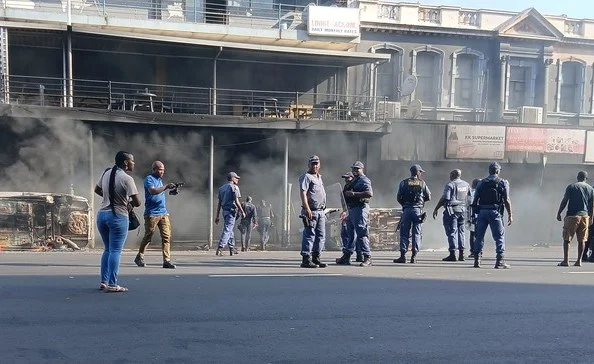
In Soweto, clashes broke out near a Home Affairs office in Orlando West, where burned vehicles remained along several streets. Metro police spokesperson Xolani Fihla said there were no reports of injuries and that officers were examining whether other vehicles had also been set alight.
Fihla said police had received reports that shots were fired toward protesters, who then responded by burning vehicles. He did not say who was accused of firing the shots or identify the vehicles’ owners.
“The situation is a bit tense, but it has died down from the earlier violence that we did see during the day,” he said.
Community leader Tshepo Mposula said the protest initially proceeded peacefully outside the Home Affairs office. Some residents later moved to shut convenience stores owned by foreign nationals, he said.
Mposula alleged that foreign nationals fired shots, inflaming the crowd and leading protesters to torch vehicles. He said the gathering had been intended as a peaceful demonstration.
“It was not supposed to escalate to this level. This was supposed to be a peaceful demonstration,” he said.
Police remained deployed in Soweto as tensions persisted and roads remained closed. Fihla acknowledged that officers assigned to monitor the march at first lacked specialized public-order training and equipment.
“We couldn’t predict that this type of situation would happen,” he said.
In Durban, riot police moved into the city center after reports that shops owned by foreign nationals had been looted. The South African Broadcasting Corp. reported the looting, while smoke hung over parts of downtown as firefighters tackled several blazes, including a fire at a municipal building.
A Metro police officer runs past a car that has been set alight after clashes erupt between protesters and foreign nationals, Durban, South Africa, Oct. 8, 2026. (AFP Photo)
KwaZulu-Natal police spokesperson Col. Robert Netshiunda told SABC that three foreign nationals had been arrested on suspicion of attacking a South African protester and breaking the person’s neck. He said the alleged assault may have sparked the wider unrest.
The latest violence followed months of protests against undocumented immigration. Demonstrators have demanded the deportation of foreigners living in South Africa illegally.
The unrest has also been linked to the fallout from a July Constitutional Court ruling that overturned procedural obstacles preventing some people from seeking asylum.
Those restrictions applied to people who entered South Africa irregularly, did not have asylum transit visas or failed to report to authorities within required deadlines. The court ruled that the barriers were unconstitutional, allowing more people to have their asylum claims examined.
After the ruling, the Home Affairs Department directed refugee reception offices to accept applications from people previously excluded under those procedures. Officials later conceded that they had not been prepared for the volume of applicants.
The government’s Inter-Ministerial Committee on Migration convened an urgent briefing Thursday to address overcrowding and mounting difficulties at refugee reception offices.
“We confirm that all refugee offices were overwhelmed by the numbers of those coming for applications,” the committee said after meeting Wednesday night.
Authorities had promised to increase processing capacity, speed up decisions and tighten identity checks. They also emphasized that the court ruling did not automatically confer refugee status or permanent residence; it only gave applicants the opportunity to have their claims assessed.
Withdrawing the directive marks a shift in the government’s approach to managing the surge in asylum applications. The department has not yet explained what replacement process it will introduce.
South Africa, the continent’s largest economy, has attracted migrants for years with the prospect of jobs and improved economic opportunities. But it has also endured repeated outbreaks of xenophobic violence for nearly two decades, often driven by accusations that foreign nationals are competing with South Africans for employment, housing and public services.
Those tensions have sharpened ahead of local government elections scheduled for Nov. 4. Unemployment of more than 30% has further deepened public frustration.
South African police said at least four foreign nationals were killed in violence earlier this year, although some African governments reported higher death tolls.
The unrest has also driven thousands of foreign nationals to leave South Africa. Zimbabweans and Malawians made up the largest groups of those departing, joined by nationals of Ghana, Kenya, Lesotho, Mozambique, Nigeria and Uganda.
Several governments repatriated their citizens, a development that added to diplomatic tensions with Pretoria.
The Axadle Times Newsletter
Keep up to date with what’s happening in Turkey,
it’s region and the world.
SIGN ME UP
You can unsubscribe at any time. By signing up you are agreeing to our Terms of Use and Privacy Policy.
This site is protected by reCAPTCHA and the Google Privacy Policy and Terms of Service apply.