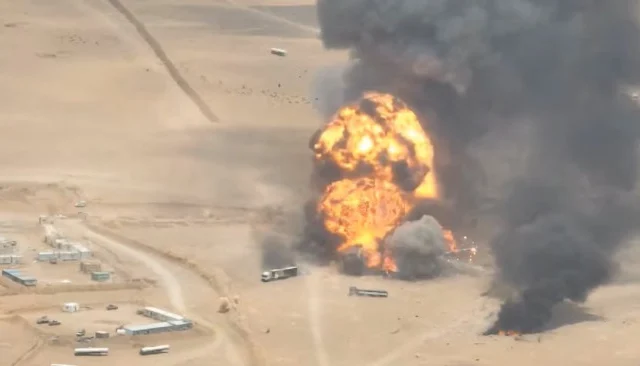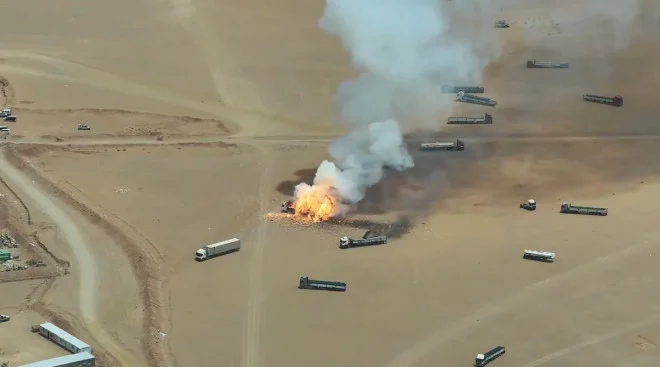
Smoke and flames billow from trucks at a camp belonging to Saudi-backed government forces after an alleged Houthi missile attack in Yemen’s eastern Hadramout province, Sept. 7, 2026. (EPA Photo)
More than 70 people were injured and fires broke out at oil facilities and utility sites across Saudi Arabia on Tuesday after Yemen’s Iranian-backed Houthi rebels launched a barrage of attacks, Saudi authorities said.
- Advertisement -
The strikes marked a sharp escalation in renewed hostilities between the U.S.-allied kingdom and the Iranian proxy group. They also risked deepening instability across a region already battered by nearly three years of war and adding fresh pressure to the global economy.
Weeks of clashes have strained already limited global oil supplies as the Houthis target a shipping corridor Saudi Arabia has used to move crude to international markets while the Strait of Hormuz remains constricted amid the U.S.-Iran war. Tuesday’s strikes hit Saudi energy facilities linked to an alternative route through Bab el-Mandeb, the strategic waterway at the southern end of the Arabian Peninsula connecting the Red Sea with the Gulf of Aden.
Houthi attacks hit oil facilities in southern Saudi Arabia
The attacks came early Tuesday, only hours after the rebels accused Saudi Arabia of carrying out an airstrike on a prison in Yemen’s northern Jawf province. At least seven people, including a child, were killed and seven others injured in that strike.
Houthi missiles and drones struck “civilian and economic facilities” in the Saudi cities of Abha, Jazan, Najran and Khamis Mushait, Maj. Gen. Turki al-Malki, a spokesperson for the Saudi-led coalition fighting in Yemen, said.
Al-Malki put the number of wounded at 73, including women and children. He described the assault as a “serious escalation” and said Saudi Arabia would retaliate.
Saudi Arabia’s Energy Ministry said the attacks sparked fires at several oil facilities and utility sites in the country’s south, forcing a temporary halt to operations.
The region is home to several significant energy installations, including Jazan’s 400,000-barrel-per-day refinery, one of the kingdom’s largest. Houthi rebels have previously attacked Abha airport.
Fire crews were working to contain the blazes Tuesday morning, the ministry said.
In a prerecorded video statement, Houthi military spokesperson Brig. Gen. Yahya Saree said the group had launched dozens of ballistic missiles and drones against oil and economic facilities, along with an air base in southern Saudi Arabia.
Saree said Jazan City for Primary and Downstream Industries, a major industrial and logistics center on Saudi Arabia’s southwestern Red Sea coast, was among the targets. He also said the rebels targeted Aramco facilities in Najran and Abha and King Khalid Air Base in Khamis Mushait.
He attributed the escalation to Saudi Arabia, warning that “every aggression against our country and people will be met with a firm response.”
Saudi Foreign Minister Prince Faisal bin Farhan, speaking during a visit to Moscow on Tuesday, accused the Houthis of using violence to advance their own interests rather than those of Yemen, despite what he described as a Saudi offer to pursue peace talks.
At a joint news conference with Russian Foreign Minister Sergei Lavrov, he said the Houthis’ latest actions were part of a continuing series of provocations and warned that Saudi Arabia would not hesitate to defend itself.
Fears mount of renewed war in Yemen as thousands are displacedThe latest fighting has raised fears that Yemen’s civil war could reignite. The conflict began in 2014, when the Houthis captured the capital, Sanaa, and large parts of northern Yemen, forcing the government into exile. A Saudi-led coalition intervened the following year in an effort to restore the government.
The war has killed at least 150,000 people, according to U.N. estimates, and has at times brought Yemen close to famine.
A truce reached four years ago reduced fighting between the Houthis and the Saudi-backed government and its allies. In recent weeks, however, clashes between the two sides have intensified on the ground.
The renewed violence killed at least 194 people and injured more than 880 between Aug. 23 and Sep. 5, the World Health Organization said. The United Nations said more than 21,000 people had been displaced over the past 27 hours, including 18,500 in the southwestern provinces of Taiz and Hodeida.
“Families are arriving with nothing: no shelter, no food, no way to know if it’s safe to go back,” said Abdusattor Esoev, head of the International Organization for Migration’s mission in Yemen. “Many of these are people who have already been displaced once, twice, even four times before.”
The current escalation followed a Houthi effort in July to operate a flight from Tehran to Sanaa, challenging a Saudi-led coalition air and naval blockade that has lasted a decade. A coalition airstrike hit Sanaa airport’s runway, preventing the aircraft from landing.
The Houthis answered with missile and drone strikes on Saudi Arabia and attacks on Saudi shipping in the Red Sea, bringing an end to a 2022 truce that had largely stopped the fighting.
The rebels also attacked Saudi-aligned forces inside Yemen. Government troops responded with operations against Houthi positions along the country’s west coast and in other areas.
Government forces have retaken territory from the Houthis in Hodeida and Taiz provinces. They have also struck rebel positions in the northern Jawf province and in the central provinces of Marib and Bayda.
The Houthis belong to a wider network of Iranian-backed groups across the region that have intensified attacks on shipping, Israel and neighboring states in recent years. The groups have cited Israel’s wars in Gaza and Lebanon and, more recently, the U.S.-Israeli war on Iran.
Although the rebels frequently coordinate their actions with Iran, they have also conducted operations independently in pursuit of their own interests.