
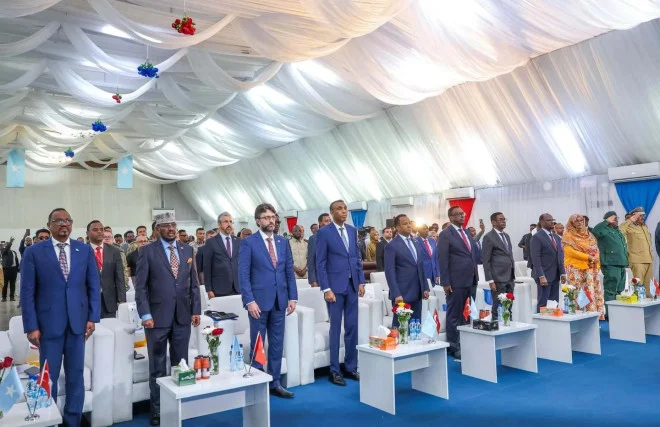
Somalia is rebuilding more than roads and public institutions; it is also working to ensure the country’s progress is understood at home and abroad. / Office of the Prime Minister, Somalia
For most of my career, I understood Somalia primarily through the reporting of a journalist.
- Advertisement -
Working for Somali independent media and international organisations, including the BBC, I covered many of the crises that have shaped the country’s international image: conflict, drought, insecurity, terrorism, piracy and humanitarian emergencies. Each was a significant story, and each warranted global attention.
With time, however, I realised that these accounts captured only one dimension of Somalia’s reality.
Beyond the headlines of crisis was another story a quieter but equally important story of a country rebuilding its institutions, strengthening governance and creating the foundations for long-term stability.
Now, as Director of Communications and Official Spokesperson for the Office of the Prime Minister of the Federal Government of Somalia, I see that process from a different vantage point. Government institutions are pursuing reforms, public services are growing, infrastructure is advancing and state bodies are developing greater capacity.
Many of these changes, however, receive far less international attention than the difficulties Somalia is still confronting.
That gap is more than a communications problem. It is also a governance problem.
Communication as a pillar of state-building
Government policy does not end with the approval of a decision or the delivery of a ministry programme. Citizens need to know what is happening and why. Investors require confidence in public institutions. Development partners need a clear view of progress, while international audiences need reliable and accurate information.
When communication is weak, even substantial reforms can go unnoticed, limiting their ability to build public trust and strengthen Somalia’s credibility abroad.
For countries emerging from prolonged conflict, strategic government communication is not a luxury or an optional administrative service. It is part of the architecture of state-building.
Laws, institutions, roads and public services are essential to a functioning state. So, too, is the trust citizens place in those institutions and their understanding of the role they serve.
Somalia has increasingly acknowledged that connection.
Building a coordinated government communication system
During the past two years, the Office of the Prime Minister has focused on improving coordination and professionalism throughout government communications.
Regular coordination platforms now convene communications directors from ministries and key public institutions. They provide a way to align messages around national priorities, coordinate public-information campaigns and deliver more consistent communication during major initiatives and other moments of national importance.
These measures may look largely administrative, but their consequences are considerable.
Nearly every ministry and major public institution now has a communications function, staffed by professionals who produce multimedia material, manage official digital channels and make government information easier for the public to obtain.
Citizens, journalists, researchers, investors and development partners are increasingly able to consult official sources directly instead of relying exclusively on secondhand reporting.
That shift marks a meaningful advance in transparency and institutional accountability.
Professionalizing government communication
The changing role of communication is also reshaping perceptions of public service in Somalia.
It is no longer seen merely as a vehicle for publicity. Increasingly, communication is understood as a strategic governance function that supports accountability, public participation and the effective implementation of policy.
More experienced journalists, communications experts and public relations professionals are moving into government institutions because they see how their skills can contribute directly to national development.
Structures alone, however, cannot create an effective system. Institutions also need professionals prepared to work in a fast-moving and increasingly complex information environment.
To address that need, the Office of the Prime Minister recently held a week-long Government Strategic Communications Capacity Building Programme in Nairobi through the UNDP-supported Transformational Governance Project (TGP).
The programme brought together communications personnel from government institutions for practical sessions on strategic communication, executive messaging, media relations, stakeholder engagement, crisis communication and digital communication.
Participants tackled real-world scenarios, designed strategies linked to national priorities, took part in simulated press briefings and responded to crisis situations under pressure.
The aim was straightforward: to raise professional standards and help government institutions communicate with greater clarity, consistency and credibility.
Trust in the age of information disruption
The value of strong communication becomes especially clear when uncertainty takes hold.
Information now moves at unprecedented speed. If institutions do not respond promptly and clearly, gaps appear. Misinformation, disinformation and speculation can quickly occupy that space, eroding public confidence.
Governments that build communication capacity are better equipped to manage crises, deliver accurate information and preserve institutional credibility.
That challenge is particularly important for Somalia.
After decades of conflict, restoring trust between citizens and public institutions remains critical to the country’s long-term stability. Strategic communication is not therefore about promoting government for its own sake. It is about giving citizens access to dependable information, supporting informed public debate and reinforcing the relationship between society and the state.
International partnerships and lessons from Türkiye
Somalia’s state-building journey has long relied on international partnerships. Support from those partners has helped advance infrastructure, security, education, healthcare, economic development and institutional reform.
Strategic communication is another field in which international cooperation can deliver lasting benefits.
Türkiye’s relationship with Somalia has grown through years of solidarity and practical cooperation spanning humanitarian assistance, infrastructure, education, healthcare and institutional development.
Since Türkiye renewed its engagement with Somalia in 2011, Turkish institutions have supported recovery and capacity-building efforts, including cooperation in media and communications.
Through organisations such as the Turkish Cooperation and Coordination Agency (TİKA) and Türkiye’s public broadcaster TRT, Somali journalists and media professionals have taken part in training on journalism, radio broadcasting, news production and challenges including disinformation.
Such programmes reflect the wider relationship between the two countries, which is grounded in knowledge sharing, institutional development and mutual learning. Alongside its contribution to Somalia’s development, Türkiye has built internationally recognised institutions in media, public diplomacy and strategic communication.
As Somalia develops its own communications architecture, engagement with Turkish counterparts offers useful opportunities for professional training, knowledge exchange and institutional learning.
At a time when information has become a strategic arena alongside diplomacy, security and economics, countries must be capable not only of governing effectively but of explaining that work effectively.
Rebuilding trust through communication
Somalia’s experience carries a wider message for countries emerging from conflict: rebuilding a state means more than establishing institutions. It also means building confidence in them.
Citizens assess governments not only by the results they deliver, but by the openness, clarity and consistency with which those results are communicated.
Strategic communication is consequently not an accessory to governance. It is one of governance’s essential functions.
As Somalia pursues stronger institutions and sustainable development, communication will remain vital to linking government action with public understanding—and to turning visible progress into trust among citizens and the international community.