Israeli airstrikes on southern Lebanon killed 11 people, including three children, Lebanese authorities said, in the deadliest attacks since June agreements helped ease fighting between Israel and Hezbollah.
Israel’s military said the pre-dawn strikes were carried out in response to an attack by the Iran-backed group on Israeli troops operating in southern Lebanon.
- Advertisement -
The escalation came as Israel and Lebanon prepared for an eighth round of US-sponsored direct talks, scheduled to take place in Rome early next month.
Although the two sides agreed to a framework deal during negotiations in Washington in June, Lebanese President Joseph Aoun said Saturday’s attacks sent a troubling signal. The “violations are a clear message on the negotiations process and American efforts aiming to implement this agreement,” he said.
Lebanon’s state-run National News Agency (NNA) reported that Israel “escalated its attacks on the south” before dawn Saturday. It said an airstrike hit a house in the village of Ansar, followed by a “series of airstrikes targeting the Ali al-Taher ridge”, a strategic elevation overlooking the Nabatieh area.
The agency later reported another strike in the southern town of Deir Zahrani.
Lebanon’s health ministry said seven people were killed in Ansar, “including three children and two women.” Aoun said “an entire family” was among those killed.
In Deir Zahrani, four more people were killed and 17 wounded, including a child and 11 women, the ministry said. The updated figures raised an earlier death toll of two.
The National News Agency said the strike destroyed the home
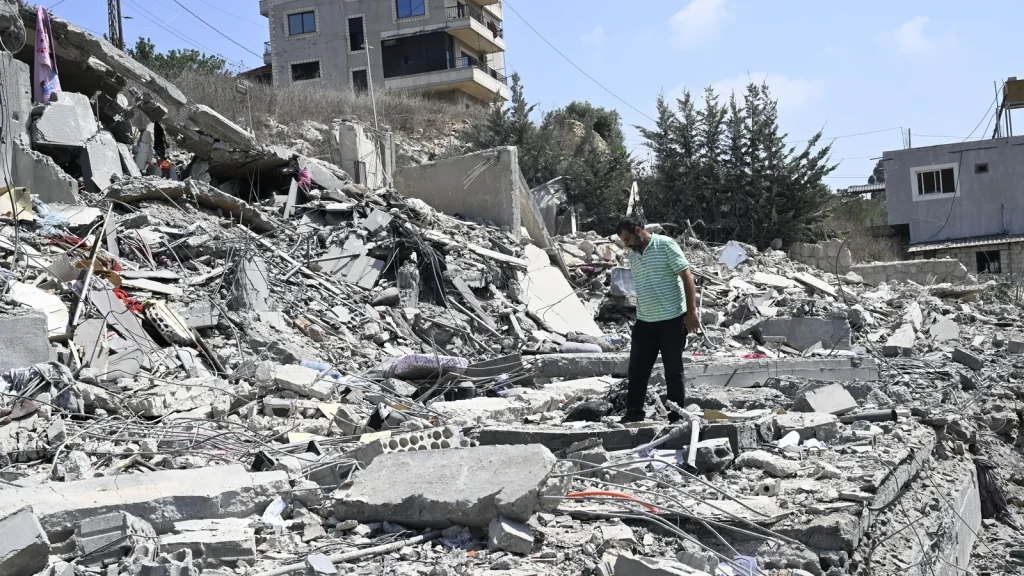
In Ansar, an AFP correspondent saw a building reduced to rubble as rescuers searched through the wreckage. Dust and debris had turned a nearby swimming pool cloudy and grey.
Abbas Khalil, 60, said he had been praying when the strike hit.
“We were shocked… There’s no justification for this,” he told AFP.
The Israeli army said it had targeted “Hezbollah terror infrastructure in the areas of Nabatieh and Ansar” after Hezbollah took “action” against Israeli soldiers near the Ali al-Taher ridge.
It later said Hezbollah had “attacked our forces inside the agreed security zone”, referring to a strip of Lebanese territory about 10km deep where Israeli troops are operating. The army called the incident “a serious violation of the agreement”.
In Deir Zahrani, an AFP correspondent reported extensive destruction and heavy traffic heading toward Sidon, as residents drove north with cars packed with belongings.
The NNA said one of the strikes near Ansar was “the first at this geographical depth since the ceasefire two months ago”.
Ansar and Deir Zahrani both lie about 20 kilometres from the border.
Lebanese Prime Minister Nawaf Salam rejected Israel’s characterization of the targets, saying those killed in Ansar “are not ‘military infrastructure’ and the women and children who were killed are not military targets”. He called on Israel to end the “extremely dangerous” escalation.
Parliament speaker Nabih Berri, a Hezbollah ally, urged “the sponsors of the negotiations and the ceasefire agreements to bear their responsibility… before it’s too late”.
Negotiations
Hezbollah said the escalation, which was “targeting civilians and expanding the areas targeted”, showed Israeli Prime Minister Benjamin Netanyahu wanted “to escalate the war in order to strengthen his domestic political position”.
Hezbollah drew Lebanon into the wider Middle East conflict in March, launching rockets at Israel in support of its Iranian backer.
Israel answered with intensive airstrikes and a ground invasion that Lebanese authorities say have killed more than 4,300 people.
Fighting has declined since a US-Iran memorandum of understanding on the wider Middle East war was reached in June, followed later that month by the Israel-Lebanon framework agreement.
Even so, Lebanon continues to report sporadic Israeli strikes and the widespread demolition of civilian structures in villages and towns across the south.
In Ansar, beside the dust-covered swimming pool, Mohammed Saab said he had counted on renting out his property each summer.
“What do I have here for this to happen?” he said in shock.
The Israel-Lebanon framework deal calls for Hezbollah’s disarmament, a phased Israeli withdrawal from southern Lebanon and the deployment of the Lebanese army in the area, beginning in “pilot zones”.
Yesterday, Hezbollah chief Naim Qassem accused Lebanese authorities of placing excessive pressure on the country’s armed forces as they implemented the agreement.
Israel’s Defence Minister Israel Katz also visited southern Lebanon this week and vowed to keep troops in the “security zone”.
But a US State Department official said “a permanent military presence in south Lebanon is not consistent with the commitments made in the framework”.