Donald Trump’s grand pronouncements now arrive wrapped in a familiar fog of doubt, with much of the world instinctively bracing for spectacle before substance.
His Board of Peace, set up in theory to manage Gaza’s reconstruction and post-war administration, seemed at first to fit that pattern perfectly.
Unveiled in January on Truth Social as “the Greatest and Most Prestigious Board ever assembled at any time, any place”, the body asks states to contribute $1 billion in return for permanent membership.
At the signing ceremony in Davos, the US President showcased AI-generated visions of a “New Gaza” filled with skyscrapers, luxury apartments along the coast, data centres and tourism districts.
It sounded less like a blueprint for stabilising a shattered territory than the glossy sales material for an ambitious real-estate venture.
Yet beneath the bombast, the 20-point plan behind the Board of Peace has emerged, against all expectations, as the most serious proposal in decades aimed at addressing the Israeli-Palestinian conflict itself, rather than simply managing its latest eruption.
Perhaps that is because no one else has put forward a more workable alternative.
But that is precisely why it matters. Hillary Clinton, hardly an instinctive Trump ally, acknowledged last month that the proposal is imperfect, but said it is the plan currently on the table – and that deadlock would be far worse.
There were sound reasons to question whether Mr Trump’s administration, or the board he created, possessed the stamina for the slow, exacting diplomacy such an effort demands.
But officials have reportedly spent months in detailed, private negotiations over the deal’s next stages. This was not a headline-grabbing announcement left to wither once global attention shifted elsewhere.
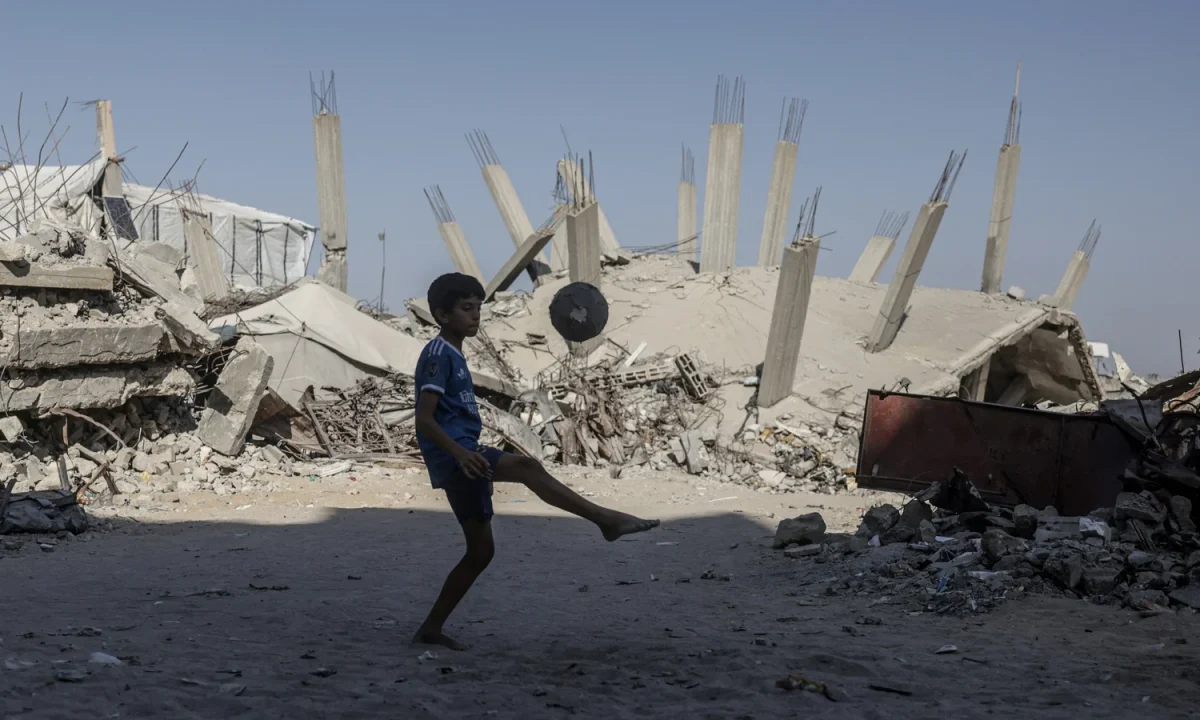
A child carries a cat through rubble after Israeli strikes on Gaza City
The contents of the plan also drew fierce examination. Its critics challenged the realism of almost every milestone leading toward its stated ambition of creating “a credible pathway to Palestinian self-determination and statehood”.
One major question centred on the pledge that Gaza would undergo a “process of demilitarisation”, with weapons placed “permanently beyond use”, even as Hamas officials repeatedly said the group would not lay down its arms.
So how should Mr Trump’s newest claim be understood – that Hamas has now accepted “COMPLETE DISARMAMENT”?
“This is a monumental step toward lasting PEACE and SECURITY,” he wrote overnight on Truth Social.
The familiar alarm bells are ringing again.
Ghazi Hamad, a senior Hamas figure involved in the negotiations, said the group was ready to accept the “difficult and painful” terms agreed in Cairo.
But he avoided the word “disarmament”, instead referring to a “comprehensive framework” that depends first on Israel meeting its own obligations under the original ceasefire deal.
Although several media organisations have cited Hamas officials discussing the arrangement, the group has not formally confirmed that it has accepted the disarmament plan announced by the Board of Peace.
In a statement this afternoon, Hamas did seem to indirectly recognise that some form of understanding had been reached, saying Israel’s commitment to halt its attacks was a “fundamental prerequisite for proceeding with implementing and establishing a timeline for what has been agreed upon”.
During the first phase of the October ceasefire, Israeli forces were supposed to pull back to an initial boundary known as the “Yellow Line”.
US President Donald Trump said Hamas had agreed to “complete disarmament”
Instead, satellite images and reporting from inside Gaza indicate Israeli troops have spent months moving that line further into the territory. By late April, Israel effectively controlled an estimated 64% of Gaza, while Mr Netanyahu has said the aim is to extend that figure to 70%.
Since the October ceasefire came into effect, Israeli strikes have killed at least 1,190 Palestinians, according to Gaza’s Hamas-run health ministry – more than four people a day on average in a war that was supposed to have ended.
Against that bleak backdrop, it is not difficult to understand why Hamas would insist that Israel meet its existing obligations before the process moves into another phase.
Even allowing for all the doubts about where this leads, the Board of Peace announcement cannot be dismissed as empty theatre.
For years, disarmament was a boundary Hamas would not even approach in negotiations. In October, it accepted a peace plan that named disarmament as an explicit objective.
Now, however reluctantly and however conditionally, it is taking part in a framework that confronts the issue head-on. That counts as movement, even if it remains delicate and reversible.
Still, if any side deserves deep suspicion at this stage, it is Israel.
The Board of Peace itself appears to understand that.
In a post on X today, it stressed that Israel “shall fully complete, without delay” every commitment it made in October, “particularly the cessation of military operations”.
Yet with an election three months away, there is little sign that Benjamin Netanyahu’s government is preparing to carry out its side of the agreement.
Today, it signalled that it would not move until Hamas had fully disarmed.
A senior Israeli official said: “There will be no IDF withdrawal from the current Yellow Line without the genuine disarmament of Hamas.”
That position reverses the order set out in the deal. Hamas has hardly behaved like a cooperative partner – its growing armed presence in Gaza cuts against the spirit of the agreement – but it did meet phase one’s core demand in January by returning the last of the deceased hostages.
Israel’s promises to halt its offensive and withdraw were not made conditional on disarmament; they were obligations already due under phase one.
After all the questions about whether Hamas would ever give up its weapons, and after all the doubts stirred by Donald Trump’s Board of Peace, the immediate test now falls on Israel: whether it will honour the commitments it has already made.
Read more: Israel must honour peace deal for Hamas disarmament – official