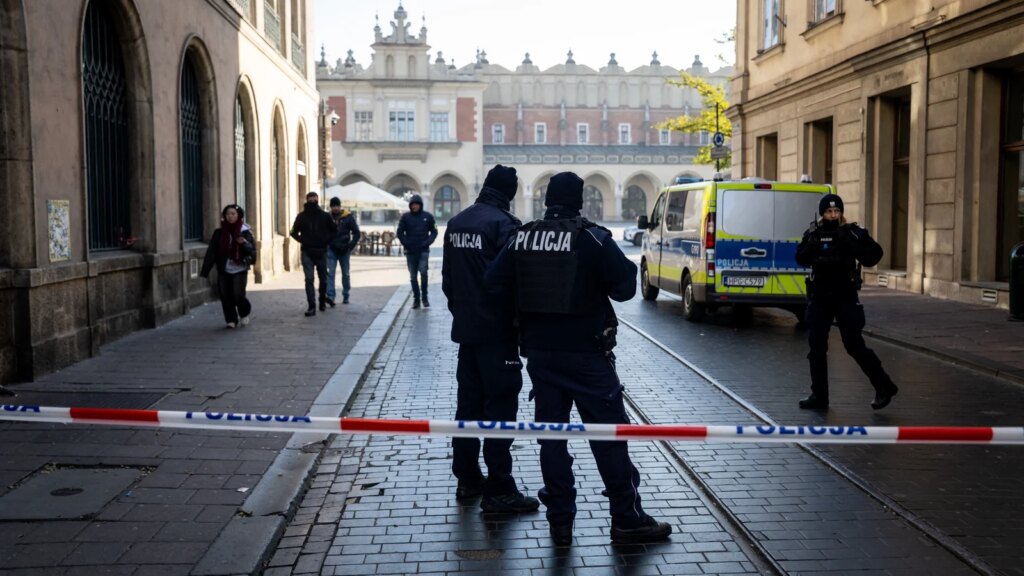
The 24-year-old man accused of killing six people in a weekend shooting spree in Krakow has died in hospital, Polish police said, two days after he was critically injured in a gun battle with officers.
“We inform you that the perpetrator of the tragic events died this morning in the hospital,” regional police wrote on X, referring to the Polish national who allegedly opened fire at random in central Krakow on Saturday.
Authorities said the suspect had been “fascinated by far-right ideologies”. Prime Minister Donald Tusk described the attack as an act of “terrorism”, making it Poland’s deadliest shooting since the end of communist rule in 1989.
Six people, including two foreign nationals, died in the rampage, while about 15 others were injured, according to officials.
The killings have plunged Poland into a week of political tension, deepening a sense of insecurity in a country already divided along fierce ideological lines.
Poland had largely been spared attacks of this kind, and its residents were unaccustomed to random street violence. That changed on Saturday, when the gunman opened fire in Krakow’s historic market square, in the centre of the country’s second-largest city.
People light candles for the victims close to the main market place in Krakow yesterday
Prosecutors opened an investigation yesterday into what they called an “act of terrorism”. Poland’s interior minister also said the suspect was drawn to “far-right ideologies”, remarks that have angered the conservative and nationalist opposition.
The attack comes as Poland enters a politically decisive week, with divisions in the country already running deep.
Tomorrow, the Constitutional Tribunal is scheduled to hold a high-stakes meeting at the centre of a continuing dispute between Donald Tusk’s government and its opponents over judicial appointments.
The right-wing opposition accuses the liberal, pro-European administration of threatening the constitutional order.
The governing coalition insists it is seeking to reverse “political” appointments to the court, along with reforms introduced by nationalists that it says fail to meet European democratic standards.
Nationalist demonstrators have spent weeks camped outside the tribunal, saying they are there to “defend it”. The standoff intensified suddenly late last month.
Riot police moved to prevent access to the building, while a judge appointed by the parliamentary majority announced that she would assume interim control – a move that effectively suspended the sitting head, who is aligned with the right and with Karol Nawrocki, Poland’s nationalist president.
Following the Krakow shooting, the nationalist Law and Justice party (PiS), which governed Poland from 2015 to 2023, cancelled protests planned for today and tomorrow. Demonstrations could nevertheless return later in the week.
Concern over Independence March on Wednesday
The greatest concern, however, is focused on Wednesday’s Independence March.
The annual procession can attract hundreds of thousands of right-wing supporters, including Catholic conservatives, white-supremacist fringe groups and antisemitic, pro-Russian far-right activists.
Mr Nawrocki has said he will attend.
Some observers have labelled the event “high-risk”, warning that marchers could leave the approved route and move towards the Constitutional Tribunal instead.
Yesterday, Mr Tusk rejected rumours that the march might be prohibited.
“No one intends to ban the Independence March,” he wrote on X. “Speculation on this matter is nothing but disinformation.”
He nevertheless appealed to participants to “refrain from aggression” and urged people not to join counter-demonstrations.
Given the depth of Poland’s political divisions and the growth of the far right, his appeals may struggle to carry weight.
“An extremely destructive polarisation which does not merely dismantle the state in an institutional sense but also divides society even more deeply on an emotional level,” leading writer Boguslaw Chrabota wrote yesterday in the weekly Rzeczpospolita.
The radicalisation of political language “gives rise to Polish Breiviks”, he argued, invoking both the Krakow shooting and Anders Breivik, who murdered 77 people in Norway in 2011.
Ewa Marciniak, a political scientist at Warsaw University, warned that the Krakow tragedy could quickly become a tool in the political struggle.
“Tragedies like the one in Krakow only serve to sharpen political divisions,” she said.
“After a period of shared mourning comes the search for those responsible, all taking place in a political climate defined by deep-seated, mutual hostility among political leaders.”
With parliamentary elections due in autumn 2027, she said events including the Krakow killings and the continuing Constitutional Tribunal dispute were likely to be used “to deepen conflicts” and “draw the public into them”.