
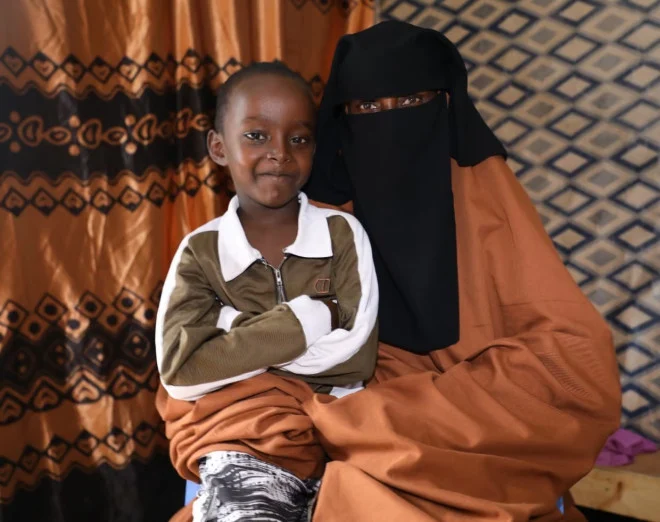
For nearly a year, Marian Haji Abdi Guled feared her son might never walk again. Then, as she rode with him to a Mogadishu hospital, relief and anxiety arrived together: Abdiqadir Salah was finally going into surgery.
Almost a year earlier, Abdiqadir, then seven, had been badly wounded with two siblings in what a Guardian investigation identified as a US drone strike on Jamaame, Somalia. At least 12 civilians, including eight children, were killed in the attack.
- Advertisement -
Abdiqadir’s small body was pierced by shrapnel, with several fragments left lodged in his back.
Doctors warned that failing to remove the metal could cost the boy his ability to walk. But Guled could not pay for the operation. For 10 months, the family remained in Mogadishu as costs mounted and income disappeared, unable to afford treatment yet unwilling to send Abdiqadir back to the village without it.
The Guardian’s investigation detailed the experiences of Guled and other civilians affected by the strike. In response, readers from around the world organised a fundraiser to pay for Abdiqadir’s surgery and recovery.
Within hours, donations had reached enough to cover the operation, rehabilitation and other medical costs, including treatment for Guled’s two other children, whose injuries were less severe.
“I was so happy when I found out that Guardian readers raised the money needed for my son’s surgery. I didn’t know people like this existed,” Guled said.
“The people who contributed to the surgery – I really appreciate their support and how they stood by our family when we needed it the most.”
On a Saturday morning in September, Guled waited nervously as Abdiqadir was taken into Kaafi hospital in Mogadishu for the long-delayed operation.
“Other patients were taken into surgery after him and came out before him – so I worried maybe something went wrong,” she said. “I got to a point where I knocked on the operating room door asking if my son was still alive, then was held back by other patients.”
Eventually, Abdiqadir was brought out. Doctors said the complicated procedure had succeeded. They removed the first two missile fragments, but judged that extracting the last would be too dangerous and could cause paralysis. The medical team decided it was safer to leave it in place and monitor him.
When the Guardian saw Abdiqadir several weeks later, the boy looked energetic, cheerful and alert. “I have one piece of metal still in me, and if they touch it, I might become paralysed,” the seven-year-old said. “[But] I don’t have any problem with the last piece of metal in my body, because I’m no longer in pain.”
The Guardian investigation into the US airstrikes that wounded Abduqadir also raised broad questions about American military intelligence, including how targets were chosen and why children were struck while plainly visible in the open. The US has not answered questions about the Jamaame attack.
US strikes in the area have continued in the months since. New America, a security thinktank that tracks US military operations overseas, says the US carried out at least three airstrikes around Jamaame between December 2025 and July 2026. Residents say drones still pass overhead.
“We cannot return to Jamaame because what caused my children to be hurt is still there,” Guled said. “I fled Jamaame with my wounded children because of the drones, and the drones are still [flying].”
Using the financial assistance left from the Guardian readers’ donations, Guled plans to move with her children to Kismayo, a government-controlled port city that has not been targeted by drone strikes. The relocation would also allow Abdiqadir to undergo further surgery if doctors decide it is necessary.
Nearly a year after the bombing, Guled continues to seek answers from the US government. “My son has been left scarred for life,” she said.
“I want the US government be held accountable for what they did to my family and for the US to stop bombing our community.”