Switzerland’s glaciers are vanishing at an accelerating pace, shedding nearly one-fifth of their mass in just five years as climate change tightens its grip on the Alps. Experts say 2026 brought the second-worst annual melt on record.
The country’s glaciers lost 5.5% of their total volume this year, according to a new study by the Glacier Monitoring in Switzerland (GLAMOS) network. The findings followed a record-hot summer that came after a winter marked by unusually sparse snowfall.
- Advertisement -
“The glaciers this year have lost enormous quantities of ice,” said Matthias Huss, GLAMOS’s chief, calling 2026 “a catastrophic year”.
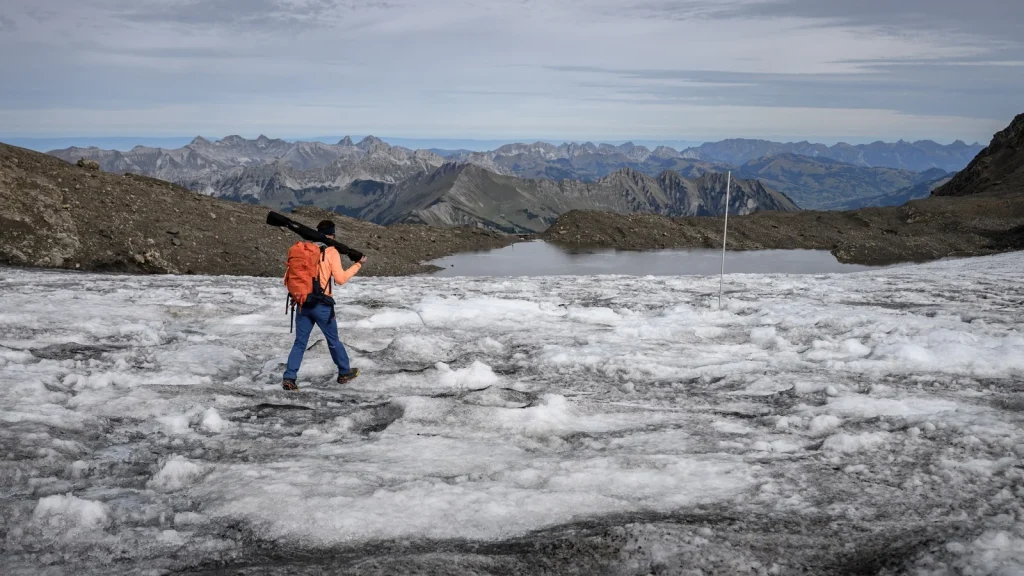
From the Scex Rouge glacier, nearly 3,000 metres above sea level, Huss surveyed the altered landscape with visible dismay.
Matthias Huss walking towards a measuring stake during a visit to record changes in the melting Scex Rouge glacier
“There will be probably no ice in 10 or maybe 15 years.”
He then began removing a four-metre aluminium measuring stake that had been driven into the glacier’s centre.
When researchers installed it in late July, the stake was buried completely. Now, more than three metres rise above the glacier’s dull, grey surface.
“It’s not that we are surprised, because we know how fast the glaciers are melting,” Mr Huss said.
“But to see the colours of the mountains where there is no snow left, there is just these rocks and these dark glaciers that are a relic from the past… it’s just incredible.”
GLAMOS said the rate of ice loss between 2022 and 2026 was “more than twice as high as in any previously monitored five-year period”. Since 2021, Switzerland has lost almost 20% of its glacier volume, the report said.
Although the country’s glaciers have been retreating for decades, the pace of that decline has accelerated sharply in recent years.
Swiss glaciers lost 10% of their volume between 1990 and 2000. Over the past decade alone, the loss reached 27%, according to the report.
GLAMOS compiled the results from detailed September measurements at 23 reference glaciers before extrapolating them across the nearly 1,300 glacial formations that remain in Switzerland.
The Weisshorn’s east side glacier where local authorities have increased the alert level following multiple ice break-offs
‘No chance of surviving’
The report followed a summer in which June, July and August each became the hottest such months recorded in Switzerland since nationwide measurements began in 1864, the Swiss Federal Office of Meteorology and Climatology said.
Heatwaves in June had already stripped away part of the snow layer protecting the glaciers. By September, that cover had disappeared entirely, even at the highest elevations, GLAMOS said.
“Alpine glaciers have no chance of surviving in the long term under such conditions,” the monitoring network said in a statement.
The scale of this year’s melting forced researchers to move measurement stakes higher up the mountains, including on glaciers at the greatest elevations, after the ice beneath their original positions disappeared.
Some glaciers lost an average of 2.5 to 4.0 metres in ice thickness, while the most exposed tongues thinned by as much as 10 metres over the summer.
Rhone and Aletsch Glaciers
Despite the higher temperatures, this year’s ice loss remained below the record set in 2022. Many glaciers had accumulated more snow before the summer melt than they had four years earlier, providing some temporary protection.
Less Sahara dust also reached the glaciers this year. That helped the snow reflect more sunlight back into the atmosphere instead of absorbing the energy and warming further.
Some glaciers nevertheless bucked that broader pattern.
Four major glaciers recorded their greatest melt on record, among them the iconic Rhone Glacier and the Aletsch, the largest glacier in the Alps.
The retreat is also intensifying concern about how much water the glaciers will be able to supply in the future.
From July through September, Switzerland’s glaciers released roughly 2.2 trillion litres of water as ice disappeared.
Mr Huss said the figure was “difficult to imagine”.
“It’s more than four times the annual freshwater consumption of Swiss households,” he said.