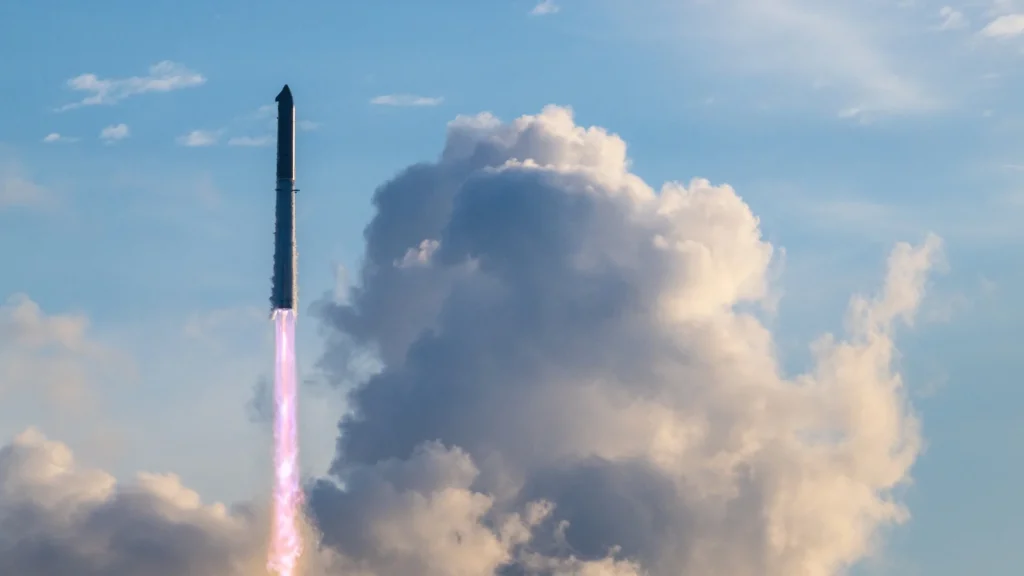
SpaceX’s SPCX.O Starship reached orbit for the first time today, overcoming an engine failure during flight to release its first group of next-generation Starlink satellites. The breakthrough came at a cost: the mission was cut short by several hours after one of the vehicle’s engines unexpectedly shut down.
Analysts said the successful deployment could ultimately bring Elon Musk’s company hundreds of millions of dollars in additional revenue.
- Advertisement -
The uncrewed, 40-story rocket lifted off from SpaceX’s Starbase facility on the Gulf Coast near Brownsville. The vehicle paired a Super Heavy booster with the Starship upper stage, producing a thunderous launch as it climbed away from the pad.
The flight had been planned to last 10 hours, but the engine problem forced SpaceX to reduce the mission to roughly three hours.
Starship blasts off on its first orbital flight
SpaceX shares, which had risen nearly 9% from the already substantial IPO price, were down about 1% today.
After propelling Starship into space, the Super Heavy booster headed back toward the Gulf, completing an engine-guided splashdown after two earlier missions ended in hard booster landings.
SpaceX said several engines on the booster stopped functioning during its descent.
‘Hourly flights’ in next few years – Musk
Starship encountered its most serious problem after reaching space, when one of its three main engines shut down ahead of schedule. During the company’s live mission broadcast, SpaceX spokesperson Dan Huot initially said the failure meant the vehicle would not be able to reach orbit.
“The team has made the call not to commit to orbit,” Mr Huot said.
That assessment changed within minutes. Engineers determined that Starship could still attempt the engine burn needed to raise its trajectory, and the spacecraft successfully completed the maneuver shortly afterward.
Once in orbit, Starship released 26 next-generation Starlink satellites individually at an altitude of about 269 km.
“All 26 Starlink V3 operational satellites deployed and operating nominally,” Elon Musk wrote on X.
All 26 Starlink V3 operational satellites deployed and operating nominally
— Elon Musk (@elonmusk) September 28, 2026
Starship was developed to accelerate the deployment of SpaceX’s Starlink network and eventually carry NASA missions to the moon.
Achieving orbit marked a crucial milestone for the rocket, whose development has been repeatedly delayed. Musk had previously forecast an orbital flight in 2022, followed by satellite launches in 2023.
Since 2023, all 13 of Starship’s earlier test flights had remained in suborbital space. The program has been under development for nearly a decade and has cost SpaceX more than $15 billion so far.
Mr Musk has said he ultimately wants Starship to fly hundreds or even thousands of times each year, a cadence without precedent in the space industry.
“Starship is 2 to 3 years away from hourly flights,” he wrote on X on Sunday.
Analysts estimate today’s launch could help generate hundreds of millions of dollars of extra revenue for Space X
Starship was originally scheduled to make six orbits of Earth during today’s flight, but the mission was shortened after the engine failure.
The malfunction also raised the stakes for the spacecraft’s deorbit maneuver. To return safely, Starship needed to fire one Raptor engine in space and precisely adjust its angle for atmospheric re-entry.
The ship is equipped with three main Raptor engines.
During the final phase of the descent, the spacecraft is designed to use its thrusters to rotate into a vertical position before striking the sea nose-up.
Future flights are expected to attempt a similar landing on solid ground in Texas. For this mission, however, SpaceX did not plan to recover the spacecraft, despite Mr Musk’s earlier hopes.
Test mission with real payload
Today’s launch was Starship’s 14th test flight.
Unlike the previous missions, it carried an operational payload: a cluster of new Starlink internet satellites that became Starship’s first orbital cargo.
Analysts estimate that deploying SpaceX’s V3 Starlink satellites could generate hundreds of millions of dollars in projected revenue for the company’s Starlink division by expanding network capacity. The forecast highlights how closely Starship’s future is tied to the business at the heart of SpaceX’s profits.
SpaceX says the V3 satellites launched Monday can process 10 times as much data as the earlier V2 mini-satellites. The company has been sending those smaller satellites into orbit in groups of 20 or 30 aboard its established Falcon 9 rockets.
As he seeks to expand the broadband constellation more rapidly, Elon Musk plans to launch V3 satellites in groups of 60 once Starship enters regular service.
Starship’s planned orbital debut came three months after SpaceX went public in a record-setting June IPO. The offering made the company the sixth-most valuable in the United States and turned Musk, who founded SpaceX in 2002, into the world’s first trillionaire.
Much of SpaceX’s market value and investors’ confidence in the company — valued at $2 trillion at Friday’s close — depends on Starship’s progress. The rocket was designed as the world’s first fully reusable spacecraft.
Starship is also central to NASA’s Artemis program, which seeks to return astronauts to the lunar surface for the first time since 1972 and establish a sustained presence there as a foundation for eventual human missions to Mars.