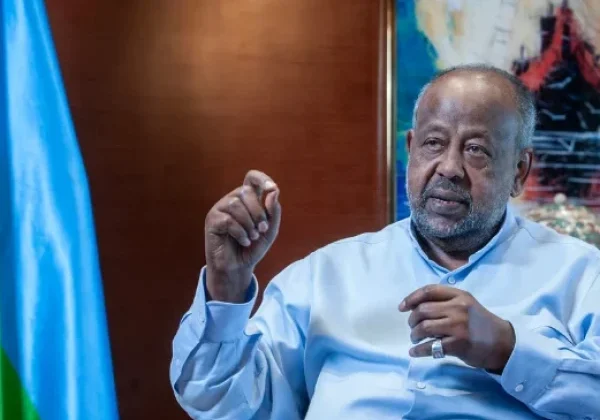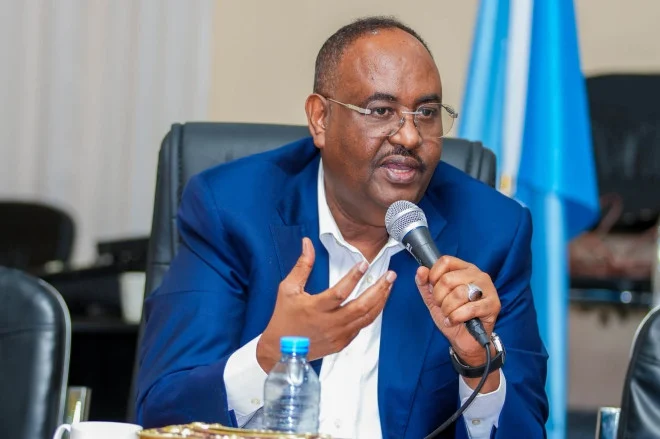
For much of his presidency, Puntland State appeared to serve less as President Said Abdullahi Deni’s destination than as his launchpad. Mogadishu dominated his political imagination and remained the yardstick by which he measured success. Garowe provided the office, security apparatus, public finances, political platform, and parliamentary leverage he needed to pursue national power. Yet he often governed as though Puntland State were only a temporary base for a future bid for Villa Somalia.
Puntland State was not treated as the mission. It was treated as the machinery.
- Advertisement -
That helps explain why the first half of Deni’s presidency was marked by intense political activity but limited institutional depth. The cabinet operated less as a forum for collective decision-making than as an extension of the presidency. Ministers were expected to implement orders, not debate them. Independent thinking carried political risk. Coordination rested too heavily with the president’s inner circle, while experienced officials and influential political figures were kept away from meaningful decision-making.
That is not a cabinet. It is a chain of command.
The Puntland State parliament, too, has frequently been handled as a problem to contain rather than a constitutional institution to honor. Legislatures are meant to examine budgets, summon ministers, investigate failures, and require the executive to account for its decisions. But an administration that interprets oversight as hostility will inevitably favor compliant lawmakers over independent representatives. It will pursue agreement instead of accountability.
That is not stability. It is institutional suffocation.
The same centralized approach has shaped Puntland State’s regional governance. Mudug, Bari, Nugaal, Karkaar, Sanaag, Haylaan, and the other regions cannot be managed indefinitely through directives from Garowe. Local administrations need clear mandates, administrative resources, predictable funding, and sufficient political room to address the needs of their communities. Instead, the presidency has repeatedly placed central control ahead of lasting local authority.
A state cannot be built from the capital alone.
The federal presidential election brought the limits of this model into sharp focus. When Deni pursued Somalia’s presidency, he anticipated the support of federal parliamentarians linked to Puntland State. He also expected allies in other parts of the country to return his backing with loyalty. At the decisive moment, however, they did not.
The result was not merely defeat. It was exposure.
Deni had built relationships with politicians, but not political conviction. He had assembled a network based on exchanges rather than a constituency committed to a common national project. Once the calculations shifted, the alliances shifted as well.
This is the lesson he was forced to confront: loyalty secured through patronage is temporary by design.
Since then, Deni has changed—at least outwardly, and perhaps in some respects by conviction as well. He has traveled more extensively, met traditional elders in Mudug and Bari, and adopted a more measured public style. His administration has also placed greater emphasis on the Puntland State Defence Forces, an institution that merits sustained funding, professional leadership, firm civilian oversight, and dependable support for its personnel.
These are positive signs. But they are not enough.
The Puntland State Defence Forces must not become another vehicle for presidential politics. A credible security sector requires professional recruitment, accountable command, regular salaries, sound logistics, parliamentary oversight, and a firm distinction between state security and factional allegiance. Security institutions that serve a president instead of the law may preserve political power temporarily, but they will not safeguard the state.
Puntland State’s public finances demand the same level of seriousness. Citizens are entitled to know how revenue is collected, how contracts are issued, how budgets are spent, and whether public money is advancing public priorities. The administration cannot ask for public confidence while treating budget transparency as something it can provide only when convenient. A government that collects revenue must account for it.
Puntland State needs more than road tours, speeches, and carefully staged public meetings. It needs functioning schools, reliable health services, effective local councils, water infrastructure, employment opportunities for young people, and an economic plan capable of turning its coastline, livestock, fisheries, trade routes, and potential natural resources into broad public prosperity rather than elite benefit.
Regional visits matter only when they produce institutions that continue working after the motorcade has departed.
Deni’s more fundamental weakness appears to be a preference for loyalty over competence. Experienced civil servants, respected elders, capable politicians, and independent policy specialists make presidential power more demanding because they ask difficult questions. They challenge assumptions, insist on procedure, and remember earlier failures. They do not applaud on command.
That is why they are indispensable.
Instead, the administration has too often promoted inexperienced aides and political intermediaries whose principal qualification is personal allegiance. Energy has value, and youth is an asset. Neither, however, replaces judgment, expertise, or institutional memory. Puntland State cannot be governed through an echo chamber populated by people whose careers depend on never telling the president “no.”
This is not strength. It is fear disguised as control.
Deni’s political background may help explain that instinct. His ties to the Islah current and his earlier service in Hassan Sheikh Mohamud’s first administration placed him in political settings where hierarchy, discipline, and internal loyalty were highly valued. But no political tradition can excuse the erosion of public institutions. No movement culture makes criticism equivalent to sabotage.
Puntland State has outgrown the politics of personal command.
Its future requires a stronger parliament, a credible cabinet, empowered regional administrations, a professional security sector, transparent public finances, and a civil service committed to the public rather than the president’s inner circle. These are not merely reform slogans. They distinguish a functioning state from a personal administration.
Deni now has an opportunity few leaders are given: failure has compelled him to reconsider his purpose. He can convert that experience into maturity by appointing serious officials, accepting criticism, opening government, strengthening institutions, and leaving Puntland State more capable than he found it.
Or he can continue governing through personal networks, political suspicion, centralized authority, and a narrow circle of loyal dependents.
The first path would define a legacy.
The second would reinforce the harshest judgment of his presidency: that Puntland State was never a homeland to govern, but merely a platform to use.
Puntland State is not a road to Mogadishu. It is not a consolation prize after Mogadishu. And it is not the private kingdom of any president.
_________________________________________
Ismail H. Warsame served as founding Chief of Staff and Director General at the Puntland State State of Somalia Presidency from 1998 to 2004. He later worked as a UN-World Bank Joint Secretariat Zonal Technical Coordinator for Puntland State and as Somalia’s National Aid Technical Coordinator in cooperation with the European Union.