
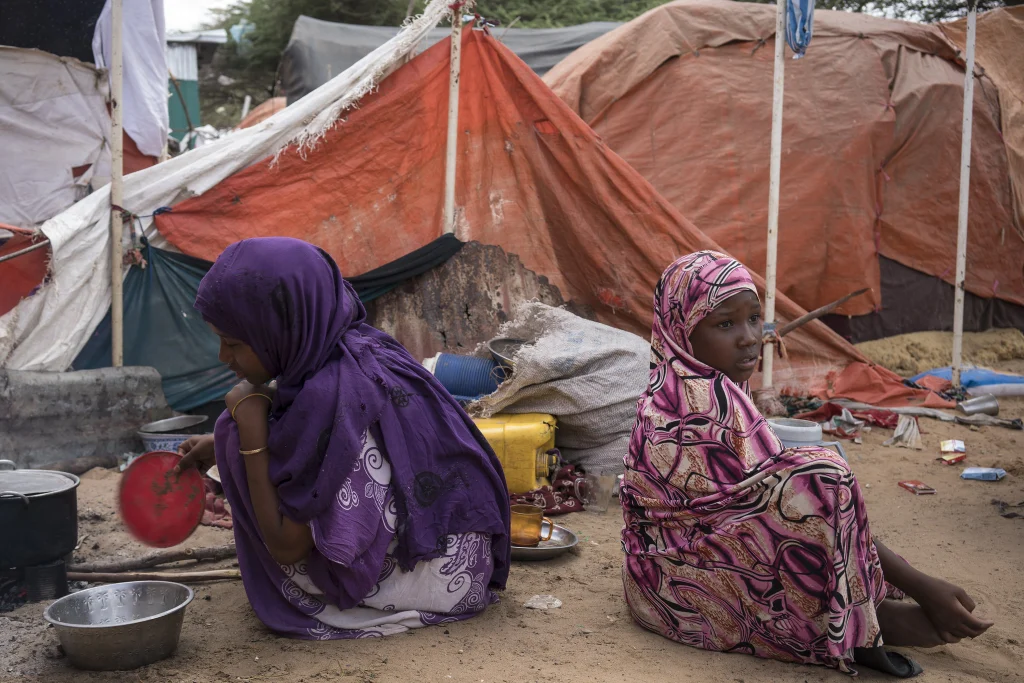
MOGADISHU, Somalia (AXADLE) — By the time Hussein Abdullahi Hussein reached Wanlaweyn with his family of nine, the farm that had sustained them was gone. The 47-year-old depended entirely on five hectares in Dudumaaye, but in November 2025 an armed clan faction set the land ablaze, destroying a crop that was supposed to be harvested the next month, he told Radio Ergo. He had borrowed $1,500 to cultivate it. Now the lenders are still demanding repayment, while Hussein’s family sleeps in the open without shelter or clean water and survives on food shared by townspeople. Local officials recorded 1,500 displaced families from that single wave — a number they say exceeds their capacity to support.
That episode marked another rupture in a Lower Shabelle displacement crisis that has deepened over ten years, with little evidence that families are moving back in meaningful numbers.
- Advertisement -
Aadan Rooble has lived through the same pattern. After airstrikes made his family’s farm in Farxaano village impossible to remain on, he spent ten days reaching Mogadishu, walking part of the way.
Today, his sons pick up casual jobs when they find them. Rooble does not believe a return home is realistic.
He is among tens of thousands of farmers and farmworkers who have left Somalia’s Lower Shabelle region over the past decade and ended up in Mogadishu’s displacement settlements, from places including Afgoye, Shalanbood, Buulo Mareer, Qoryooley, Janaale, Awdheegle, and Wanlaweyn. In many cases, the front lines that first forced them out have shifted. Yet only a tiny number have returned — and the explanation is more complicated than the usual assumption that people are simply waiting for aid.
This reporter was raised in Shalanbood, where he completed primary school before moving to Marka for secondary school, graduating in 2006 and leaving Somalia the same year. He returned in 2014 and has spent the past decade based in Mogadishu, while maintaining close contact with relatives and community members still in Shalanbood — tracking, through them, the steady erosion of agricultural life that this investigation now examines more broadly.
Three pressures, one farming heartland
Conflict remains the most visible cause. The prolonged war between the government and Al-Shabaab has repeatedly reshaped control of towns such as Buulo Mareer, including during a 2023 Al-Shabaab assault on an African Union base there. In some areas of Lower Shabelle, the war has not passed at all. By late 2025, as African Union forces pulled back, Al-Shabaab had retaken roughly five districts across Lower Shabelle and Middle Jubba. As of mid-2026, Kurtunwaarey and Sablaale in Lower Shabelle remain under the group’s control, according to the European Union Agency for Asylum’s security assessment. For families displaced from those districts, going back is not merely unaffordable or risky. For now, there is no viable home to return to.
Land is the older fault line. Since 1991, when militias from outside the region seized farmland belonging to local agricultural communities, Lower Shabelle’s land question has remained unsettled. Around Wanlaweyn, clan fighting over land, including clashes involving the Rahanweyn and Gaaljecel, has been documented for well over a decade, rising, subsiding, and erupting again.
Climate is the quieter force, but no less destructive. Drought and river floods have destroyed whole planting seasons even where there is no immediate fighting. In Shalanbood, farmers displaced in late 2025 by a combination of conflict and failed rains are living on exposed ground, while sand blown inland from the coast covers what remains of arable land.
In practice, the three pressures often overlap. A farm may survive a dry season and then be lost to violence two years later. One farmer in Shalanbood told this publication that the town’s main irrigation canal, once linked to Janaale, has not been dredged for so long that most residents can no longer cultivate. In Janaale, a 60-year-old farmer described paying two authorities in one day: a religious tax to Al-Shabaab, which controls the farmland during daylight, and a government tax at night when he returns home.
Most camp residents were never landowners
It is tempting to imagine Mogadishu’s camps as places filled mainly with landowners waiting to reclaim farms. The reality is different. Most displaced people from farming areas worked land owned by others, earning wages rather than holding titles.
A UN OCHA report on Somalia’s displaced population found that most IDPs make a living as porters, domestic workers, and day laborers. A World Bank and UNHCR study found that host communities, rather than displaced families, are more likely to own farmland. The divide is historical. Lower Shabelle’s agricultural workforce has long included Bantu and Jareer communities who, according to the European Union Agency for Asylum, lost farms under Somalia’s land-reform laws of the 1970s and then saw what remained seized or looted by clan militias after the state collapsed in 1991.
That difference is central to understanding the crisis. It creates two separate barriers to return.
For those who owned farms, returning is too expensive
Field reporting in Afgoye and Shalanbood found that farm labor — clearing, weeding, and harvesting — is commonly priced by the jibaal, a plot measuring 25 by 25 metres, or about 625 square metres (roughly 6,730 square feet).
A laborer earns $7 to $10 per jibaal and can clear one or two plots a day, placing daily wages at about $7 to $20. But reviving farmland left idle for years requires far more than a few days of work. Replanting, fixing irrigation, and paying workers before any crop is harvested can cost thousands of dollars.
Omar Mohamud Ali cultivated land near Wanlaweyn for fifteen years before three consecutive failed harvests left him owing $500 for seeds and equipment, he told Radio Ergo. He has been in a Mogadishu camp for three years, still wanting to return, but still unable to repay the debt.
No aid program identified during this reporting appears designed to meet costs on that scale. Cash assistance over the past decade — from $93 a month in a 2017 European Commission-funded program to more recent transfers of $85–180 a month — has been meant to cover food and basic household needs, not to finance the restart of a farm.
For laborers, the work has disappeared
For the larger number of displaced people who depended on wages from someone else’s farm, the obstacle is not whether the daily rate is attractive. If the landowner has not returned, there is no employer and no job.
That point cuts against a common claim: that displaced families remain in camps because aid is easier than work. Somalia’s own labor data points in another direction. A recent study by Somalia’s Institute of Economic Affairs found that poor and non-poor people work at nearly the same rates, and linked low incomes to the shortage of available jobs rather than a refusal to work.
A 2024 survey of IDPs in Galmudug by the Joint IDP Profiling Service found that 55 percent depend on daily labor as their main source of income, compared with 16 percent who rely on aid. In Mogadishu’s camps, that work often means washing clothes, construction labor, collecting firewood, or petty trade — jobs that are frequently scarcer and less remunerative than the agricultural work they replaced.
What aid can and cannot do
Cash support matters, but its effect is more limited than it may appear from outside.
For a small minority, assistance becomes a form of start-up capital and changes long-term plans. In Baidoa’s Barodi camp, one woman used $180-a-month cash aid to open a shop and later a butchery, telling Radio Ergo that she now intends to build a life away from the camps rather than return to her village.
For most families, however, aid is a safety net, not a way of life. When World Vision ended cash support for nearly 500 families in two Baidoa camps in 2025, people did not simply leave for home. They lost their only predictable income, because no functioning farm awaited them there.
Farmers who never left face the opposite side of the same problem. In Buulo Mareer, a local farmers’ union leader told Al Jazeera that the area’s strongest farming years came when Al-Shabaab barred NGOs from working there, because imported food aid had been driving down prices for local producers. The mechanism was different, but the result was similar: aid can end up competing with farming instead of helping rebuild it, affecting both displaced families and those still on the land.
Some are choosing to build elsewhere
Not every displaced family is waiting for conditions to change. In Garasbaley, on the outskirts of Mogadishu, 103 displaced families — many from Lower Shabelle’s farming towns — formed a rotating savings group in 2025, Radio Ergo reported. Each family contributed $4.50 a month with the explicit aim of buying land permanently, rather than continuing to rent or hoping that their home areas would become safe and viable again.
After Radio Ergo reported on the initiative, a local businessman donated more than $29,000 to help secure land for the families still waiting. The case is not one of dependency. It shows displaced farming families using the few instruments available to them to create something durable, because genuine return has not been made possible.
A decade later
When displaced farmers and farmworkers are asked what they need, the answer is seldom simply more cash. What they describe is the chance to farm again without facing costs far beyond anything they can raise.
Land disputes remain unresolved. Irrigation systems have deteriorated beyond quick repair. Farmers who stayed behind pay taxes to two rival authorities in a single day. And while a decade of aid has helped keep people alive, it was never structured to cover the true price of returning to agricultural life.
Aadan Rooble and families in the same position are not choosing camps over home. They are trapped between the cost of going back and the limited help available to make that return possible.
ABOUT THE AUTHOR
Ismail Abukar is Co-founder and Chairperson of the Organization for Prisoners’ Rights (OPR). He has carried out primary field research in Somalia for seven years, documenting prisoners’ rights, enforced disappearances, press freedom, and electoral corruption. His investigations have appeared in African Arguments and Axadle, including “The Disappeared” (June 2026), “The Journalists Who Disappeared” (August 2026), and “A Government With One Foot Out the Door: Somalia’s Foreign Passport Crisis” (August 2026). He holds an MA in International Law and Human Rights from the University for Peace (UPEACE) and maintains an active ORCID record: 0009-0003-1435-3691.