
UK Prime Minister Andy Burnham is facing growing calls to commit Labour to rejoining the European Union after saying he would examine every option for building a closer relationship with the bloc.
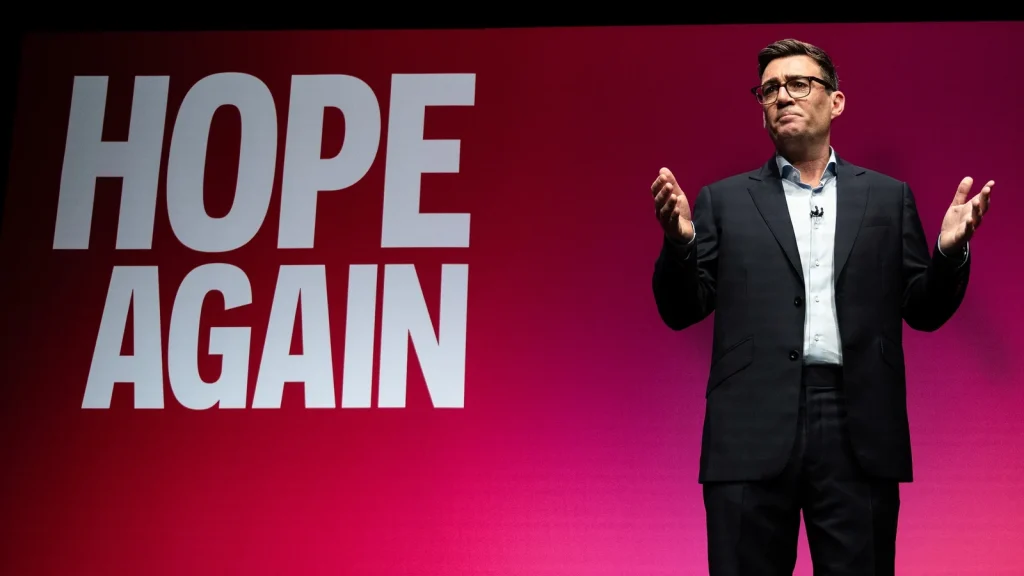
Addressing Labour’s conference today, Mr Burnham said Brexit had caused “more harm than good” and argued that Britain must confront the question of its “long-term relationship” with the EU.
- Advertisement -
He said he would use the UK-EU summit expected later this year to outline the “different options” available and seek political agreement on the country’s future direction.
Labour MP Stella Creasy responded by saying “everything must be on the table”, including the removal of the “red lines” in the party’s 2024 manifesto that rule out rejoining the EU’s single market or customs union.
“We stand with this Prime Minister in making the changes that truly live up to the challenges of 2026, not 2016.”
In his speech in Liverpool, Mr Burnham said Britain had “lost some control” over both the economy and immigration since leaving the EU.
He said: “We will not give Britain the clear path we need into the rest of the century until we decide on a long-term relationship with what is still our largest market.
“I cannot say to you that where we are is good enough. Brexit has done more harm than good.”
A UK-EU summit planned for July was postponed following the resignation of Keir Starmer, and no replacement date has yet been announced.
In a further criticism of Brexit, Mr Bunrnham said: “Brexit hasn’t given us control. We’ve lost some of the control we had over our economy, as a decade of low growth has put us in a weaker position. And we’ve lost some of our control over immigration.
“At its most fundamental level, this is a debate about fairness. So I understand the anger about what is happening in the Channel.
“Shabana (Mahmood) has done a great job in beginning to restore our grip over the system.”
He added: “We make these changes while always grateful to those who have come here and are contributing to our country.
“But control over immigration was weakened when we lost collaboration with our European partners and we are still having to work hard to bring it back.”
Cabinet minister Heidi Alexander said “no-one wants to go back to the toxicity and divisions” that marked the Brexit debate, while warning that the issue could not be avoided in discussions about Britain’s future.
Speaking at a Politico fringe event in Liverpool, the Transport Secretary said: “I think he’s right to say we need to set out the options.
“But he was also pretty clear at saying we need to develop some consensus around this.
“No-one wants to go back to the toxicity and the divisions of previous Brexit debates.
“The world is changing. Europe’s changing. You saw those conversations that Canada and Mark Carney were having.
“And so, look, let’s take our time on this. We need to respect the red lines that were set out in the manifesto. And I think it is really important for trust in politics that we don’t breach the trust of the British people.
“But you can’t have a conversation about the future of this country and not address this question.”
(L-R) Ed Miliband, UK foreign secretary, Shabana Mahmood, UK home secretary, and Angela Rayner, UK housing secretary listening to Andy Burnham’s speech
Naomi Smith, chief executive of Best for Britain, said Mr Burnham should go further by pledging to rejoin the EU.
She said: “Our best-in-class, seat-level polling resoundingly demonstrates half-measures on Europe won’t deliver a Labour-led government at the next general election, or protect us from the waking nightmare of prime minister Nigel Farage.
“We said it needed to be a deafening alarm bell to every slumbering Labour MP and snoozing No 10 strategist. Burnham’s speech today proves he’s wide awake – and alive to the dangers.
“It’s vital the Labour government seizes this moment, not in 2029 or a year, or six months’ time.
“With the public behind him, progressives imploring them, and the economic case etched in stone, we should signal to the EU – today – that the UK is ready to apply for membership, to take us back to where we belong at the heart of Europe.”
Conservative deputy leader Alex Burghart said: “Andy Burnham came to office with no plan to tackle the challenges facing our country. So instead, he is trying to reopen old wounds by restarting the battles of the Brexit years.
“Labour cannot pin the blame for their disastrous economic decisions on a vote that happened over a decade ago. Besides, they are already dragging us into the European Union via the back door with their EU reset.”
Burnham vows electoral reform, reversal of privatisation, free social care
Mr Burnham also promised to expand public control over essential services, pledging to reverse decades of privatisation and set Britain on a different course.
The 56-year-old former mayor of Manchester, who has been in office for only 10 weeks, fought back tears as he spoke about his late father and outlined long-term plans for free social care, changes to the UK’s electoral system and a controversial overhaul of pensions.
“I accept people will not agree with every part of it, but I believe it can turn Britain around,” Mr Burnham said.
He paused during the address, swallowing tears before discussing his father, who died earlier this month after suffering from Alzheimer’s.
“I’m going to use this job to build the kind of Britain my dad wanted to see and fight with everything I’ve got to keep it together.”
Mr Burnham then delivered an impassioned defence of plans to provide free social care in England for people who need assistance while living with illness or disabilities.
“I accept I may pay a political price. But someone has to go through the pain barrier and rip the plaster off,” he said, acknowledging the challenge of introducing such a system.
He told Labour MPs and activists that stronger public control of housing, energy and water, alongside greater powers for local leaders, could help revive Britain’s struggling economy.
“I will make a break with the direction of the past 40 years and put Britain on a new path, build a new economy and a new politics,” said Mr Burnham, the UK’s seventh prime minister in a decade.
He said his government would soon bring forward a bill repealing Margaret Thatcher’s “ideological ban on public ownership of water companies”, introduced during her time as prime minister from 1979 to 1990.
He also pledged to create a “National Care Service” that would be “free at the point of use”, although the scheme would not begin until after the next general election, expected in 2029.
To fund his proposals, Mr Burnham said he would campaign at the next election on changing the way pensions increase — a move quickly condemned by right-wing parties as an attack on older people.
“By potentially scrapping the triple lock, Andy Burnham will abdicate his responsibility to British pensioners,” said Nigel Farage, leader of the anti-immigration Reform UK party.
Since becoming prime minister on 20 July, Mr Burnham has adopted a more optimistic tone and worked to reinforce his approachable public image.
Labour’s conference slogan is ‘Hope Again’, and delegates appear more upbeat than during the previous two years, when several policy U-turns prompted internal recriminations.
However, a new YouGov poll published Tuesday showed Labour had fallen behind rival Reform, which recorded 25% of voting intentions compared with Labour’s 24%.
Mr Burnham also unveiled sweeping electoral reforms that could eventually open the way to proportional representation.
Labour will contest the next election on a pledge to replace the existing first-past-the-post system so that “everyone’s vote counts and everyone’s voice is heard”, he said.
He told the party’s annual conference that a new national commission would examine possible reforms, with all political parties invited to take part in its work.