Japan has warned that close security coordination with the United States and South Korea remains “critical” to regional stability, after US President Donald Trump announced a reduction in military exercises with Seoul and praised his relationship with North Korean leader Kim Jong-un.
Mr Trump said on Sunday that he had instructed the Pentagon to scale back what he described as “inappropriate and hostile” drills involving US and South Korean forces.
- Advertisement -
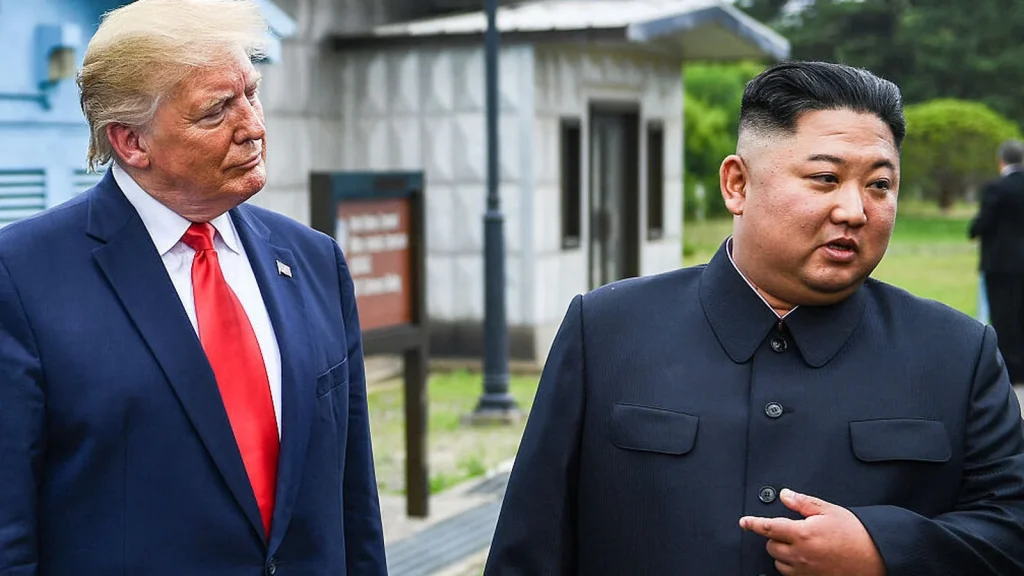
A day later, he argued that his personal ties with Mr Kim were making the situation “much safer”. The two men met three times during Mr Trump’s first term, but have not met since he returned to the White House.
While celebrating his rapport with the leader of nuclear-armed North Korea, Mr Trump criticised the US ally South Korea for not assisting Washington in its campaign against Iran — a conflict he said was intended to prevent Tehran from developing an atomic bomb.
Asked about the status of discussions with Mr Kim, the US president replied that “it’s very positive” but offered no additional information.
He went on to emphasise the strength of their relationship, claiming it had helped ease tensions between the two countries.
“Kim Jong-un has always treated me with great respect,” Mr Trump said.
“I understand him. He understands me.”
South Korean protesters hold placards as they attend a rally opposing the joint military exercise between South Korea and the US known as Ulchi Freedom Shield (UFS)
‘Critical’ cooperation
The 11-day Ulchi Freedom Shield exercises are intended to prepare South Korean and US forces for a potential conflict with North Korea. Pyongyang has long condemned the manoeuvres as practice for an invasion.
Japanese Defence Minister Shinjiro Koizumi voiced firm support for security cooperation between Tokyo, Washington and Seoul, describing it as essential amid growing regional challenges.
“As Japan faces the most severe and complicated security environment in the post-war era, the cooperation among Japan, the United States and South Korea is critical to the peace and stability of the region,” Mr Koizumi said during a visit to Australia.
Australian Defence Minister Richard Marles said Canberra remained “very concerned about North Korea’s nuclear programme as well as its missile programme, and we have consistently made that point”.
South Korean officials said the exercises had proceeded according to plan, while expressing hope that the personal relationship between Mr Trump and Mr Kim could eventually help revive diplomatic talks.
Seoul’s presidential office said yesterday that the drills reflected “no intention to attack North Korea or escalate tensions on the Korean peninsula”.
However, South Korea’s unification ministry, which oversees relations with the North, said it could not establish whether Mr Trump and Mr Kim had been in contact.
“While communication channels between the two sides exist, we cannot verify the specific content of the exchanges,” a spokesperson said.
Mr Trump also renewed his criticism yesterday of US security commitments to South Korea and NATO allies that have declined to take part in the war with Iran.
“Wait a minute. We have 39,000 soldiers over there, guarding you from Kim Jong-un, your next-door neighbour, and you’re not going to help us on a very easy military operation in Iran. That’s strange,” Mr Trump said in the Oval Office.
“We can’t go around and protect all of these countries, especially when they’re not there to help us,” he added.
North Korea has made no public response, although Pyongyang has repeatedly denounced the regular joint military exercises held in South Korea.
Shaky alliances
The United States has about 28,500 troops stationed in South Korea, where they support the country’s defence under an arrangement dating back to the 1950-53 Korean War. That conflict ended with an armistice, not a formal peace treaty.
A joint field training exercise by South Korea-US Combined Forces Command in Pohang last month
Yet Mr Trump’s repeated attacks on long-standing alliances have raised fresh questions about the strength of Washington’s security commitments in East Asia.
The decision to reduce the exercises was announced as the only US aircraft carrier currently operating in the Pacific, the USS George Washington, was being redeployed to the Middle East to replace the USS Lincoln.
The Lincoln has faced scrutiny over crew mental-health concerns and supply problems following an extended deployment.
Across the region, US partners are also being pressed to increase military spending. One of them is Taiwan, which Beijing claims as its territory and has threatened to seize by force.
Taiwanese President Lai Ching-te has pledged record defence spending for 2027.
Amid mounting pressure from Washington to commit more resources to security, Mr Lai’s government has promised to raise defence spending to five percent of GDP by 2030.
Read more:Iran threatens fresh offensive as US rules out extending ceasefire