
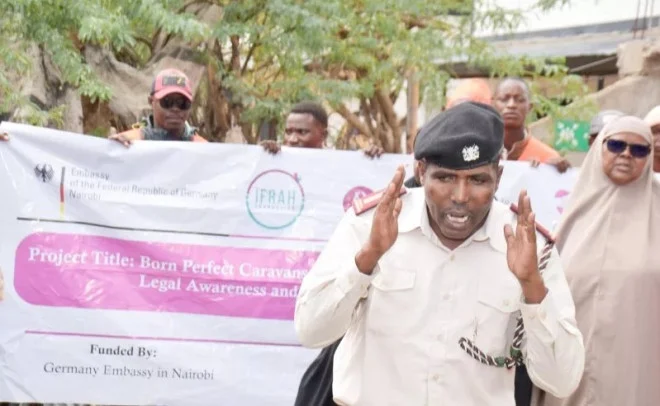
Iftin East location Chief Dekow Ahmed speaking. /STEPHEN ASTARIKO
Residents in Garissa are being reached through a new community campaign aimed at ending female genital mutilation and returning school-age children to classrooms.
- Advertisement -
Human rights activists, the national government and community leaders have joined forces in the initiative, which is being conducted across Garissa County.
The campaign, organised by Girlkind, brings together police officers, local administrators, religious leaders, community representatives, elders, women, youth, boda boda riders and human rights actors. Girlkind is a non-governmental organisation involved in advocacy against FGM and the protection of children’s rights.
Teams have been moving through different parts of the county, taking the campaign’s message to households and villages. The outreach ended on Wednesday with a meeting in Iftin town.
Organisers say the approach is a departure from traditional sensitisation efforts, which typically rely on residents attending public meetings. Instead, campaigners are taking the discussion to the communities themselves.
Girlkind programme officer Hamas Abdi said the organisation had chosen to engage residents where they live.
“We have therefore agreed to change our strategy and take the message directly to the people. Rather than waiting for people to come to meetings, we have decided to go to them,” she said.
Hamas said Girlkind was working alongside police, local administrators, religious leaders and community members to maintain the campaign and reach families who might not attend conventional public forums.
“That is why we are moving along the roads, visiting villages and reaching out directly to families and community members so that our message can reach as many people as possible,” she said.
She said the campaign sought to give communities a clear understanding of the harm caused by FGM and the importance of protecting girls from the practice.
“Our main objective is to ensure the message about the dangers and consequences of FGM gets home. FGM is not only a violation of the rights of girls and women, but it also exposes them to serious physical, psychological and social consequences,” she said.
Hamas said collective action was necessary to create communities in which girls could grow up safely and enjoy their rights and dignity.
Activist Asia Hassan said FGM’s persistence despite being outlawed in Kenya showed that stakeholders needed to reassess their methods while improving both public awareness and enforcement.
“FGM is criminalised in Kenya, yet the practice continues and is now being done more discreetly. This means we must move beyond awareness and strengthen enforcement so that those who violate the law face the consequences,” she said.
Asia urged the entire community to take responsibility, saying efforts to eliminate FGM could not be left to the government and civil society organisations alone.
“All stakeholders must speak with one voice. We cannot leave the responsibility of fighting FGM to the government or civil society alone. Parents, guardians, elders, health workers, and the entire community have a role to play in protecting our girls,” she said.
Zeinab Hussein, the gender officer at Iftin police station, described FGM as a grave violation of the rights of girls and women and warned that those involved would be prosecuted.
“Female genital mutilation is a harmful practice that has no place in our society, and I want to make it clear the government has criminalised the practice. Anyone found facilitating, encouraging, performing or knowingly allowing FGM to take place will face the full force of the law,” she said.
Zeinab asked residents to alert police or other relevant authorities about planned or ongoing cases so that intervention could take place before a child undergoes the procedure.
Keeping children of schoolgoing age at home was another central concern during the campaign.
Zeinab said children who are out of school face heightened risks of FGM, child marriage, exploitation and other forms of abuse.
“Parents have a responsibility to ensure their children attend school and remain in school. We cannot allow our children to be denied their right to education because of harmful cultural practices, poverty, neglect or any other reason,” she said.
“Every child deserves an opportunity to go to school, acquire knowledge and skills and build a better future.”
She said the effort was intended to go beyond enforcement by helping communities change harmful attitudes and protect children.
“This campaign is therefore not about policing alone; it is about working together with the community to change attitudes, protect our children and build a safer and more educated society,” she said.
Iftin East chief Dekow Ahmed cautioned parents who intentionally keep their children out of school that they could be arrested and prosecuted.
He said the government would soon conduct a mop-up exercise to locate children who had reached schoolgoing age but were not attending classes.
“Every child who has attained the age of going to school must be in school. We are going to embark on a mop-up exercise to identify children who are staying at home instead of attending school. Parents who will be found deliberately keeping their children out of school will be arrested and dealt with according to the law,” Dekow said.
The administrator called on parents and guardians to assume full responsibility for their children’s education, saying access to schooling was essential to a better future for children and the wider community.
The participation of boda boda riders, elders, youth, women, local administrators and security officers also allowed residents to raise security concerns affecting their daily lives.
Instant Analysis
The campaign signals a shift towards a community-led response to FGM, reflecting the reality that awareness efforts alone have not eradicated the practice. Involving police, elders, religious leaders, women, youth and boda boda riders may improve reporting and make early intervention more effective. Its parallel focus on children who are out of school is also important: prolonged absence can leave them vulnerable to FGM, child marriage and exploitation, while education provides a vital layer of protection.