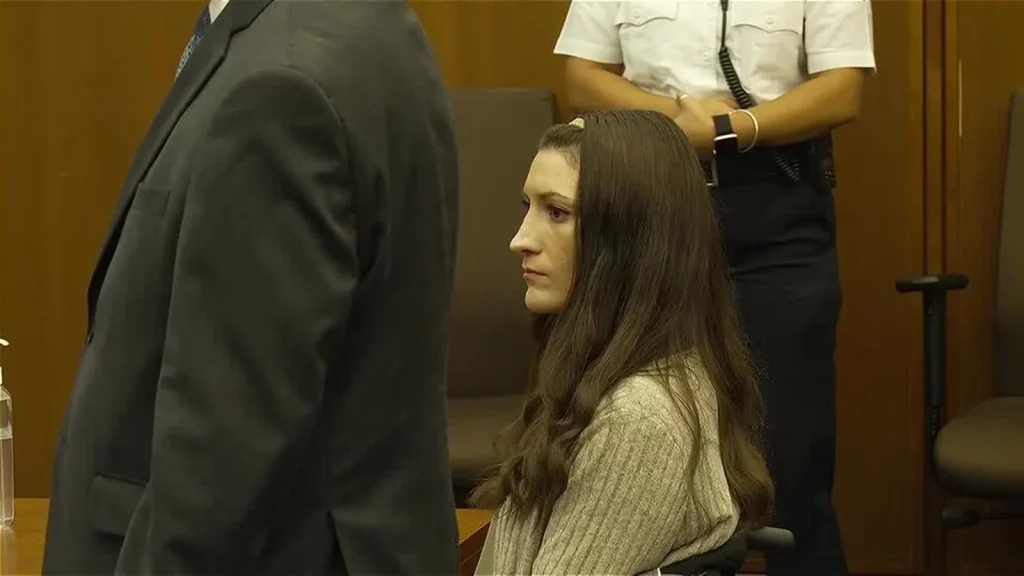
The murder trial of Lindsay Clancy ended without a verdict after a Massachusetts jury deadlocked over whether the American mother was legally responsible for killing her three young children.
Judge William Sullivan declared a mistrial after seven days of deliberations, following an appeals court’s rejection of a last-minute defence request to replace a juror.
- Advertisement -
The 12-member jury could not reach the unanimous decision required in US criminal cases. Eleven jurors supported finding the 36-year-old Ms Clancy not guilty by reason of insanity, while one juror disagreed.
Prosecutors must now decide whether to bring the case before a new jury.
“I’ll be making that decision shortly,” Tim Cruz, the Plymouth County district attorney, told reporters.
Ms Clancy will remain in custody while prosecutors consider a possible retrial.
The televised five-week trial, which included evidence from more than 80 witnesses and days of harrowing testimony, intensified a national debate over maternal mental health. It also drew comment from US President Donald Trump.
“It’s a horrible tragedy,” Mr Trump told reporters at the White House. “I assume there’s going to be another trial.”
We need your consent to load this rte-player contentWe use rte-player to manage extra content that can set cookies on your device and collect data about your activity. Please review their details and accept them to load the content.Manage Preferences
The near-six-week televised proceedings reopened long-running questions about the treatment of postpartum mental health in the US, as well as how the justice system should handle cases involving mothers who kill their children.
There was no dispute that Ms Clancy, 36, strangled her three children with exercise bands in the basement of her home in Duxbury, a Boston suburb, in January 2023.
She then cut herself with a knife before jumping from a second-storey window in an attempt to take her own life. The fall left her paralysed.
Her lawyer, Kevin Reddington, argued throughout the trial that Ms Clancy should be found not guilty by reason of insanity, or lack of criminal responsibility. He portrayed her as a loving mother who was experiencing a psychotic episode when she killed Cora, five, Dawson, three, and eight-month-old Callan on 24 January 2023.
Relatives, including Ms Clancy’s now ex-husband Patrick, described the deterioration in her mental health during the months after the birth of her third child. She repeatedly sought help from healthcare providers, who prescribed her a range of drugs.
The case was compared with that of Andrea Yates, a Texas woman who drowned her five children in a bathtub in 2001.
Judge William Sullivan
After an appeals court overturned Ms Yates’s original murder conviction, she was found not guilty by reason of insanity in 2006. Her lawyers argued that she had suffered from severe postpartum psychosis.
Prosecutors in Ms Clancy’s case did not deny that she had been struggling with mental health problems.
They argued, however, that she understood killing her children was wrong and deliberately went ahead with the act.
The prosecution called a psychologist who examined Ms Clancy and concluded that she had planned to take her own life. The psychologist said she killed the children because “she was convinced that they would suffer without her”.
Prosecutors pointed to evidence that, shortly before the killings, Ms Clancy sent her husband to collect a food order and visit a pharmacy after using her phone to calculate how long he would be away.
Patrick Clancy told the court that his wife had left a psychiatric hospital less than two weeks earlier, but that she showed no indication in the following days that she intended to harm herself or the children.
When he left to collect dinner, he said, she appeared to be in a “normal” mood.
He spoke briefly with his wife by phone while he was at the pharmacy.
When he returned home, he found her on the ground in the backyard with cuts to her wrists and neck.
She told him she had attempted suicide.
He asked where the children were, she said, and was told they were in the basement.
After calling 911 and waiting for first responders to arrive, Mr Clancy ran downstairs, where he found the children with exercise bands wrapped around their necks.
Several witnesses, including Mr Clancy, testified that Ms Clancy later spoke from hospital about hearing a man’s voice telling her that if she did not act, she would lose her chance.