Hope is growing that dozens of workers trapped for a week in an underground chamber at Nepal’s Rasuwagadhi hydropower plant survived the deadly flash floods, officials said.
“In Rasuwagadhi, we think 46 people are trapped in a room-like structure in the tunnel,” Amhsu Kiran Shahi, a board member of the Nepal Electricity Authority, told Reuters.
- Advertisement -
“We are very confident that they must be alive after one week because … they have food and water over there in the building.”
Nepali authorities have so far rescued 279 people from hydropower projects overwhelmed by an unprecedented torrent of ice, rock, mud and debris unleashed by a glacial collapse near the country’s border with China.
Residents pass a damaged home in Devighat, Nuwakot
‘Going in again’
The 111-megawatt Rasuwagadhi Hydroelectric Project sits in the badly affected Rasuwa district, in a mountain valley about 5km from Nepal’s border with China.
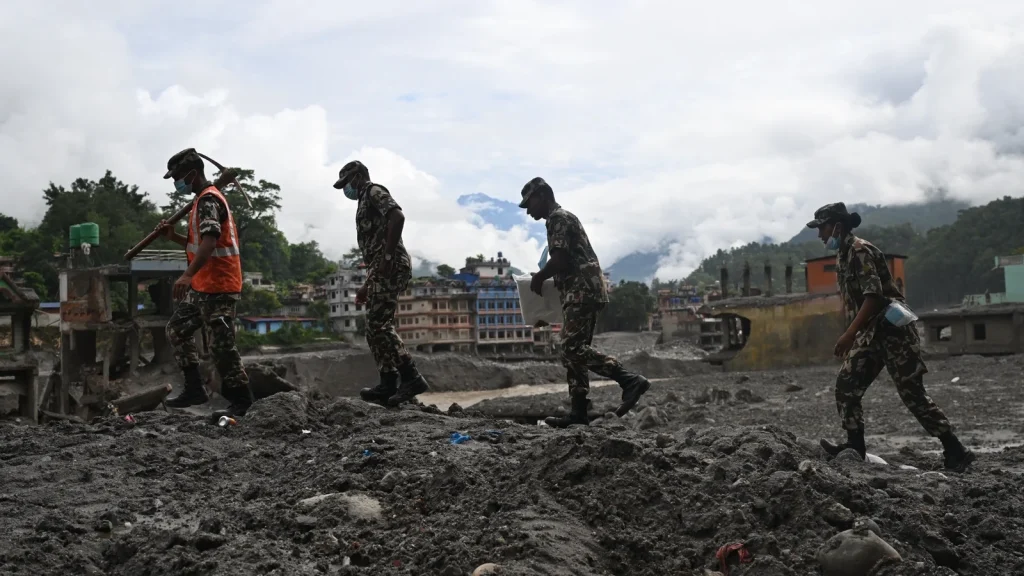
“This is the only project where it’s possible to walkthrough the tunnel. The army tried doing that three days ago, but they didn’t find the room,” Mr Shahi said. “We are going in again.”
Nepalese forces are also searching for survivors thought to be trapped in tunnels at other sites. Powerhouses at those projects contain spaces and rooms where workers can shelter, army spokesman Raja Ram Basnet said.
Drone footage shows scale of Nepal flood damage
At the Upper Trishuli 3A facility, another hydropower project struck by the floods, rescue crews spent nearly six days locating the tunnels beneath the thick layer of mud, Mr Shahi said.
“We are expecting (survivors) in there because we are told there is a dry space inside. We are trying to break into the tunnel now,” he said.
“We are using every technology available in Nepal right now, and we are taking help from the Indians, Chinese, Koreans. We have experts from Australia too.”
A preliminary United Nations Development Programme (UNDP) assessment estimated that the disaster generated at least 2.2 million tonnes of debris, including sections of buildings, rocks and sediment — an amount equivalent to six Empire State buildings.
Relatives attend a symbolic cremation for four family members who remain missing
Funerals begin for those missing after a week
As the search continued, Nepali families began holding symbolic funeral rites to “liberate the souls” of relatives missing since the floods swept through their villages and homes a week earlier.
Emergency crews have recovered more than 1,000 bodies, while nearly 4,500 people remain missing.
After spending days searching shelters and mortuaries, some relatives abandoned hope and began carrying out last rites for their loved ones.
We need your consent to load this rte-player contentWe use rte-player to manage extra content that can set cookies on your device and collect data about your activity. Please review their details and accept them to load the content.Manage Preferences
Rescuers have so far recovered only bodies from tunnels sealed by sludge. Teams continued digging, drilling and blasting through the debris, however, hoping to reach anyone still alive.
Nepal’s Foreign Minister Shisir Khanal said he had not given up on the possibility that some of the thousands still missing could have survived.
“Miracles do happen,” he said in an interview. “At this point, I do not want to completely give up hope.”
The aftermath of flooding along the Bhotekoshi River
‘Global responsibility’
Nepal’s Prime Minister Balendra Shah described the catastrophe as “a serious indication that the risks we face in the Himalayan region are increasing alongside climate change”.
“Climate change is a global contribution, and disaster response is also a global responsibility,” he added in a post on Facebook.
Scientists say the Himalayas, the world’s highest mountain range, are heating rapidly as global temperatures rise, speeding the loss of glacial ice.
Glaciers across the wider Himalayan and Hindu Kush ranges provide a vital water source for about 240 million people in mountainous areas, as well as 1.65 billion more people living in the river valleys of South and Southeast Asia.
Anger has mounted over the scale of the destruction in Nepal, a largely rural country of 30 million people.
Nepal has made only a small contribution to the greenhouse gas emissions driving global warming, yet it is among the countries bearing some of its harshest consequences.
Nepal has warned that rebuilding could cost “billions of dollars”.
The country’s economy was already under strain, leaving it with limited resources to respond to a disaster of such magnitude.
The extent of the damage was underscored by Chinese state media, which said road access to the badly affected Gyirong Port in Tibet had only been restored today following “days of round-the-clock repair work”.
With mortuaries overflowing, Nepalese authorities have buried hundreds of unidentified bodies after collecting DNA samples.
Nepal said 1,114 bodies had been recovered and 3,916 people were still missing.
Two Irish citizens are among the hundreds of foreign nationals missing, bringing the overall toll from the 26 August disaster to 1,130 dead and 4,462 missing.
Chinese state media reported 16 deaths and 546 people missing.
Foreign journalists face restrictions when reporting from Tibet, while Chinese authorities maintain tight control over information sources in the region.
Tibetan advocacy groups in exile have challenged China’s account of the disaster, but Beijing maintains that the “release of information has been open, transparent and timely”.