
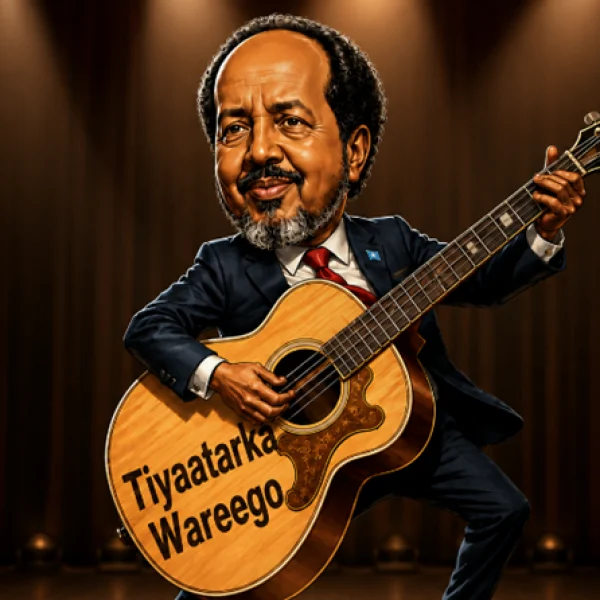
OP-ED: Hassan Sheikh’s Traveling Democracy Show Is Weakening Somalia’s Political Order
Somalia’s president, Hassan Sheikh Mohamud, was elected on May 15, 2022, and his legal term ended on May 15 this year. Yet rather than ushering in clarity, his tenure has taken the country’s political culture into an unprecedented and increasingly disruptive phase. National politics now resembles what some Somalis call a mobile theater—tiyaatarka wareego—a production that shifts from one venue to the next even as Somalia’s underlying crises continue to deepen.
- Advertisement -
The performance first moved through the federal states, where the formal rituals of democracy were staged around results that increasingly seemed predetermined. Galmudug followed a path much like South-West State: candidates, parties, electoral committees, ballots and cameras supplied the visible scenery, while political agreements appeared to determine the outcome. The traveling show has now reached Villa Hargeisa, the seat of the House of the People. Parliament’s term expired in April, yet the government continues to organize a speaker election as if the institution remains constitutionally in place.
Hassan Sheikh has several political tools at his disposal, but they appear directed toward the same public deception. His admission that he can change his position from one day—or even one hour—to the next seems designed to recast inconsistency as adaptability. Meanwhile, the traveling political spectacle and its party arrangements help conceal an expanding deficit of personal credibility. That approach ignores the central role of integrity in forming durable alliances and building politics around functioning parties.
Initially, many Somalis viewed this political style as little more than a mischievous phase—an attitude that would soon fade. That impression was challenged by WhatsApp screenshots showing large gatherings in Mogadishu attended by municipal employees who were reportedly threatened with losing their jobs if they stayed away. What began as a practice associated mainly with the capital gradually spread beyond Mogadishu. In Jubaland and Puntland State, political disputes eventually hardened into direct and increasingly dangerous confrontation.
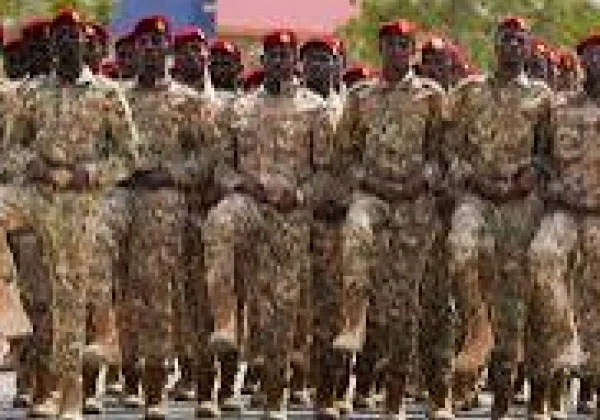
In December 2023, Villa Somalia mounted a major deployment of troops and logistical assets to Ras Kamboni in Jubaland State. Former President Mohamed Abdullahi Farmaajo had previously opted to wait until military conditions were favorable before making such a move. Neither al-Shabaab nor the difficult terrain could readily take advantage of Farmaajo’s decision to leave the area untouched. Hassan Sheikh arrived with a different political production, presenting the operation as an effort to “register defected Jubaland security forces” into the national army. The show quickly collapsed. Young Somali soldiers in uniform were left to face the consequences of a political calculation that placed brave national forces in a confrontation driven by personal interests—and ended in a defeat they had not experienced during their service.
The same gamble emerged again early this August, first in Galkayo on August 5 and then in Bosaso the following day. Puntland State Security Forces (PSF) disarmed forces that Hassan Sheikh had been organizing as part of an effort to destabilize Puntland State. The plan had been signaled in July, when Prime Minister Hamza Abdi Barre used a public Independence Day speech to speak of intervening in Puntland State to demand what he described as the PSF’s rights.
Behind the government’s public defense of the PSF was the deployment of the Somali National Army in pursuit of a political objective. That decision exposed national forces to confrontation and possible losses for personal political advantage. The deeper injustice was the regime’s willingness to place the national army in danger for political purposes while pushing Puntland State toward yet another conflict with fellow Somalis.
Hassan Sheikh’s political reach appears to extend into nearly every area of public life. This week’s announcement of the Form Four and Grade Eight examination results in Mogadishu also carried the familiar air of theater. Academics and education specialists had received confidential reports from the municipality’s examination management describing a crackdown that left many students facing widespread failure. The poor results were followed by mass evictions in Mogadishu, producing a shelter crisis on an industrial scale. Taken together, the failures have made graduation and university enrollment inaccessible to many students, leaving a generation discouraged about its prospects and convinced that the state has treated it unjustly.
Scholars of state-building often use the term kleptocracy to describe this model of governance—literally, “rule by thieves”—in which the state fails in its basic responsibility to protect its people.
Throughout his term, Hassan Sheikh has acted out a political script that the history of Somali governance could scarcely have anticipated: a mobile theater of democracy that carries the country from one stage to another while its central crises remain unresolved. The performance has exacted a steep price, weakening institutions, intensifying political confrontation and leaving ordinary citizens to absorb the consequences. The curtain may eventually fall, but Somalia will still have to confront the damage left behind.
Mohamed Ibrahim is a political strategist, state-building researcher, and Senior Fellow at several think tanks and research institutions.
DISCLAIMER: The views expressed in this article are the author’s own and do not necessarily reflect Axadle’s editorial stance