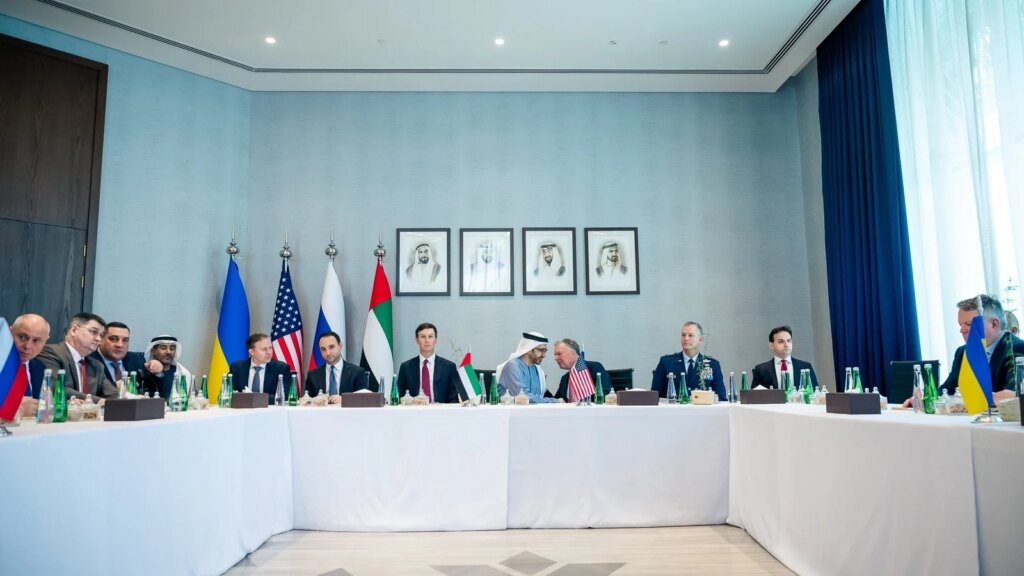
After two days of US-brokered peace talks in Abu Dhabi, Russian and Ukrainian negotiators said they had made some headway, though American mediators acknowledged that deep mistrust and major disagreements — particularly over territory — continued to block a breakthrough.
The meetings marked the first direct peace discussions between Russia and Ukraine in nine months. The clearest outcome was an agreement on a major exchange of prisoners of war, while the two sides offered few other concrete results after the talks concluded.
“I think that we have a good momentum to bring the solution before the new year comes,” Ukrainian negotiator David Arakhamia said, offering no further details.
He said he hoped the negotiations could resume “as soon as possible”.
Asked by a Russian state television reporter whether a peace agreement was now closer, Vladimir Medinsky replied: “I think so yes.”
“But at the moment, a great deal depends on all those involved in the process. A great deal depends on Ukraine, on the US stance, and on whether Europe comes to its senses,” he added.
Speaking in Dublin after talks with Taoiseach Micheál Martin, Ukrainian President Volodymyr Zelensky said the negotiations could offer a “window of opportunity” for a breakthrough before the end of this year.
“Today, there really is this opportunity, this window of opportunity, when all those participants who are now engaged in the negotiation process, genuinely want to achieve a result before 2027,” he said.
Mr Zelensky said the outcome would depend partly on “the will of American side to pressure on Russia or not, it depends on format of their dialogue with Russians.”
Vladimir Medinsky (L) said the ‘world needs a new, modern, updated security system’
Mr Medinsky said earlier that discussions about a possible new European security framework had occupied a central place during the two-day negotiations.
“Together with the American side, we exchanged our views on this – on some points we reached a common understanding, whilst on others we did not,” he said, adding that “this discussion will, of course, continue”.
“The world needs a new, modern, updated security system – one that is fair and does not disadvantage any particular countries,” Mr Medinsky said.
He was less receptive to the prospect of European countries taking part in future negotiations.
Mr Medinsky said it was “unclear” what Russia and the European Union could discuss, arguing that Moscow had “not received a single peace initiative or a single concrete peace proposal from European countries”.
“When they come up with some concrete proposals, then we’ll give those proposals some thought,” he said.
“As things stand, I think it would be useful for them to learn, for example, from the American envoys – in terms of common sense, realism and a desire to achieve peace,” he added.
Jared Kushner said Russia and Ukraine agreed their biggest ever release of prisoners
US envoys Jared Kushner, the son-in-law of US President Donald Trump, and Steve Witkoff are due to meet Ukrainian President Zelensky in Dublin tomorrow after taking part in trilateral discussions on ending the war.
Mr Zelensky said he hoped the American officials would return from their meeting with Mr Putin carrying “specifics”.
European governments have been unsettled by Mr Trump’s suggestion of a possible agreement with Russia to reshape Europe’s post-war security arrangements, as well as fears that Washington could pressure Kyiv into accepting a de-facto defeat.
With the negotiations stalled over territory, US mediators have sought to shift attention towards postwar security guarantees and reconstruction.
Mr Kushner said Washington wanted to “create a new framework” for security involving Ukraine, Russia and Europe that would deliver “decades, if not centuries, of peace”.
Russia had identified a similar objective as a priority weeks before its invasion of Ukraine, when it issued an ultimatum demanding that Western countries withdraw troops from eastern Europe.
Ukraine has warned against a “Yalta 2.0”, a reference to the post-World War II division of Europe by Western leaders and the Soviet Union. The EU, meanwhile, has said security arrangements can be addressed only after a ceasefire.
Mr Kushner also said the negotiations had produced agreement on the largest prisoner release yet between Russia and Ukraine.
“One of the positives is we agreed that we’re going to have the biggest humanitarian release of prisoners, which we’re going to finalise the numbers tomorrow,” Mr Kushner said.
The two countries have exchanged thousands of captured soldiers during the almost five-year war, which began with Russia’s 2022 invasion.
Volodymyr Zelensky speaks with Denmark’s PM Mette Frederiksen during a visit to Copenhagen
Before the talks ended, Ukraine said its negotiators would meet separately with European officials and the US envoys in Abu Dhabi after concluding discussions with the Russian delegation.
Mr Zelensky welcomed the decision by the United States to bring Europe into the negotiations.
“It was not simple to involve Europe. That is point number one,” Mr Zelensky told reporters when asked to explain what had changed in the US approach, which he had said he was “happy” to see.
Speaking in Copenhagen, he said European security could not realistically be discussed “without Europe”.
He again underlined the importance of securing guarantees for Ukraine’s future safety.
Mr Kushner told delegates that the United States had “narrowed the gaps” between the two sides, though he did not provide details, and said he hoped the process would move towards a “solution” to Europe’s worst conflict since World War II.
Mr Zelensky described the discussions as “constructive and quite substantive”. He said his negotiating team had reported progress on humanitarian matters and security guarantees.
Asked whether Mr Kushner and Mr Witkoff had altered their approach to the peace process, Mr Zelensky said: “I see changes. I’m very happy with what I hear.”
Ukrainian soldiers travel along a road in the Donetsk region
Fighting continued overnight. Aleksandr Drozdenko, governor of Russia’s Leningrad region, said on Telegram that a Ukrainian drone attack had caused a fire at Ust-Luga, a strategically important Baltic port used for oil exports.
Russian air defences also destroyed 146 drones during “continuing” combat operations, he said.
In Paris, US Secretary of State Marco Rubio described this week’s negotiations as “very productive” and said European countries should eventually join the talks “because they are part of solving this problem”.
Mr Zelensky said it was also “time” for Europe to select a representative for the negotiations.
Ukraine pushes for truces
Kyiv has firmly rejected Mr Putin’s demand that it surrender the whole of the eastern Donbas region as part of any peace agreement.
As the territorial dispute continues to hold up progress, US mediators have focused on possible postwar security guarantees and reconstruction plans.
Ukraine’s chief negotiator, Rustem Umerov, said Kyiv’s immediate priorities remained a ceasefire and credible security guarantees.
“Our people are waiting to end this war,” he said.
In Paris, the Ukrainian and French foreign ministers praised US efforts to secure “partial truces”, describing them as a possible “first step toward a complete and unconditional ceasefire”.
Last month, a locally negotiated truce in Ukraine’s Kherson region, brokered by US First Lady Melania Trump, became the longest interruption in fighting since the war began.
Ukraine is also seeking long-term assistance for its armed forces after the war.
A senior Ukrainian source told AFP that Kyiv wanted at least 10 years of financial backing to maintain an 800,000-strong army capable of defending against any future Russian attack.
Before the talks, Mr Trump suggested that Ukraine might ultimately have to surrender territory, saying: “They’re going to end up with a little bit different shape.”
Russian forces have continued advancing westwards but have failed to capture the entire Donetsk region, which Moscow has demanded Kyiv relinquish, including the territory still under Ukrainian control.
Russia continues to bombard Ukraine and its energy infrastructure, fuelling fears that millions of Ukrainians could face another winter without reliable heating, running water or electricity.