
A Kenyan court has handed cult leader Paul Mackenzie a 200-year prison sentence for the deaths of 190 children who prosecutors said were starved on his orders and buried in a forest, in one of the most shocking mass killings linked to a religious movement in modern times.
Justice Diana Kavedza, delivering the judgment, imposed 100 years for murder through starvation and another 100 years for direct homicide.
Prosecutors said Mackenzie led an apocalyptic Christian church in a forest near Kenya’s Indian Ocean coast and instructed followers to stop eating — along with their children — so they could reach heaven before the world ended.
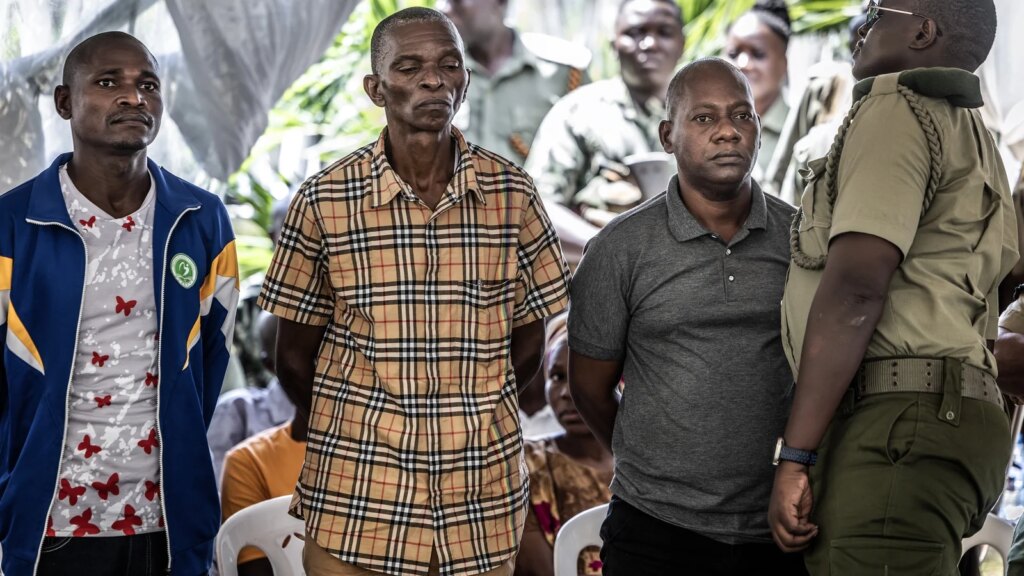
Accomplices allegedly enforced his commands by threatening and beating victims. Investigators later found emaciated bodies in shallow graves and latrines, while some victims had been buried alive.
Mackenzie denied the murder charges and argued that he had not forced anyone to starve. The court rejected that defence.
Paul Mackenzie pictured at the Shanzu Court in Mombasa, Kenya in 2024
The case stunned Kenya in April 2023, when police began recovering bodies from Shakahola Forest near the coastal town of Malindi.
The trial covered the deaths of 190 children and one adult, but the Kenya National Commission on Human Rights says 448 bodies were eventually recovered from the forest.
Mackenzie is separately accused of ordering the deaths of 52 people whose bodies were discovered at another site in a village 30km away. If confirmed, the suspected death toll would reach 500. He has pleaded not guilty in that case.
The scale of the alleged killings recalls the doomsday cult in Uganda that left more than 700 people dead in 2000, as well as the 1978 Jonestown massacre in Guyana, where an American cult leader ordered more than 900 followers to drink poison.
Stephen Mwiti, 48, lost six children to the sect. His wife, who was also one of Mackenzie’s convicted accomplices, had taken them to Shakahola, where they were starved to death.
Even if the adults had agreed to fast, “what about the children?” Mr Mwiti told Reuters before the sentence was announced.
“I lost children and I will not be able to get them back no matter what happens to Mackenzie and his accomplices,” Mr Mwiti said.
“I expect him to be sentenced to death or be jailed for life so that he never comes out to cause more deaths.”
Dan Mackenzie, one of Paul’s sons, said his father’s teachings had not spared his own family.
“I didn’t end up in Shakahola, because I didn’t believe anymore about … going to heaven. So I left the church and started doing my own thing,” he told Reuters.
“I lost friends too, and my younger brother. It’s justice to the people who we lost over there in Shakahola.”
Authorities had been aware of Mackenzie since 2017, when police searched his premises. Two years later, officials shut down his church in Malindi, prompting him to move to nearby Shakahola Forest.
The deaths intensified demands for stricter oversight of religious organisations. President William Ruto appointed a task force in May 2023 to examine the country’s legal and regulatory framework. Separate government-backed and Senate proposals followed in 2024, but neither has yet become law.
Ojiro Odhiambo, head of rapid response at the Kenya Human Rights Commission, described the conviction as a significant step while arguing that responsibility extended beyond Mackenzie and his followers. Local administrators, police, intelligence officers and religious leaders, he said, had failed to respond to repeated warnings.
“All these people have failed the people,” he said.
In 2023, Mr Ruto said that, as president, he accepted responsibility for the government’s failure to prevent the deaths.