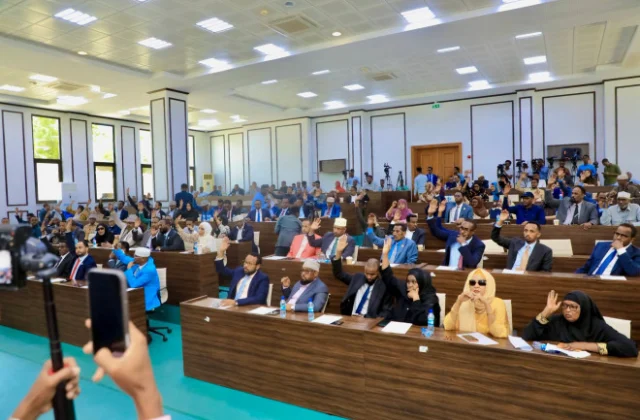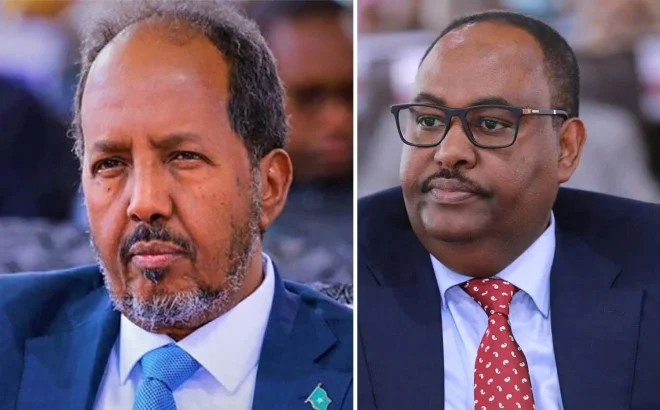
Somalia’s Parliament says its March 2026 vote brought the country’s provisional constitution, in place since 2012, to completion. Adopted as Somalia rebuilt after civil war, the document left crucial questions about the distribution of authority between the federal government and regional administrations unresolved. Puntland State and Jubbaland, two federal member states, reject the outcome. Their opposition poses a central question for Somalia’s federal order: who can complete a constitution when some member states reject the settlement it produces?
Puntland State participated in December 2022 negotiations on the division of powers and the judiciary, but it did not sign either text that emerged. The federal government and four other member states, including Jubbaland, signed both.
- Advertisement -
And so the question is whether Puntland State’s refusal amounted to a veto, and what constitutional issues remain if it did not.
Articles 44 and 54, which address resources and the allocation of powers, are often translated as requiring matters to be “negotiated and agreed upon”. But the authoritative Somali text contains no separate equivalent of “agreed upon”; it expressly requires negotiation. The UN Political Office for Somalia described the widely circulated English version as an unofficial translation of the officially signed and stamped Somali text.
That Somali wording distinguishes consultation, negotiation and agreement. Elsewhere, it uses the Somali word heshiis when referring to agreement. Yet English-language commentary has repeatedly treated the additional words as though they appeared in the adopted provision. Any demand for fidelity to Somalia’s Constitution should begin with the language it actually contains.
The mistranslation has created a particular constitutional puzzle for English-language analysis: what legal force can be given to an agreement requirement that Article 54 does not separately state?
Puntland State sat at the December negotiating table. It reserved its position for internal consultation, then said in January 2023 that it wanted separate discussions with Mogadishu. It subsequently declined invitations to rejoin the joint forum.
In June 2023, Puntland State presented its preferred settlement. It said every power outside Article 54’s four federal competences – foreign affairs, monetary policy, defence, citizenship and immigration policy – should fall within the member states’ “exclusive constitutional jurisdictions”. Even in those four areas, Mogadishu would have to “reach consensus” with Puntland State on implementation until the federal Constitution was finalised and the federal and Puntland State constitutions aligned. Resource arrangements would be negotiated separately with each state. Puntland State proposed first reaching an agreement with Mogadishu, then pursuing harmonisation and a referendum.
Article 54 did not assign powers beyond those four areas outright to the states; it left the broader distribution open to negotiation. Puntland State was offering its own answer to that unresolved constitutional question.
Puntland State’s vision of the federal government was unusually limited even compared with highly decentralised federations. Bosnia and Herzegovina, for example, assigns its common institutions authority over customs, foreign trade and transport between entities, among other responsibilities. Puntland State sought state control over much of Somalia’s economic and social sphere, while leaving resource-sharing to bilateral agreements. The proposal therefore carried a confederal logic: the argument over Article 54’s division of powers masks a broader dispute over the kind of state Somalia should become.
Puntland State joined the federal order with its own government and constitution. Article 142(1) protected powers derived from that constitution during the transition. Elsewhere, the Constitution specifically required consultation on the federal system, security decisions and certain international negotiations. Jubbaland may rely on rights held by every federal member state, but it cannot claim Puntland State’s constitutional position from before 2012. The National Consultative Council brought federal and state leaders together for negotiations. The December agreements gave the review commission and Parliament’s oversight committee material to use in preparing proposed amendments. That does not mean Puntland State became bound merely because four other states accepted the texts. It did not. But whether Puntland State’s signature was constitutionally necessary is a separate issue. Under the constitutional process, Parliament held the authority to adopt a common constitutional text.
The special procedure for finalisation required a two-thirds majority in each parliamentary chamber, followed by a majority in a referendum for popular ratification. It did not require additional approval from every state president. The Constitution also gave the states seats on review bodies and representation in the Upper House, Parliament’s chamber for the federal member states.
The Constitution anticipated that not all federal institutions and member states would exist immediately. It temporarily assigned the absent Upper House’s functions to the House of the People, the lower chamber, while requiring proper consideration of federal power-sharing and regional interests. States joining later would enter a shared constitutional order; the text created no separate ratification stage for each new member.
In its September letter to the United Nations, Puntland State maintained its legal objections while calling for a “political settlement”. It proposed an “inclusive Somali dialogue” to establish a transitional roadmap, supported by mediation from Security Council member states and a security guarantor. In substance, that is a request to reopen the political bargain. Negotiation could settle the dispute, and seeking mediation does not surrender constitutional rights. External actors may help broker another agreement, but only Somalia can give that agreement the force of Somali constitutional law.
Critics say a constitutional settlement of such importance requires more than parliamentary numbers: it needs “national consensus”.
Broader acceptance could strengthen the Constitution’s durability. Somali Public Agenda has called for renewed dialogue and, in one proposed pathway, parliamentary approval of the changes reached through negotiation. Political compromise and constitutional government are not incompatible. The problem arises when consensus is treated as an additional approval requirement that the Constitution itself does not establish.
The 2012 Provisional Constitution was born from political bargaining. That bargain mattered because it became law, creating institutions, rights and rules intended to survive the coalitions that negotiated them. A new agreement could redistribute powers or establish new consent rights, but those changes would still need to acquire constitutional force.
Nor would an agreement between Puntland State and Mogadishu represent every other state, Parliament, opposition group or Somali voter. It would show that the two administrations had resolved their differences. But who would certify “national consensus” beyond that? The phrase provides no settled answer, however desirable broader acceptance might be.
Puntland State’s refusal by itself did not prevent Parliament from adopting the amendments. Anyone challenging Parliament’s action must identify the constitutional rule it violated. The 2012 Constitution assigned federal-state disputes to the Constitutional Court; the 2026 text expressly allows review of amendment procedures and gives the Federal Supreme Court the Constitutional Court’s functions until that court is established.
For citizens, the Constitution sets out its own approval mechanism. Article 190 permits the text to enter into force before the referendum, while Article 195 reserves final popular approval for a vote once the necessary conditions are verified, including a completed and verified national voter register and a fully operational electoral commission. That vote has yet to take place. Neither parliamentary approval nor an internationally mediated agreement replaces it.
When every major disagreement requires the rules to be renegotiated, it becomes harder for any constitutional settlement to achieve finality.
_______________________
Abdurahman Nur is an analyst writing on Somali politics, federalism and constitutional affairs.