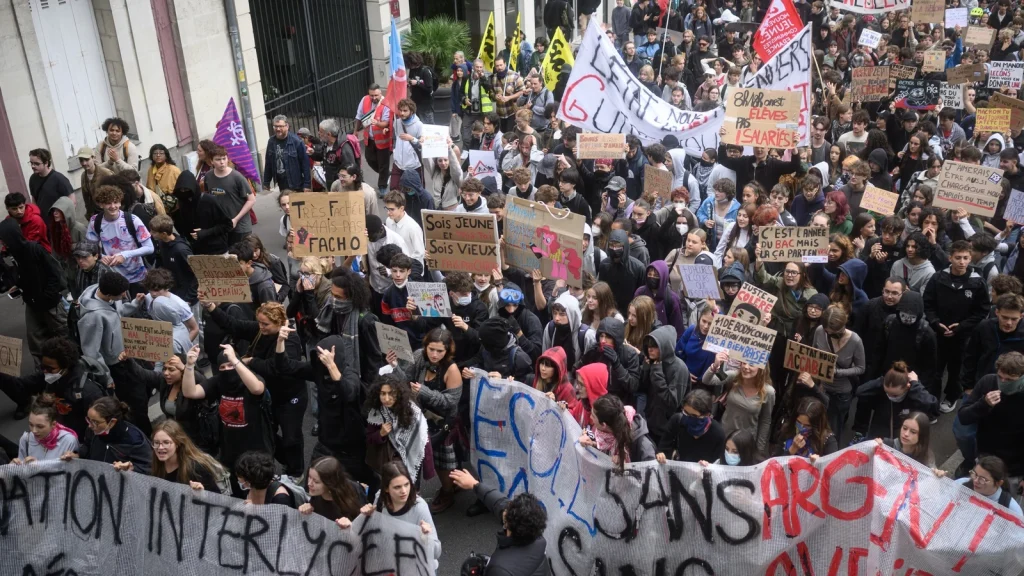
Most students in France returned to classrooms today after several days of protests over worsening school conditions, as the United Nations expressed “concern” about clashes that have at times turned violent.
Since high school students began blocking entrances in late September, tens of thousands of people have joined demonstrations across the country, prompting authorities to deploy riot police.
- Advertisement -
The protesters, most of them aged between 15 and 18, have pointed to teacher shortages, overcrowded schedules, deteriorating classrooms and school buildings ill-equipped to withstand rising temperatures.
France’s justice ministry said today that more than 6,800 people had been detained since the demonstrations began. Some 86% of those detained were minors.
Police fire a water cannon at protesters during a demonstration in Bastille
The United Nations said today it was monitoring the unrest “with concern” and appealed to all sides to maintain peace.
“We are following with concern incidents related to the student protests and high school blockades in France, some of which have turned violent,” said Shabia Mantoo, a spokesperson for the UN human rights agency.
Although most of the demonstrations have remained peaceful, some protesters have set fires and damaged bus shelters.
Police have responded with tear gas, batons and blast balls, drawing allegations from students and rights groups that officers have used excessive force.
Authorities have launched 18 internal investigations into alleged police misconduct.
The government suspended the use of stun grenades after a 15-year-old lost a hand on Monday when police fired one during the unrest.
‘Marked slowdown’
A government source said today that officials were observing a “marked slowdown” in the protests. The source also told journalists that most injured high school students “were not hurt by police action (but were) students who injured themselves accidentally” during the demonstrations.
Many students, however, said they had no intention of backing down. Organisers have already called for major protests next week.
Students gathered at the base of the July Column in Place de la Bastille during a demonstration in Paris
“We’re saving our energy for next week,” said a 16-year-old student in Toulouse, in southwestern France.
Alice, a high school student in the southern port city of Marseille, said the education minister’s announcements represented “a first step but they’re not enough”.
Marius Mesnil, a student union representative, said protesters were “being offered a few crumbs” and called for another round of demonstrations on Tuesday.
Police said they used tear gas in Bastille square in Paris yesterday evening to disperse several “high-risk profiles”.
Seeking to ease tensions, Education Minister Edouard Geffray announced late Thursday that around 3,000 substitute teachers would be sent in over the coming days to cover for absent staff at the 114 high schools facing the greatest disruption.
Prime Minister Sebastien Lecornu has pledged to present a plan addressing the crisis by the end of October. Economy Minister Roland Lescure said the government could meet demands for additional school resources despite the severe constraints facing the 2027 budget.
Under the current draft budget, education is set to receive the second-largest funding increase after defence, rising by 1.4% to €90.9 billion.
The education ministry said only 141 of France’s 3,700 high schools, known as lycées, were closed today.
That compares with roughly 800 schools that were shut last week because of the protests.
Éléonore Caroit cautioned against turning toward far-right politics after the unrest
Earlier, a French junior minister said public anger over high energy bills and mounting living costs had helped create a “climate of discontent” behind the violent protests.
Éléonore Caroit, France’s Minister Delegate for Francophonie, International Partnerships and French Nationals Abroad, said she had seen “disturbing” and “heartbreaking” images from the riots.
Ms Caroit was speaking from Dublin, where she is attending a meeting of EU development ministers.
In an interview with RTÉ’s Morning Ireland, she said: “The government is investigating all the actions and the claims.
“At this stage, there is a really clear instruction to use only proportionate measures when it comes to preserving order in France.”
She said the government wanted to restore calm while addressing student demands “when they are legitimate”.
“There is a mass of demands but now we have a series of really clear requests and concerns,” she said, adding that the “situation is calming”.