
Ireland is preparing to unveil a draft seven-year EU budget on Saturday, setting the stage for a high-stakes showdown among European leaders at next week’s summit in Brussels, RTÉ News understands.
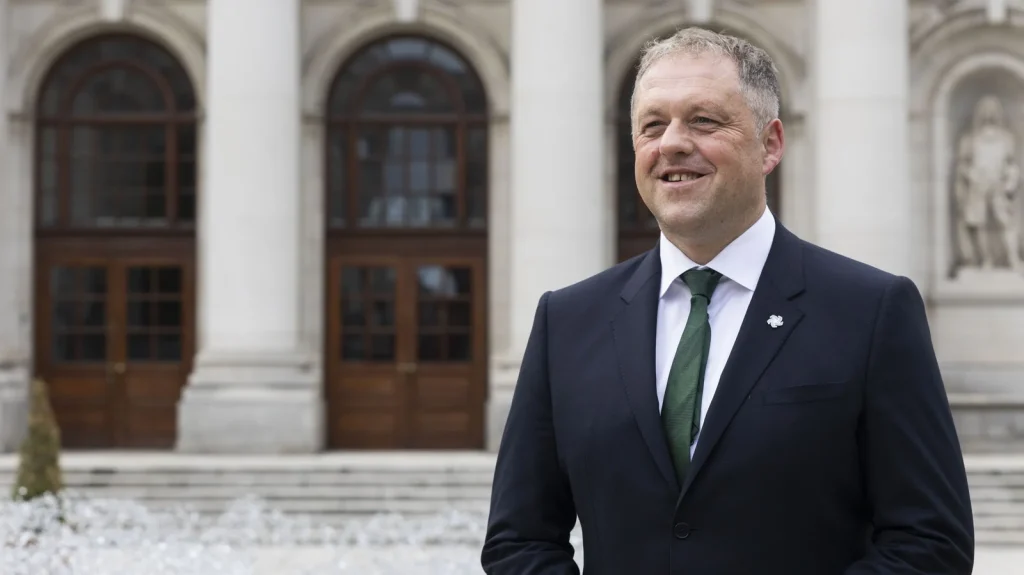
Minister of State for European Affairs Thomas Byrne is expected to present the closely watched proposal at a news conference in Brussels.
- Advertisement -
The budget represents the defining challenge of Ireland’s EU presidency, with net contributor countries pushing for a smaller spending plan focused more heavily on competitiveness and defence, while other member states are fighting to protect funding for agriculture and cohesion.
Known as the Negotiation Box, the document will outline the overall size of the budget, alongside detailed spending allocations and ceilings that member states will contest over the coming months. It follows weeks of consultations by Irish officials, ministers and Taoiseach Micheál Martin with national capitals seeking to identify their negotiating red lines.
Yet despite the intensive diplomatic effort, the divisions between the two camps have deepened in recent days.
The European Commission’s original proposal, published in July 2025, envisaged a seven-year budget worth €1.9 trillion.
Taoiseach Micheál Martin will sign off on the draft before its presentation on Saturday
However, the so-called frugal states — Germany, the Netherlands, Denmark, Austria, Finland and Sweden — wrote to the Irish Government on September 29 calling for “several hundred billion” to be cut from that figure before the Negotiation Box reaches EU leaders.
The six countries, whose signatories included German Chancellor Friedrich Merz, said they account for almost 40% of member states’ contributions to the budget, which will cover the period from 2028 to 2034.
“While net contributors as a whole are in the minority they shoulder around three quarters of the total financing burden,” they said.
The letter said the dispute was “about political priorities and about whether we can achieve the goal we have jointly set ourselves: a strong and sovereign Europe in an uncertain world.”
“To achieve this, the MFF must be fundamentally reformed. We must make choices.”
In a separate intervention, the leaders of 17 countries belonging to the so-called Friends of Cohesion group wrote to the Taoiseach on Friday, urging him to recognise the continued importance of agricultural and cohesion funding.
The letter, seen by RTÉ News, said that “Cohesion Policy and the Common Agricultural Policy are long-standing policies, but their objectives are as relevant as ever.”
“They promote convergence between Member States and regions, strengthen the Single Market and support rural, less developed areas.
“They also contribute to Europe’s competitiveness and food security, while providing tangible support to millions of European citizens and demonstrating the added value of common European spending.”
Mr Martin, who will approve the draft before it is presented on Saturday, has acknowledged that bridging the divide between the two groups will be extremely difficult.
The European Parliament will also have to agree some 21 pieces of legislation next year
The Government is seeking an overall agreement among national capitals by the time Ireland’s presidency ends in December.
Securing a deal before a series of general elections next year is regarded as politically crucial, given the possibility that hard-right and eurosceptic parties could make gains or return to power.
The European Parliament must also approve around 21 pieces of legislation next year to ensure EU funding can reach recipients, including farmers, from 1 January 2028.
The budget’s design has also been reshaped, with the Common Agricultural Policy incorporated into so-called National Regional Partnership Plans, or NRPPs.
The plans will cover direct payments and rural development funding, allowing national governments greater flexibility in distributing money while leaving a smaller share of the CAP budget ring-fenced.
CAP payments will additionally depend on compliance with a range of conditions applying to the NRPP as a whole.
The letter from the 17 Friends of Cohesion prime ministers said overall cohesion and CAP funding “must be preserved in the next [seven-year budget].”
It warned that “these policies already face reductions in real terms under the [European] Commission’s proposal, despite the overall increase in the size of the [budget].
“Reducing them further would not modernise the EU budget; it would only weaken it and risk undermining public support for the European project.”
Ireland’s draft Negotiation Box will also identify which new sources of revenue could win political backing from a majority of member states.
The so-called New Own Resources are potential measures to increase the budget’s capacity while helping repay debt linked to the EU’s post-Covid recovery fund.
Among the proposals are a levy on large corporations, taxes on gambling and tobacco, a charge on cryptocurrencies and funds that could be recovered from the EU’s Emissions Trading System, or ETS.
Germany and several other countries have rejected joint EU borrowing as a means of covering the cost of a larger budget.