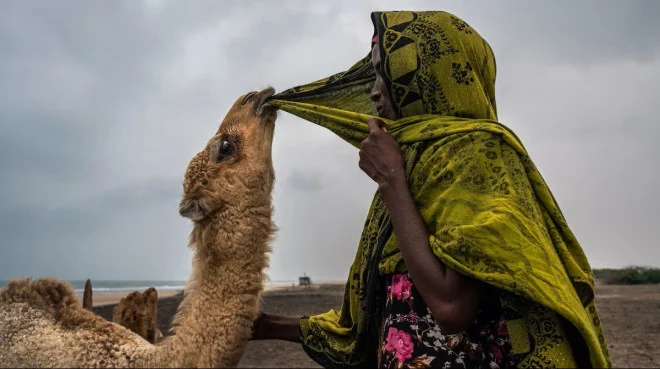
For Somalia’s nomadic communities, the camel has never been merely an animal—it has been the foundation of life. I understood that long before I encountered the subject in a textbook. Across Somalia’s arid and semi-arid regions, home to the world’s largest camel population, the sun can scorch the ground and water can command greater value than gold. In that harsh landscape, the camel (geel) represents survival, transport, financial security and pride (gobnimo).
The Somali Experience For generations, Somali elders have preserved a detailed body of living knowledge (aqoon-daqameed) about how to draw on every benefit the camel provides. When severe droughts (Abaar) empty wells and kill other livestock, the female camel (Hal) continues producing sweet, nourishing milk. Rich in water, fat and essential nutrients, it can sustain families without requiring additional food or drink. Through careful observation over many generations, pastoralists learned to lead their herds to particular saline shrubs (Galool ama loo yaqaan Cag- lo) and deep-rooted Acacia trees (Caday), which naturally enhance the milk’s mineral and water content.
- Advertisement -
They also developed ethno-veterinary treatments using natural resins such as myrrh (Malmal) to treat wounds, while memorizing camel lineages (Abtirsiinyo Geel) across generations to maintain strong, resilient herds. Within Somali society, the camel has long served as an instrument of peace and dignity: it is used to pay blood money (Diya) in the settlement of clan disputes, offered as bridal wealth, and celebrated in major works of poetry (Gabay) and labor songs (Heello). To own camels was to possess independence—to cross the scrubland without being dependent on anyone else.
Beyond our cultural heritage The Quranic perspective
The Holy Qur’an offers a deeper spiritual understanding of the camel, presenting it as both a humble desert companion and a living sign (Ayah) of divine mercy and extraordinary design. From childhood, many Somalis encounter the verse in Surah Al-Ghashiyah (88:17), in which Allah asks: “Do they not look at the camels, how they are created?” Islamic teaching frames the camel’s ability to withstand intense heat and carry heavy loads across difficult terrain not as an accident, but as an expression of God’s kindness (a’fah). Surah An-Nahl (16:7) says: “And they carry your loads to a land you could not have reached except with great difficulty to yourselves.” The account of the Prophet Salih (peace be upon him) further describes the She-Camel of Allah (Naqatullah), a divine miracle granted to the people of Thamud, with a sacred right to share community water sources—“a time of drink,” as stated in Surah Ash-Shu’ara 26:155. For generations, this story has conveyed lessons about environmental balance, animal welfare and responsible stewardship, reminding believers that the camel is a trust to be treated with reverence and gratitude.
The Scientific Discovery
Modern science is now illuminating the biological and molecular mechanisms behind many of the camel’s remarkable abilities. Studying the animal through contemporary research has made clear how closely laboratory findings can echo the knowledge preserved by Somali pastoralists and the spiritual lessons found in the Qur’an.
What our ancestors recognized through experience and what the Qur’an described through divine inspiration are now being examined in laboratories around the world. Biochemists and geneticists have identified the camel as a striking example of evolutionary engineering. Its red blood cells are oval rather than round, enabling them to continue circulating as the blood thickens during severe dehydration. They can also expand by up to 240% without bursting when the animal drinks more than 100 liters of water within minutes. Researchers have documented the camel’s flexible body temperature, known as heterothermy, which reduces the need for sweating by allowing its core temperature to shift naturally from 34C ° at night to 41C ° during the hottest part of the day. Analysis of camel milk has revealed another self-preserving biological system: it contains single-domain antibodies (nanobodies), lactoferrin and lysozymes that actively destroy harmful bacteria at ambient temperatures of 40C°. Unlike cow’s milk—which generally requires immediate refrigeration, pasteurization or conversion into hard cheese and butter to slow spoilage and prevent dangerous bacterial contamination—camel milk is complete in its natural form. It needs no complex processing or artificial modification. It contains three to five times more Vitamin C than cow’s milk, lacks heavy allergen proteins, and has small, easily digested fat globules that support rapid hydration and nutrient absorption in the gut. Even the camel’s waste reflects this efficiency: because its intestines reabsorb water so effectively, the manure is expelled almost dry and can serve as an immediate, low-smoke cooking fuel in treeless plains. Considered together, these three bodies of knowledge reveal a striking consistency.
Somali pastoral wisdom, foundational Qur’anic teachings and modern scientific research all converge on the same conclusion: the camel is an exceptionally distinctive and divinely designed miracle.
The animal is so precisely adapted that it can withstand the desert’s hostility without artificial systems to compensate for its weaknesses. It functions as a self-sustaining life-support system—created by God to flourish in barren environments while providing nourishment, protection and hydration to its young and to the human herders whose survival depends on it.
____________________________________
About the author: Ahmed Hussein, New Business Development expert in Agro-processing and Agribusiness with extensive international experience. A qualified Food Scientist (master from Cornell University) and a Food Processing Engineer (Master from University of Toronto)
[email protected]Tel: +1-678-646897