by Mohamed IbrahimTuesday July 21, 2026
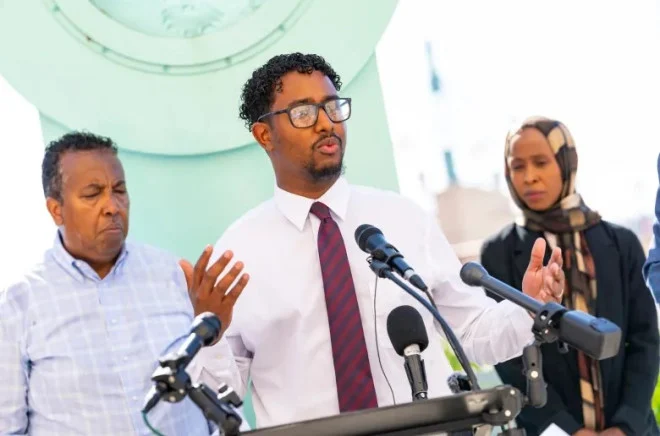
Suleiman Adan, deputy executive director of CAIR-MN, speaks at a press conference on July 14, 2026, in response to comments by Ramsey County Sheriff Bob Fletcher about Somali gangs. Credit: Aaron Nesheim | Sahan Journal
A surge of violence involving Somali youth has intensified alarm among families and community leaders, prompting renewed outreach and a public meeting planned by the Ramsey County Sheriff’s Office.
Omar Jamal, who leads the sheriff’s office’s East African engagement unit, said the recent violence has required him to step up his work with families.
Earlier this month, Jamal met with several parents, among them a Somali mother who has lost two children to gun violence.
“It is getting out of hand,” Jamal told Sahan Journal. “I think it’s about time the community takes this issue very seriously and tries to see if there’s anything that can be done.”
Ramsey County Sheriff Bob Fletcher, Jamal and other sheriff’s office officials are scheduled to hold a community meeting Tuesday at 6 p.m. at the Arden Hills patrol station, 1411 Paul Kirkwall Drive, as they seek to respond to the increase in violence.
Earlier this month, Fletcher discussed shootings near northeast Minneapolis’ Quarry Shopping Center over the Fourth of July weekend during an episode of his livestream program, Live on Patrol. He tied the incidents to a dispute involving what he described as Somali gangs.
Fletcher said 300 Somali youths, including some he said belonged to the groups, gathered at an Arden Hills juice shop before traveling southwest to Minneapolis, where they shot at one another.
His remarks drew anger from many Somali community members, who said they worsen an already tense climate of politically driven and hateful social-media rhetoric targeting the community. Others, however, argued that the backlash risks diverting attention from the urgent task of stopping the violence.
Are they gangs, or not?
Ramsey County Sheriff’s Deputy and gang investigator Ben Seidl said investigators have identified 12 gangs involving Somali youth. The largest is based in Minneapolis, while the others operate in Twin Cities suburbs including Burnsville and Eden Prairie.
Seidl said those groups differ from more conventional gangs, such as “Family Mob” and “G Block,” 25 members of which were indicted last month on allegations of trafficking fentanyl in south Minneapolis. Traditional gangs generally involve larger groups committing crimes for the organization’s benefit or under its direction, he said.
“What’s different about Somali gangs from other gangs is that most of them are not involved in selling narcotics — it’s more about bragging rights and just ego,” Seidl said during Fletcher’s livestream. “From what I’ve seen, there’s really no monetary gain out of this stuff.”
Another distinction, Seidl said, is the deliberate use of high-profile settings for shootings. He pointed to incidents outside high school graduations and the Minnesota State Fair, including a 2023 shooting at the Washburn High School graduation ceremony that he said set off a prolonged feud between the Minneapolis group and several suburban groups.
The Ramsey County Sheriff’s Office says the groups identified by its investigators have been connected to 14 homicides and more than 100 shootings over the past two years.
Jamal, who has worked for the sheriff’s office for more than five years, said his conversations with parents and young people have shown that shootings often begin with minor disputes.
“It’s over nothing,” he said. “When you really look at it, you wonder the reasons behind why they kill each other.”
Burnsville Police Department spokesman Paul Omodt said gang activity remains a concern for the department, though he did not identify any particular group or specify Somali youth. He said Burnsville works alongside other Dakota County law enforcement agencies on the issue.
“Our department’s focus is on the people committing crimes and the behaviors that put our community at risk,” Omodt said. “We also know that keeping a community safe is about more than enforcement. We spend a great deal of time building relationships with our community through partnerships with schools, Dakota County, community organizations, businesses, and residents.”
Public issue should be private
At a Tuesday news conference, Somali leaders criticized Fletcher’s comments and said they had compounded the pressures facing the community.
After some Somali offenders were indicted in a Medicaid fraud case, President Donald Trump cited the matter in justifying Operation Metro Surge, described as the largest immigration enforcement operation in U.S. history. The president’s supporters have continued directing hateful rhetoric at the broader community, the leaders said, and singling out Somali gangs while other gang activity exists across Minnesota contributes to that pattern.
“We need to tone down the language of condemnation and of singling out. It doesn’t help anybody,” said Ali Gaashaan, executive director of Volunteers of Somalia. “It doesn’t help with the solution, it doesn’t make the state safer and it doesn’t help Somali parents and their kids who want to take a different path.”
The leaders said they do not dispute that youth violence is a serious community problem. Their objection, they said, was Fletcher’s decision to raise it publicly on a livestream without first engaging the community, a move they believe added to the volume of hateful rhetoric directed at Somali Minnesotans.
In a statement issued after the response from community members, Fletcher said his focus is on helping the roughly 300 Somali youths involved in gang activity and that he welcomes community input in pursuing that objective.
“My 40 years of experience in addressing gang violence in our community has taught me that we need a three pronged approach of prevention, intervention, and enforcement to impact the issue,” Fletcher said. “This is about saving lives. I am thankful the conversation has begun.”
Abdirizak Bihi, an activist and radio host in Minneapolis’ predominantly East African Cedar-Riverside neighborhood, said that while some community members disliked Fletcher’s remarks, the comments have also led more people to confront the issue of youth violence.
“We are seeing a lot of people talking about it in coffee shops, at community gatherings,” Bihi said. “We’ll hear that last night there was a shooting and there was a young man who died, or we are hearing about a young girl that got hurt.”
He said the rise in violence has also brought increased efforts from youth-focused community organizations, including the Hoops4Unity youth basketball league.
Still, the violence continues. Bihi, who is also a parent, said Fletcher’s discussion of gangs caught the attention of him and other parents because little information is available about what is driving the shootings.
“He’s the law enforcement and we are not, so we can have concerns but we need the facts, and we definitely need to engage all of us together,” he said. “The most important thing that we all want is to save young people, those who are dying and those who are being incarcerated. We don’t want that.”