By Abdirahman Hussein and Edwin OkothWednesday August 12, 2026
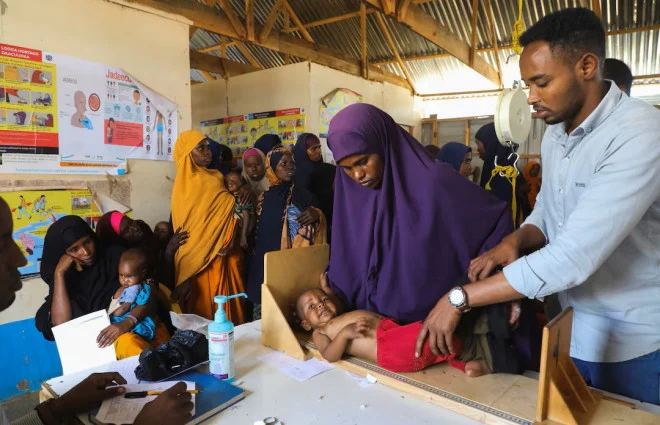
A Somali health worker measures an internally displaced child for signs of malnutrition at the Medecins Sans Frontieres (MSF) health centre in the Elbet 1 camp, where humanitarian funding is shrinking even as needs surge, according to MSF, in Baidoa, Somalia August 10, 2026. REUTERS/Feisal Omar Purchase Licensing Rights
- Advertisement -
More than 80% of funding for acute malnutrition programmes in parts of Somalia has disappeared this year, Médecins Sans Frontières said on Tuesday, as one in four children screened in displacement camps in the southwest is found to be severely malnourished.
MSF Health Adviser Mitchell Sangma said U.S. support for aid agencies in Somalia had fallen from $70 million last year to nothing this year. Other Western donors have also reduced their contributions, leaving relief organisations unable to keep pace with worsening needs.
“This year we have admitted 22,000 nutrition cases, more than 80% higher than last year. When we need this massive scale-up in intervention measures, we are seeing less interest from donor support,” Sangma said.
At Elbet 1, a sprawling settlement of makeshift shelters pieced together from tarpaulins in the southwestern town of Baidoa, parents take their children to a clinic beneath a corrugated iron roof. Medical workers weigh them, measure their height and check the circumference of their arms, a key indicator of malnutrition.
A July MSF survey covering 888 households across 14 displacement sites in Baidoa found severe malnutrition in one out of every four children. One-third of households reported eating just once a day, while only 2% said they could afford three meals.
At Bay Regional Hospital in Baidoa, which serves residents of the town, semi-nomadic communities and the displacement camp, a dozen severely underweight children lay in a ward. Some received fluids through drips, while others were given oxygen to assist their breathing.
“My child had been sick for a month and a half, and we kept her at home. God knows we did not know that we could get medical assistance. We gave her a small amount of medicine, but it did not help,” said Abdi Isse, lying beside his child, who had been admitted for malnutrition.
FAILED RAINS, CONFLICT, EXACERBATE CRISIS
Somalia’s hunger crisis is deepening as successive failed rainy seasons destroy crops, kill livestock and drain water sources. Conflict and insecurity have intensified the pressure, disrupting livelihoods and restricting access to food, healthcare and humanitarian assistance.
In February, the Somali government and the United Nations said about 6.5 million people in the country were facing acute hunger because of drought.MSF said it had screened more than 21,000 children under five in Baidoa since the beginning of the year, with acute malnutrition rates at about 50%. Acute malnutrition is less severe than severe malnutrition but still involves rapid weight loss and can be fatal.
Because of the rising caseload, MSF has tripled the number of beds at its Baidoa facility, which provides therapeutic feeding, to 150 in recent months.
Sangma said medical teams were being forced to make painful choices about which patients to admit and when to discharge them. With food and water still scarce, many of those sent home develop complications and return to the hospital, he said.
‘THE WORLD CANNOT WAIT FOR FAMINE’
The United Nations estimates that more than half a million people were displaced in Somalia during the first three months of 2026, with drought responsible for virtually all of the movement. Women and children made up about 85% of those displaced.
The emergency has renewed concerns that Somalia could again approach famine, as it did in 2022. Aid agencies warn, however, that their response is being hampered by a severe shortage of funding.
MSF says donors have made only about $300 million available for Somalia, compared with the $2.2 billion provided in 2022 during a similarly severe drought.
“The world cannot wait for a famine declaration before acting,” said Allara Ali, MSF’s project coordinator in Somalia. “Action is needed now to prevent loss of lives.”
Reporting by Abdirahman Hussein in Baidoa and Edwin Okoth in Naiorbi; Writing by Vincent Mumo Nzilani and David Lewis; Editing by Aidan Lewis and Sharon Singleton