
Ebola patients are filling treatment wards in eastern Congo, with all 29 beds at a center in North Kivu occupied this week as a surge in infections put further pressure on an already fragile health system. The increase comes even as transmission appears to be easing in some of the hardest-hit parts of the country.
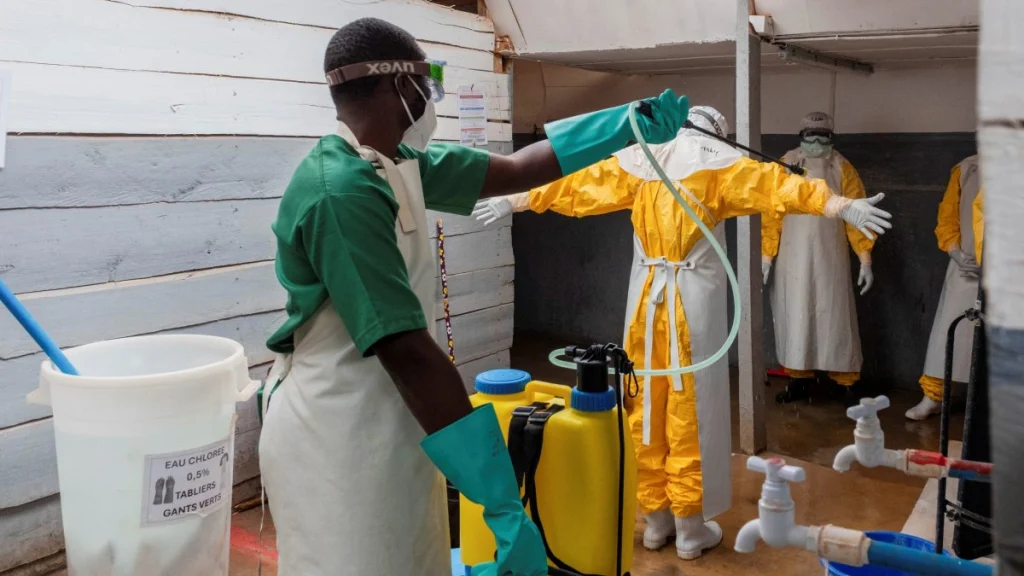
At the Kitatumba Ebola treatment center in Butembo, a city of roughly 2 million people, a critically ill patient received oxygen while masked medical workers in gloves and protective aprons moved through the ward.
- Advertisement -
“We’ve seen a very sharp increase over the past two weeks,” said Stephanie Hoffmann, project coordinator for Doctors Without Borders, or MSF.
“Sometimes there are patients who know they have Ebola but cannot find a bed,” she said.
Authorities opened two more treatment centers in Butembo this week, bringing the city’s total to four. Even so, doctors say some patients reach care in such advanced condition that they cannot be saved.
Hoffmann said a 10-year-old boy died in triage Tuesday before he could be admitted.
The strain on Butembo reflects the broader challenge of containing Ebola in eastern Congo, where conflict, shortages of health workers and limited resources have weakened medical services.
Cases spread to new areas
Researchers believe the Bundibugyo species of Ebola circulated for months before Congo confirmed the first cases in Ituri province in May.
The response has been complicated by funding cuts, gaps in disease surveillance, armed conflict and the absence of approved vaccines and treatments for the strain.
Government data showed that, as of Tuesday, Congo had recorded 7,820 confirmed cases and 3,779 deaths.
Ituri remains the province most affected by the outbreak. But infections in North Kivu have climbed sharply this month, with the World Health Organization reporting Sunday that the province accounted for about one-third of newly confirmed cases and deaths.
South Ubangi became the seventh province to report infections last week. The development led the WHO to warn of a “pronounced geographic redistribution of transmission.”
In some of Ituri’s hardest-hit areas, there are signs the spread is slowing as health workers establish treatment centers, search for cases, trace contacts and explain prevention measures to residents.
Still, the outbreak remains “massive,” said Julien Harneis, the United Nations’ special Ebola coordinator.
Health workers cautioned that fewer admissions at individual treatment centers do not necessarily signal that the outbreak is ending.
“Assuming the outbreak is under control because some Ebola treatment centres are admitting fewer patients would be a mistake,” Anthony Kergosien, MSF’s emergency coordinator in Congo, said in a Sept. 18 statement. “The outbreak is not shrinking; it is moving.”
Mistrust complicates response
In North Kivu, local leaders and health workers say funding and staffing shortages are being compounded by widespread mistrust of Ebola responders.
Government data shows that more than 60% of people diagnosed with Ebola in the province have died, compared with a national fatality rate of about 48%.
Health workers say inadequate public information and fear of treatment centers are prompting some people to wait before seeking help. By the time they arrive, the illness may be too advanced for effective treatment.
Dr. Michel Paluku Mukuloli, who runs a hospital in Butembo, said some patients believe that entering a hospital guarantees an immediate transfer to an Ebola treatment center.
MSF doctors treat a patient inside the Kitatumba Ebola treatment center, as aid agencies intensify efforts to contain a new Ebola outbreak involving the Bundibugyo species, in Butembo, North Kivu province, DRC, Sept. 23, 2026. (Reuters Photo)
“Patients think that if they arrive at the hospital, they will be immediately sent to the treatment centre to die,” he said.
Daily life in Butembo also underscores the difficulty of applying prevention measures. Minibuses remain crowded, and markets continue to draw large numbers of people.
Pablo Paluku Lwanzo, head doctor of the Butembo health zone, said some residents reject temperature screening and hand-washing requirements at city entrances and outside public buildings.
Only two of the zone’s nine health checkpoints are operating because there are not enough staff, he said.
Suspicion has also led some residents to question whether Ebola exists at all.
A welder in Butembo said his 12-year-old son, who had respiratory problems, died after being moved to an Ebola treatment center. None of the relatives or neighbors who accompanied the boy became sick, and the man said that convinced him his son had been wrongly diagnosed.
“For me, Ebola does not exist,” he said, speaking on condition of anonymity.
Attacks add to pressure
Hostility and anger have spilled into attacks on Ebola response teams.
Workers who disinfect homes and conduct safe burials have faced resistance from residents. Lambert Maboko, a member of a burial team, said a person attacked him with a machete and fractured his knee.
Team members now pray together before going into the field, he said.
Earlier this month, residents burned a health post they accused of cooperating with Ebola responders, according to staff. Patients were forced to flee into the surrounding community.
Microscopes, solar panels, medicines and hospital beds were destroyed.
“I’m at a loss for words,” said Kakule Mahamba, head of the Hope health post, while looking over the charred building.
Congolese authorities and the WHO say they are working to restore confidence through public information campaigns, household visits and deeper involvement from religious, traditional and community leaders.
Steve Ahuka, Congo’s incident manager for the Ebola response, said Wednesday that authorities had secured better access to communities over the previous four weeks.
“While pockets of resistance remain, we believe that with the involvement of traditional, religious and neighbourhood leaders … we can make progress,” he said.
The WHO said North Kivu had recorded a decline in cases in recent days after several weeks of steep increases. It nevertheless warned that shortages of money, personnel and treatment beds continued to threaten the response.
“The pressure is particularly acute in North Kivu, which … has seen a significant increase in transmission with limited bed capacity for patient care,” the organization said in response to Reuters questions.
Memories of earlier outbreaks
North Kivu was the epicenter of three earlier Ebola outbreaks, including the 2018-2020 epidemic. That outbreak was Congo’s largest and deadliest before the current crisis.
The earlier epidemics were caused by the Zaire species of Ebola, unlike the Bundibugyo species now circulating.
Responders know less about Bundibugyo Ebola. Its initial symptoms can be relatively mild and may resemble common diseases such as malaria and typhoid fever, making the illness harder to identify.
The lack of approved vaccines and treatments for the strain has also intensified suspicion, especially among residents who remember the medical tools available during the previous outbreak.
“People remember the 2018 outbreak and ask why vaccines and treatments existed then but not today,” said Pepin Kavota, a civil society coordinator in the nearby city of Beni.
Reports of sexual exploitation and abuse involving responders during the 2018-2020 outbreak, including some WHO personnel, further weakened public confidence, Kavota said.
The WHO said it accepts that “trust must be continually earned” and has introduced stronger measures to prevent and respond to abuse since the earlier outbreak.
Last month, provincial authorities recruited pro-government fighters known as Wazalendo to guard responders and promote compliance with Ebola prevention measures. Armed men now staff some hand-washing stations along roads into Butembo.
A force leader warned that people who repeatedly ignored Ebola control measures could be taken by force to treatment centers and whipped.
Health officials fear that coercion could worsen the mistrust already obstructing the response.
“We should not need to use the police or the army in a response,” Lwanzo said. “The population must be sensitised and willingly adopt the measures that are being put in place to protect them.”