
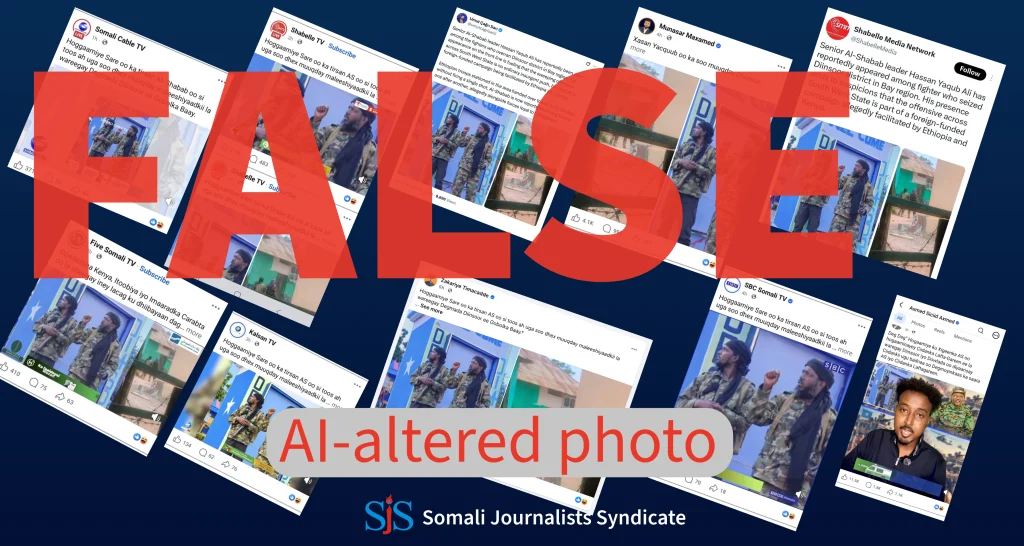
MOGADISHU, Somalia 19 October 2026 – A digitally manipulated image swept through Somali media circles on Sunday, 18 October 2026, fueling claims that senior Al-Shabaab figure Hassan Yaqub Ali had “reportedly appeared” alongside fighters who took control of Diinsoor town in the Bay region of Somalia’s Southwest State on 16 October, after an offensive by forces loyal to Abdiaziz Hassan Mohamed “Laftagareen.”
Several news platforms and social media users amplified the narrative, alleging that the fighting across Southwest State formed part of a “foreign-funded campaign” purportedly “facilitated by Ethiopia and Kenya.”
- Advertisement -
The posts, accompanied by the AI-altered photo, drew thousands of views on Facebook, X, formerly Twitter, and YouTube. Accounts aligned with Aden Mohamed Nur (Aden Madobe) and the Somali Federal Government also circulated the images.
Local journalists and members of the public flagged the material to the Somali Journalists Syndicate (SJS), which then examined the images through open-source verification techniques.
SJS established that the visuals used to bolster the claims were AI-altered versions of photographs originally published by Al Jazeera English in 2016. In the authentic images, Al-Shabaab leader Hassan Yaqub Ali appeared to the left of the group’s spokesperson, Ali Mohamud Raage. In the altered version, however, the two men in black turbans had been moved to different positions and their faces artificially brightened, exposing the crude use of AI manipulation.
The original Al Jazeera photographs were captured in central Somalia in November 2016.
In Al Jazeera’s reporting at the time, Hassan Yakub Ali was identified as Al-Shabaab’s governor in the Galguduud region.
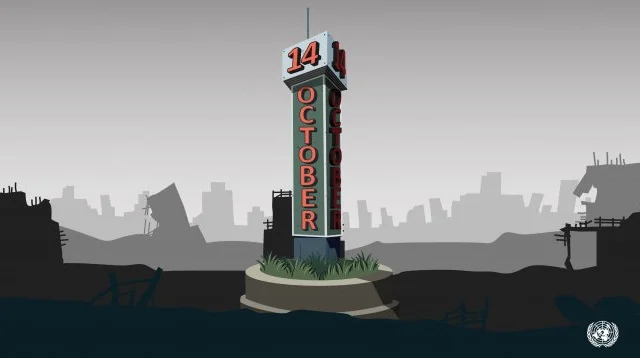
The manipulated image was additionally set against a background showing a monument in Diinsoor, situated in the centre of the town’s market. That monument image was lifted from a video clip shared on social media on 16 October, the same day media outlets reported that pro-Laftagareen forces had captured the town.
Diinsoor is one of at least four towns in Southwest State that pro-Laftagareen forces have reportedly retaken in recent weeks.
Why the context matters
The circumstances in which these images spread through local media are central to understanding their impact.
Since the conflict erupted in Southwest State, rival camps have accused one another of relying on foreign backers and of allowing terrorist groups into their ranks.
In late March 2026, Somali Federal Government forces and local clan militias attacked Baidoa, forcing the administration of then Southwest State president Abdiaziz Laftagareen to flee the city. Laftagareen resigned on 30 March, 2026.
In June, the Federal Government installed Aden Mohamed Nur (Aden Madobe), the former Speaker of the Federal Parliament’s Lower House, as the region’s new leader, a move that prompted pro-Laftagareen forces to mount attacks on Baidoa.
Turkish fighter jets were reportedly used to strike locations near Baidoa in an effort to repel the assaults and strengthen Aden Madobe’s administration and Federal Government forces.
Somali government officials and figures in the Aden Madobe administration have repeatedly accused pro-Laftagareen forces of involving Al-Shabaab in the fighting, a charge Laftagareen’s camp has denied.
In late March, Laftagareen made a counteraccusation, alleging that the Federal Government had cooperated with Al-Shabaab during the first offensive to wrest Baidoa from his administration.
Officials and supporters on both sides have continued to deploy sweeping allegations, and sometimes inflammatory rhetoric, to press their case and claim battlefield gains over their rivals. Those claims and counterclaims are often pushed into public view through the media.
Civilian impact and the danger of AI-manipulated photos
The armed confrontations in Southwest State are still producing civilian casualties, and the humanitarian consequences remain grave.
According to Médecins Sans Frontières (MSF), which supports Bay Regional Hospital, 234 civilian casualties, including 49 women and 27 children, have been recorded since 17 August. At least nine civilians have reportedly been killed, among them a local journalist and a healthcare worker.
Deploying AI-generated and AI-altered images to reinforce serious allegations during an armed conflict raises the risk of misinformation, deepens tensions, and can further inflame hostilities. When doctored visuals are presented as genuine proof of the involvement of armed groups or foreign actors, they can mislead the public, erode confidence in credible journalism, and intensify polarisation.
SJS says the spread of such images highlights the need for local media outlets and editors to verify visual material before publication, especially when claims involve armed conflict, alleged terrorist participation, or foreign interference. Media stations, journalists and editors also need stronger training and improved verification tools to identify AI content before presenting it as factual information