
Saturday August 1, 2026
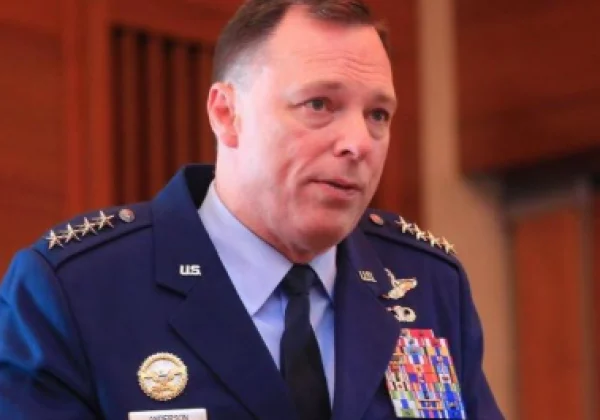
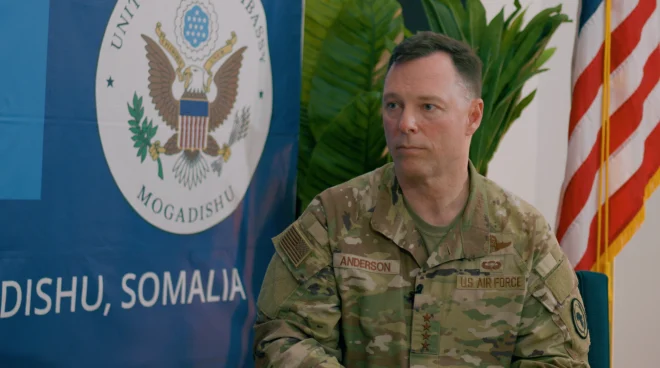
AFRICOM commander General Dagvin Anderson speaks during an interview shared by the US Embassy in Mogadishu on July 31, 2026. (Photo: Screengrab)
Mogadishu (AX) — The United States is not abandoning Somalia, the commander of U.S. Africa Command (AFRICOM), Gen. Dagvin R.M. Anderson, said, while making clear that Washington expects Somali leaders to take increasing control of the country’s security.
Speaking to journalist Omar Faruk Osman in Mogadishu on Friday, Anderson said the United States had devoted substantial resources to strengthening Somalia’s counterterrorism forces and would continue working with the country so long as its government remained in the lead.
“The United States has not turned its back on Somalia,” Anderson said. “We’ve been committed here for several years. We have engaged, I think, very constructively.”
He cited the U.S.-trained Danab Special Forces as a central accomplishment of the bilateral security partnership.
“We helped build the Danab, one of the most capable forces on the continent. I am very proud of our engagement building that counterterrorism force. We have completed that. We have built that force, and it is here, and it’s ready to be used for counterterrorism.”
Anderson said Somalia must now preserve the force, expand its capabilities and deploy it for the mission it was created to perform.
“But now it’s up to Somalia to sustain that force, to continue that force, to build it and continue to make it effective going into the future and use it as it was designed to counter terrorism,” Anderson said.
The AFRICOM chief also acknowledged mounting questions in Washington about how long the United States should continue helping Somalia before the country can manage its security challenges independently.
“There are people in Washington who say we’ve been here for several years. At what point does Somalia become independent and take care of these issues?” he said.
He said the United States is managing security concerns in several parts of the world, making continued involvement in Somalia dependent on visible progress and stronger national leadership.
“If Somalia steps up and the government takes the lead on this, we will continue to be there because there is mutual interest,” Anderson said. “But if we can’t see that, and political instability and political infighting continue, then it’s going to be very hard for us to continue to stay engaged.”
Anderson’s comments come as questions grow over the future of U.S. policy toward Somalia following President Donald Trump’s return to office. Trump has previously criticized Somalia and Somali immigration while advancing tougher immigration policies and engaging in public disputes with Democratic Rep. Ilhan Omar.
At the same time, U.S. military activity in Somalia has increased despite uncertainty over Washington’s long-term role. Data compiled by the New America Foundation shows that the United States has conducted more airstrikes against al-Shabab and the Islamic State group in Somalia since Trump’s return to office.
The number of strikes has already surpassed the combined total recorded under Presidents George W. Bush, Barack Obama and Joe Biden. It also puts Trump on course to exceed the 219 strikes carried out during his first term.
Most of the operations have focused on al-Shabab, the al-Qaida-linked group that has fought Somalia’s federal government since 2007 and holds territory in parts of south-central Somalia. Other strikes have targeted the Islamic State affiliate operating from the country’s northeastern mountains.
Over the past two decades, the United States has committed billions of dollars to Somalia through military training, intelligence assistance, counterterrorism support and humanitarian aid. Washington remains one of Mogadishu’s most important security partners as the federal government works to weaken militant groups and gradually assume primary responsibility for national security.