
Ethiopian federal troops battled overnight to prevent Tigrayan rebels from taking control of a town in the Afar region, a humanitarian source said Friday, as an apparent internet blackout was reported across northern Ethiopia.
Forces from the northern Tigray region captured several airports and mounted assaults in the neighboring Afar and Amhara regions this week, saying they were again engaged in a “full-blown war” with the federal government.
- Advertisement -
The escalation has revived fears of the communications shutdown and restrictions on essential supplies that characterized the 2020-22 civil war in Tigray. That conflict is estimated to have killed about 600,000 people.
Internet monitor NetBlocks reported an “internet disruption in northern Ethiopia,” coinciding with accounts of a telecommunications blackout in Tigray.
Agence France-Presse (AFP) could not reach contacts in the region by telephone Friday because of the reported outage.
In Afar, a humanitarian source described “heavy fighting overnight” near Abala, a mountainous town on the border with Tigray.
“The federal forces pushed the rebels from entering the town,” the source said, adding that the military had deployed a drone.
Amhara’s North Wollo Zone also saw intense clashes Thursday, including fighting near Lalibela, the UNESCO World Heritage site known for its celebrated rock-hewn churches.
Analysts believe the Tigray People’s Liberation Front, or TPLF, may be reviving the approach it used in the previous war by advancing south through Amhara toward Addis Ababa. The operation in Afar, meanwhile, could be intended to disrupt supply lines from Djibouti, the gateway for almost all of Ethiopia’s international trade cargo, including fuel.
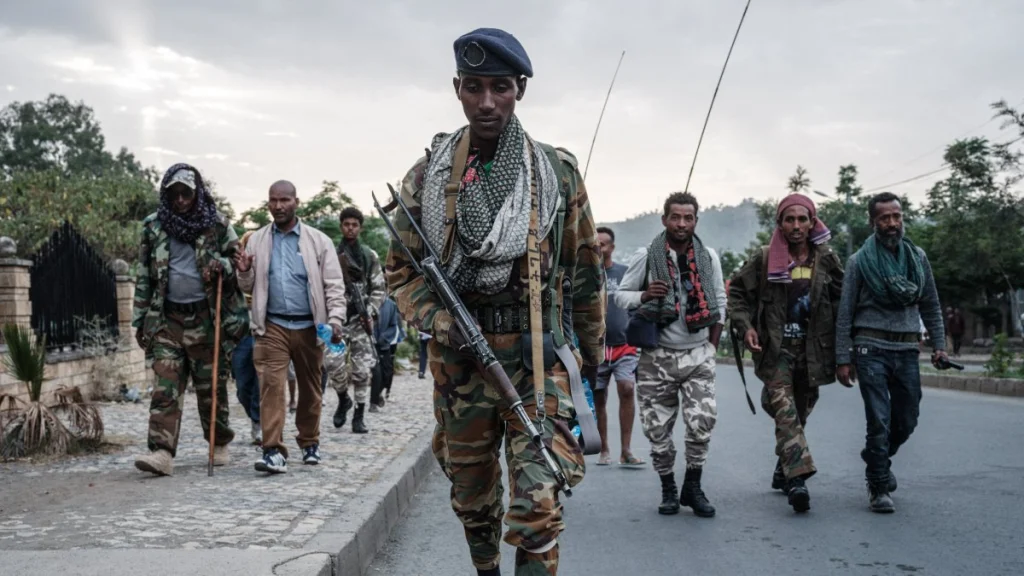
Members of the Tigrayan forces patrol along a street as tensions intensify after the forces launched a major offensive against the federal government in multiple locations in Mekelle, Tigray Region, Ethiopia, Sept. 24, 2026. (Reuters Photo)
The TPLF has also formed an alliance with six other armed groups across Ethiopia as it seeks to topple Prime Minister Abiy Ahmed’s government.
“The alliance is likely trying to seize settlements alongside key infrastructure routes to undermine the federal government’s ability to supply,” Edward Bach of consultancy firm Verisk Maplecroft told AFP.
The federal government nevertheless holds a substantial military advantage. Its forces include an army of about 500,000 and a large drone arsenal, while outside partners — most notably the United Arab Emirates — also support the government.
The latest violence puts Washington in a difficult position. Earlier this month, the United States lifted sanctions on Ethiopia and Eritrea over atrocities committed during the previous civil war, saying the “national emergency … has expired.”
The U.S. Embassy backed Ethiopia’s government this week, saying it was “disappointed to see the leadership of the TPLF … launch a large-scale offensive.”
The fighting also risks involving neighboring Eritrea, which is concerned that landlocked Ethiopia may seek to invade it in an effort to secure access to the Red Sea.
Panic buying
In Tigray, meanwhile, residents rushed to buy provisions as the prices of basic goods climbed sharply.
“There is panic in the community,” Samuel Gebreslassie, 37, who works at a spice shop in the regional capital Mekelle, told AFP Thursday.
“There is deep fear that banks, telecom networks, electricity and basic goods could be cut off again.”
The TPLF governed Ethiopia from 1991 until 2018, when Abiy’s rise to power pushed it aside and eventually helped set the stage for a civil war marked by widespread war crimes and sexual violence.
The 2022 Pretoria Peace Agreement preserved an uneasy calm through last year, but it was never fully implemented. About 1 million people remain displaced.
Clashes later began to recur, as federal forces carried out multiple drone strikes in Tigray in recent months and concentrated troops near the border.
Rights organizations have accused the TPLF of carrying out forced recruitment this year while preparing for a renewed conflict.