
Somalia, Ethiopia, and the Responsibility to Think Beyond Today
Some political questions cannot be understood through daily headlines, temporary disputes, or the personalities currently occupying public office. They must be examined through history, geography, national interests, and the ambitions that states pursue across generations. The relationship between Somalia and Ethiopia is one such question.
Governments change, leaders come and go, and political language evolves. Yet the strategic interests of nations rarely disappear. Ethiopia’s desire for reliable access to the sea is not a new development. It arises from the country’s geography, economic ambitions, population size, and desire to strengthen its influence in the Horn of Africa. For Ethiopian leaders, sea access is therefore not simply a commercial issue; it is increasingly presented as a long-term national priority.
Somalia must understand this reality without exaggeration, fear, or denial. The most important question is not whether Ethiopia has strategic ambitions. Every state has ambitions. The question is whether Somalia possesses an equally clear and enduring national strategy to protect its territory, coastline, resources, unity, and sovereign decision-making.
The sea is more than an economic asset
Ethiopia is landlocked, while Somalia has Africa’s longest mainland coastline, positioned beside some of the world’s most important maritime routes. This gives Somalia enormous economic potential, but it also places the country at the centre of regional and international competition.
Somalia’s coastline could support ports, fisheries, logistics, energy, tourism, maritime trade, and thousands of jobs. Properly managed, it could become one of the foundations of national development. But the sea is not merely an underused economic resource. It is inseparable from Somalia’s sovereignty, security, territorial integrity, and future influence.
Ethiopia has every right to seek commercial access to ports, establish lawful trade corridors, and negotiate economic partnerships with neighbouring countries. Regional integration can benefit both countries. Somalia itself would gain from becoming an important maritime gateway for Ethiopia and other landlocked states in East Africa.
However, commercial need cannot be transformed into a territorial entitlement. Access to a port is not the same as ownership of land. A trade agreement is not the same as political recognition, military control, or a permanent concession that weakens Somalia’s sovereignty.
Somalia should remain open to mutually beneficial cooperation, but cooperation must be based on international law, national consent, transparency, and respect for the country’s territorial unity. Economic opportunity should never be used as a justification for arrangements that create future disputes or divide Somali society.
Where did Somalia’s national ambition go?
The generation that led Somalia to independence possessed a powerful national vision. The idea of Soomaaliweyn—Greater Somalia—reflected the aspiration that Somali-inhabited territories divided by colonial borders would one day be united.
Whatever one thinks of the political feasibility of that project today, its existence demonstrated something important: Somalia once had a generation that thought beyond immediate survival. It imagined a national future and attempted to organize politics around a larger historical purpose.
Today’s generation has inherited a very different reality. Instead of debating how to unite Somali territories, Somalis are struggling to preserve the unity of the internationally recognized Somali state. The country remains affected by political fragmentation, constitutional disagreement, insecurity, weak institutions, corruption, clan competition, and recurring confrontation between the federal government and member states.
This transformation should concern every Somali. A nation can lose territory through war or foreign occupation, but it can also lose its sense of nationhood gradually. When younger generations grow up seeing division as permanent, they may begin to regard fragmentation as natural and unity as unrealistic.
That is perhaps the greatest long-term danger.
Political borders are protected not only by soldiers and diplomatic statements, but also by a shared national consciousness. If citizens no longer believe they belong to a common political community, sovereignty becomes increasingly difficult to defend.
Weak nations do not control the plans made for them
When Somalia is weak, other actors gain greater influence over its future. This does not mean that every Somali crisis is the result of foreign interference. Somalis must accept substantial responsibility for the country’s condition.
Political leaders have repeatedly prioritized short-term advantage over national institution-building. Disputes over offices, elections, resources, and authority have consumed energy that should have been directed toward security, justice, economic development, and public services. Clan loyalties are frequently mobilized against national interests, while political disagreements are too often treated as existential conflicts.
Nevertheless, Somalia’s internal failures do not erase the reality of external competition. A weak country occupying strategic territory will inevitably attract foreign interests. Somalia possesses a valuable coastline, natural resources, ports, fisheries, and a location connecting Africa, the Middle East, and the Indian Ocean.
Regional and global powers will pursue their interests in Somalia. That is normal state behaviour. The failure occurs when Somalia lacks the institutions, unity, and negotiating capacity required to pursue its own interests in return.
If Somalis do not develop a long-term national plan, others will develop plans for Somalia. Those plans will naturally serve foreign priorities before Somali ones.
Hassan Sheikh Mohamud and historical responsibility
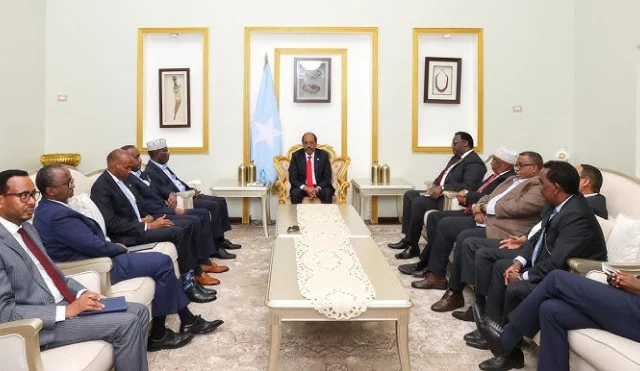
President Hassan Sheikh Mohamud leads Somalia during a period in which decisions made today could shape the country long after his administration has ended. His responsibility cannot be measured only by elections, political alliances, or the length of his term. The deeper question is: What kind of Somalia will his government leave to the next generation?
A president holds office temporarily, but presidential decisions can affect a nation for decades. Agreements involving territory, ports, military access, natural resources, or international recognition must therefore never be treated as ordinary political transactions. They require constitutional legitimacy, public transparency, expert scrutiny, and broad national consultation.
The president must also recognize that Somalia cannot effectively confront external challenges while remaining internally divided. Protecting sovereignty requires more than speeches condemning foreign actions. It requires rebuilding trust between Mogadishu and the federal member states, strengthening national institutions, completing the constitutional process, professionalizing the security forces, and creating a foreign policy supported across political divisions.
National unity cannot be demanded only when an external crisis emerges. It must be built consistently through justice, consultation, fair resource-sharing, and respect for the federal system.
Somalia also needs a policy that extends beyond Hassan Sheikh Mohamud, any future president, political party, clan alliance, or regional administration. Its fundamental national interests must not change whenever a government changes.
That policy should clearly define Somalia’s position on territorial integrity, maritime boundaries, port agreements, foreign military access, natural resources, regional trade, and relations with neighbouring states. It should distinguish between legitimate economic cooperation and arrangements that risk weakening national sovereignty.
Somalia must define what it wants
Ultimately, this debate is not only about Ethiopia’s ambitions. Ethiopia has stated and pursued what it believes serves its national interest. The more urgent question is whether Somalia can define and defend its own.
What does Somalia want to become in twenty, thirty, or fifty years? Does it want to remain a divided political space where foreign actors negotiate separately with competing Somali authorities? Or does it want to become a stable maritime nation that uses its geography to build prosperity, security, and regional influence?
Defending Somalia does not require permanent hostility toward Ethiopia. The two countries are neighbours and will remain so. They share security concerns, trade opportunities, and deep historical connections. Their peoples would benefit from peaceful relations and economic cooperation.
But sustainable cooperation is possible only when sovereignty is respected and agreements are reached between legitimate states on equal terms. Friendship cannot be built through pressure, and regional integration cannot succeed by bypassing Somalia’s constitutional order.
Previous generations left Somalis a dream of unity and national dignity. Today’s generation may not be able to fulfil every historical aspiration, but it carries a minimum responsibility: to preserve the country, protect its sovereignty, and prevent temporary political interests from determining Somalia’s permanent future.
Tomorrow’s generations will not judge today’s leaders by their speeches alone. They will judge whether Somalia’s land remained protected, whether its sea remained under sovereign control, and whether the nation became more united or more fragmented.
History will remember not only what Ethiopia wanted, but also whether Somalia knew what it wanted—and whether its leaders had the wisdom and courage to defend it.
By Ali Musa
Axadle Times international–Monitoring