
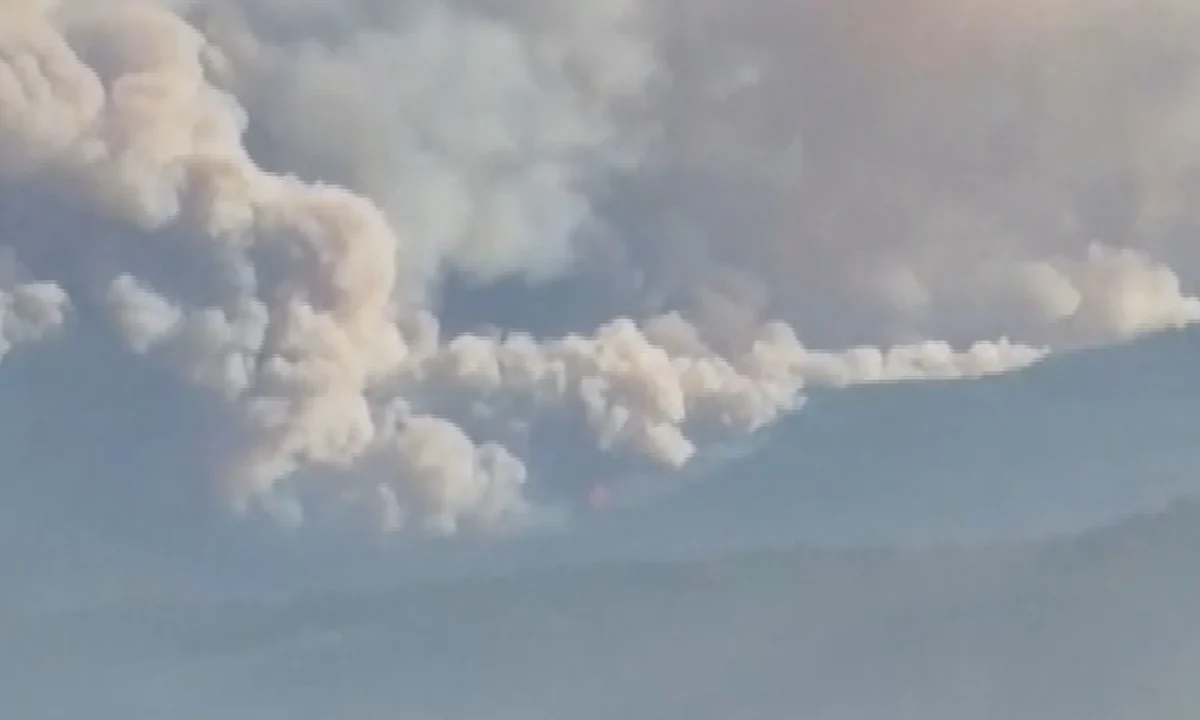
British Columbia has declared a state of emergency as a fast-moving wildfire forced thousands of residents to evacuate, with the blaze nearly doubling in size overnight.
The Bald Range wildfire was burning out of control and had expanded to roughly 9,500 hectares, driving evacuation orders in Summerland, Peachland and other communities west of Okanagan Lake in the province’s southern interior.
The area is home to most of British Columbia’s wine production and is Canada’s second-largest wine-producing region.
Premier David Eby said at a news conference that a fire official had compared the blaze to “a bomb going off”.
“Homes have been lost, and properties have been destroyed. Some people became trapped as conditions changed very quickly, and needed to be rescued,” Eby said, warning that the situation remained highly dynamic and dangerous.
Summerland had about 12,000 residents in the 2021 census, while Peachland is home to roughly 6,500 people.
Declaring a state of emergency gives the provincial government immediate access to extraordinary powers, including the ability to restrict travel, protect supplies from price gouging and coordinate rescue operations.
Officials said the Bald Range wildfire had triggered British Columbia’s largest evacuation event of the summer so far. More than 20,000 people across the province have been ordered to leave their homes.
“A lot of farms have been affected. We don’t know how many structures have been lost. They’re still busy fighting the fire,” Summerland Mayor Doug Holmes said in a phone interview.
“We have to brace ourselves for the worst.”
Overnight evacuation
Many residents fled during the night, heading south toward Penticton or north to Kelowna before highway closures cut off some routes.
As they escaped, residents captured videos showing flames along the highway and structures burning nearby.
By yesterday afternoon, ash had begun collecting on cars and homes in surrounding areas, while the fire cast an orange glow across the sky.
Summerland lost power and issued a boil-water notice.
The municipality said untreated water entered the system after the wildfire forced water to bypass the treatment plant.
Several Canadian provinces, including Ontario and Quebec, have fought wildfires this year as hot, dry weather intensified the threat across heavily forested areas.
Fire crews from Mexico, Australia, France and New Zealand have joined efforts to contain the blazes.
In British Columbia, where heat and dry conditions have heightened the risk of further spread, about 1,500 firefighters were battling more than 100 fires.
The province has issued 40 evacuation orders and 49 alerts.
Wildfires have burned across 4 million hectares in Canada this year, according to the Canadian Interagency Forest Fire Centre.