Iran is preparing to adopt a “fully offensive” military posture after negotiations aimed at securing a permanent end to its war with the United States stalled, a senior Iranian official said.
Washington, for its part, has ruled out extending the temporary ceasefire agreement.
- Advertisement -
Momentum toward peace talks — and the return of oil tanker traffic through the strategically vital Strait of Hormuz — has evaporated, raising the prospect of a prolonged conflict that began when the US and Israel attacked Iran on 28 February.
“Iranian entities must be prepared to escalate tensions in the Strait of Hormuz and the wider region, as Iran will be ready to make decisions and take action on difficult decisions,” the official said. If diplomacy failed, Tehran would launch a “timely and precise” military strike to break the US naval blockade, he added.
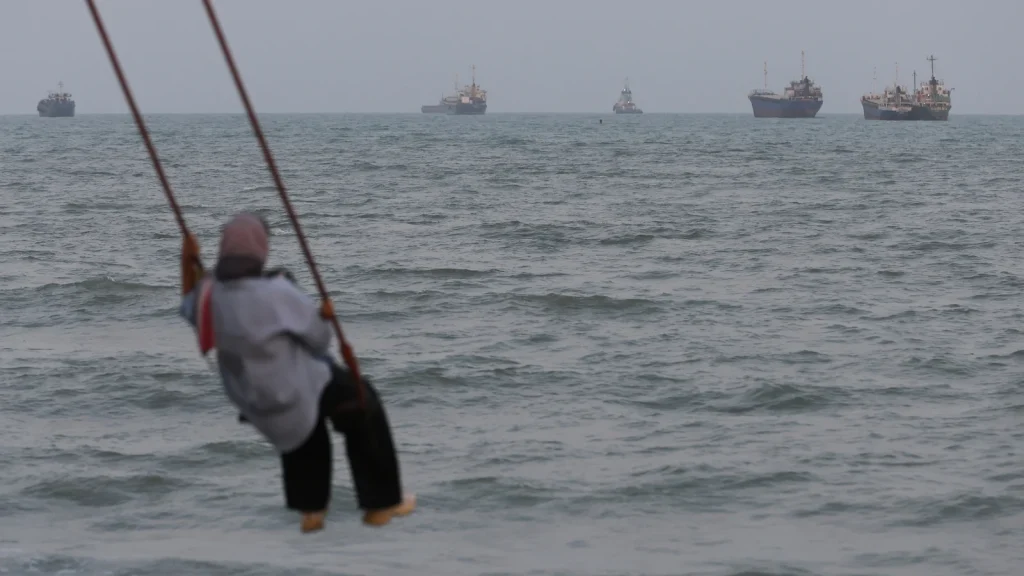
Two youths look out on the Strait of Hormuz last week
Signed on 17 June, the memorandum established a 60-day window for negotiating a broader agreement covering Iran’s nuclear programme and US sanctions.
It also called for the “immediate and permanent termination of military operations on all fronts”. But the deal rapidly began to unravel after the two sides clashed over control of the Strait of Hormuz, the narrow passage through which a fifth of the world’s oil and liquefied natural gas moved before the war.
Asked by reporters yesterday whether the US wanted to extend June’s interim agreement, US President Donald Trump answered no.
One tentative diplomatic opening emerged in media reports that Mr Trump had initiated back-channel contacts with the Islamic Revolutionary Guard Corps (IRGC), which has expanded its influence during the war and controls significant sections of Iran’s military and economy.
Axios, citing two people with direct knowledge of the discussions, reported that former Director of National Intelligence Tulsi Gabbard spoke with an Iraqi Kurdish leader who maintains close ties to the IRGC. Through that intermediary, the US reportedly sent a message to IRGC commander General Ahmad Vahidi.
Fox News subsequently reported that Mr Trump confirmed the account during a telephone interview.
Daily life continues amid ongoing tensions between the United States in Tehran, Iran
According to Axios, the Trump administration questioned whether the Iranian negotiators at the table truly represented the IRGC. Reuters, meanwhile, reported that Mr Vahidi had emerged as a central figure in the negotiations.
Axios said Mr Vahidi indicated that he was in agreement with Iran’s negotiators.
“I can’t go into the details of it, but I will say that the conversations between the US government and different areas of the Iranian government at all areas is probably more robust than it’s maybe ever been,” Jared Kushner, Mr Trump’s son-in-law and special envoy, told Fox News Channel Chief Foreign Correspondent Trey Yingst in a separate interview on Monday.
READ MORE:Hamas disarmament could begin within 30 days – Kushner
Iran argued that point 5 of the Memorandum of Understanding authorized it to manage the strait, which it shares with US ally Oman. The US rejected that interpretation.
Fighting resumed after Iran opened fire on vessels it said were attempting to pass through Hormuz along an unauthorized route. On 7 July, Mr Trump declared that the agreement was “over”.
The Iranian official said Washington would have to fulfill all provisions of the Memorandum of Understanding within several weeks before Tehran would agree to further negotiations.
While Iran’s leaders continue to project resolve, three Iranian officials said they were concerned that additional economic pressure could deepen hardship, fuel renewed unrest and further weaken the Islamic Republic’s legitimacy.
The country entered the war already facing high inflation, a weakening currency, energy shortages, sanctions and serious structural problems. It must now also deal with damaged infrastructure, interrupted trade, lost production and the enormous expense of reconstruction.
US President Donald Trump speaking in the White House yesterday
Iran has also been negotiating separately with Oman over arrangements for managing the strait and says the two countries are close to reaching an agreement.
Mr Trump responded by threatening the Gulf state, a longstanding US security partner.
“If Oman gets in the way, we’ll bomb the shit out of them,” Mr Trump told Fox News.
Thousands of people have died in the conflict, most of them in Iran and Lebanon.
Iran has struck US military bases and infrastructure in Oman, Jordan, Kuwait, Israel, the United Arab Emirates and Saudi Arabia, among other countries.
High fuel prices
In a speech at a rally on Friday, Mr Trump warned Americans to expect elevated fuel prices to continue as the war persists.
Benchmark Brent crude futures have soared during the conflict, reaching $126 a barrel at their peak — about 75% above pre-war levels.
Brent settled more than $2 higher yesterday at $90.87 a barrel.
Gasoline prices have climbed above $4 a gallon for Americans preparing to vote in November’s congressional elections, compared with less than $3 before the war, according to automotive group AAA.
Oil prices are rising as a result of the conflict
Only single-digit numbers of ships crossed the Strait of Hormuz yesterday, despite a modest increase from the weekend, according to preliminary shipping data.
Kpler ship-tracking data showed that six commodity vessels made the passage: three leaving the Gulf and three entering it. That compared with a 10-day average of 11 ships.
Three vessels crossed on Saturday, while two passed through the waterway on Sunday.
No very large crude carriers or tankers transporting liquefied natural gas were recorded among the vessels making the crossing.
Some ships may have transited the strait with their transponders turned off, meaning they would not have been included in the tally.