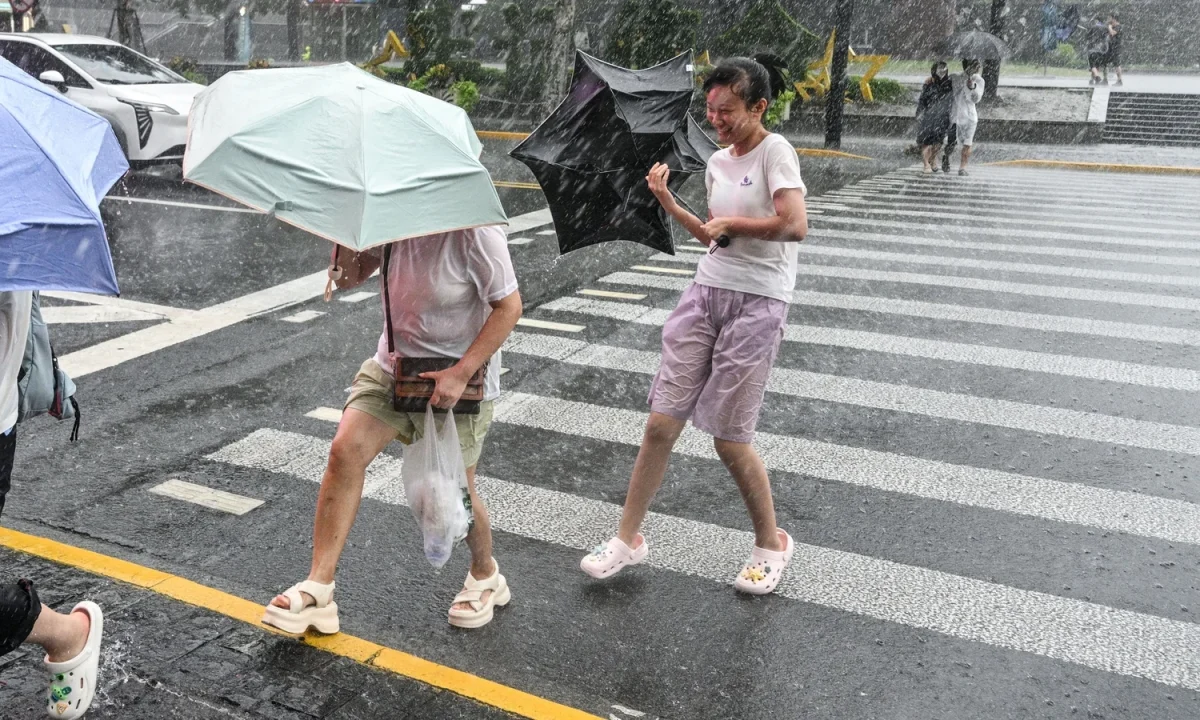
Typhoon Dolphin has left a broad trail of torrential rain and fierce storms across eastern China, flooding roads in Shanghai as its remnants drenched several coastal provinces.
The storm carried maximum sustained winds of 151km/h near its centre when it came ashore in Zhejiang, the province southwest of Shanghai, yesterday evening. It weakened into a tropical storm after making landfall.
Its sprawling rain bands continued to batter Anhui, Jiangsu and Shandong today, keeping much of eastern China under wet and unsettled conditions.
Residents’ livestreams shared on social media showed streets in Shanghai’s suburban Jiading and Qingpu districts still waterlogged this morning, with floodwater gathering around roads and neighbourhoods.
Dolphin is the strongest typhoon to hit China this year
Shanghai’s two airports cancelled 943 flights combined because of the typhoon, cutting their capacity by nearly 40% today, state broadcaster CCTV reported.
In Zhejiang’s Wenzhou, powerful gusts and driving rain overturned a truck, according to video posted on TikTok yesterday. The driver’s condition was not immediately clear.
Dolphin, the strongest typhoon to strike China this year, is expected to push farther inland towards the central provinces of Hubei and Henan in the coming days, while sending moisture northward.
The typhoon had already travelled 6,000km before it made landfall
Authorities in Beijing issued warnings for torrential rain and said the capital was ready to activate its flood-control response tomorrow morning.
Before reaching land, Dolphin had travelled 6,000km, giving the system a life cycle three times longer than that of an ordinary typhoon. The journey also helped it develop an exceptionally large cloud system that spread across eastern China, CCTV said in a separate report.
Dolphin packed maximum sustained winds of 151km/h near its centre when it made landfall in Zhejiang
The storm’s potential impact was being compared with Typhoon Doksuri in 2022. That system crossed China after devastating parts of southeastern Fujian province and went on to produce record-breaking rainfall in Beijing.
As Dolphin’s cloud bands encounter colder air farther north, Beijing, Tianjin and Hebei are expected to face continued rain through Thursday, CCTV reported.