Wildfires raged across southern Albania as Hungary urged households and businesses to reduce electricity use, underscoring the mounting strain that Europe’s latest heatwave and drought are placing on communities in the continent’s south and east.
Europe, the world’s fastest-warming continent, has endured a summer of record heat and damaging wildfires, with France and Spain among the countries hit hardest.
- Advertisement -
Slovakia registered its highest temperature on record on Wednesday, reaching 41.4C, the Slovak Hydrometeorological Institute (SHMU) said. Austria also broke its national temperature record for a second consecutive day, with 41.2C recorded in the country’s east, according to its national weather agency.
The heat’s centre of gravity has moved eastward, prompting Italy to place most of its major cities under a red heat alert as temperatures approached 40C in some regions.
People attend Pope Leo XIV weekly general audience at St Peter’s Basilica
In Rome, visitors welcomed the decision to hold the Pope’s weekly audience indoors as they looked for shelter from the oppressive heat.
“I suppose it’s better to hold it indoors because of the heat,” said Diego Amaya, a tourist from Mexico.
Low levels on the Danube and the Rhine
Hungarian households and companies reduced their electricity use this week after the government appealed for conservation to relieve pressure on the national grid during the severe drought.
Budapest is expected to experience the peak of the heatwave over the next two days, with temperatures forecast to rise to nearly 40C on Wednesday afternoon.
Water levels on the Danube have fallen to record lows, forcing Hungary to largely shut down its only nuclear power plant. The facility relies on the river for cooling, and the interruption has created an energy crisis that has pushed available power-supply capacity to its limits.
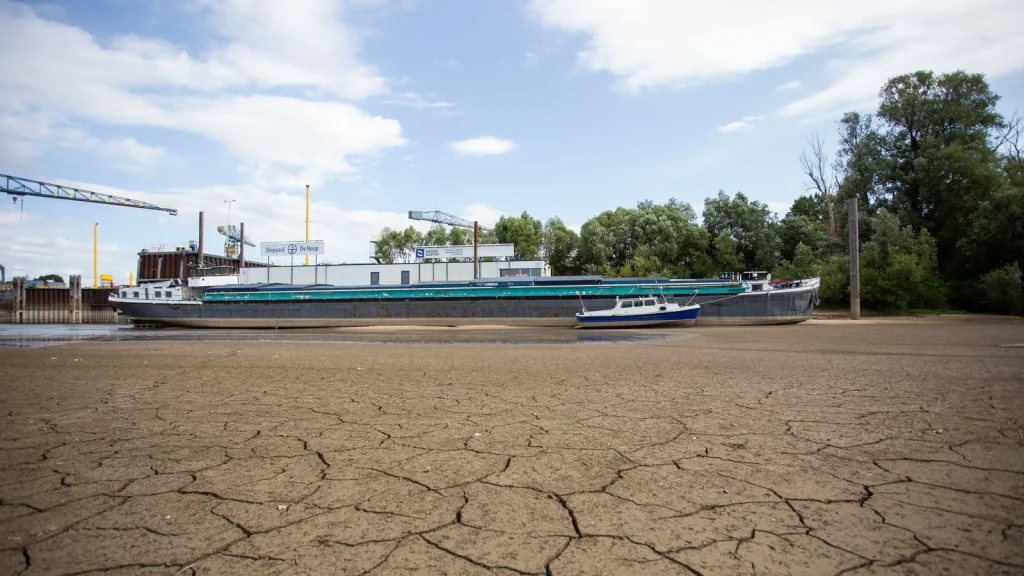
Exposed ships on the Rhine due to low water levels
Slovenia’s sole nuclear facility at Krsko, which also supplies neighbouring Croatia, said on Wednesday that it would begin reducing reactor output overnight because of unusually high temperatures and diminished flows on the Sava River, a tributary of the Danube.
Initially, the plant will operate at 80% of its full capacity.
In Germany, meanwhile, the Rhine has also reached exceptionally low levels. Some cargo services have been suspended, while vessels that continue to sail are carrying substantially lighter loads.
The Rhine is a major transportation route for commodities such as grain, ore and petrol.
Wildfires burn in Albania
In Albania’s southern Mallakaster region, fires drove around 15 families from their homes, along with their livestock and pets. Crews on the ground and aircraft worked to keep the flames from reaching houses near a village.
Firefighters were also battling another blaze in rugged, mountainous country south of Gjirokaster. Authorities believe lightning may have sparked the fire.
Across the border in Greece, a wildfire possibly ignited by vibrating electricity conductors and intensified by gale-force winds has scorched thousands of hectares of farmland near a popular holiday destination northwest of Athens.
A burnt car after a wildfire in Porto Germeno in Greece
The fire appeared to be largely under control on Wednesday, but hundreds of firefighters stayed behind to guard against renewed outbreaks while six helicopters targeted scattered areas that were still smouldering.
The prolonged hot and dry summer is also exacting a heavy price from agriculture.
Britain’s cereal harvest is expected to be the poorest since comparable records began in 1984, according to an analysis released on Wednesday. Crops have withered during one of the driest and hottest spring-summer periods on record.
Austria hits all-time temperature high for second day running
Austria’s national weather agency reported a temperature of 41.2C in the east of the country.
The reading in Bad Deutsch-Altenburg surpassed the previous national record of 41C, set on Tuesday in Vienna, GeoSphere Austria said in a statement.
The new high came during an exceptional period of heat and scant rainfall that has already produced a series of local temperature records.
Austria experienced its fourth-hottest July on record, while some monitoring stations recorded precipitation shortfalls of as much as 90%, according to the weather agency.
Christina, a 20-year-old ice-cream seller in Vienna, told AFP on Tuesday evening that business had been unusually quiet earlier in the day because of the searing heat.
“Later, when the sun goes down, we have lots of clients, thankfully,” she said, adding that “the fan is saving us, it’s our life-saver”.
Experts say climate change has worsened drought conditions across Europe this summer, with extreme heat driving the exceptionally dry weather.