
US President Donald Trump has warned that Iran will pay a direct price for every attack on shipping in the Strait of Hormuz, pledging to destroy an Iranian bridge or power plant each time Tehran fires on a vessel, as tensions surged after Yemen’s Iran-aligned Houthis threatened another crucial energy corridor.
Five tankers altered course in the Red Sea today to steer clear of the Bab el-Mandeb Strait, one day after the Houthi warning to halt Saudi oil exports exposed a fresh danger to global energy flows from the widening conflict.
Yesterday, three tankers carrying Saudi crude bound for China and India turned back.
Iran’s joint military command cautioned, according to state media, that if President Trump’s threat were acted upon, Iranian forces would strike regional oil, gas, electricity and economic infrastructure and stop the export of “even a single drop of oil”.
“Those who contribute to such aggression, whatever the kind of support, will also be considered as legitimate targets,” Iranian Foreign Minister Abbas Araqchi said on social media.
Iran’s near-total blockade of the Strait of Hormuz has fuelled inflation worldwide, while the added threat to vessels from the Houthis, who hold territory near the Bab el-Mandeb Strait, drove oil prices close to a six-week high.
Millions of barrels of Saudi crude each day have been routed toward the kingdom’s Red Sea port of Yanbu in an effort to bypass the Strait of Hormuz.
Should tankers be unable to move through the Red Sea’s southern strait, the only remaining northern passage runs through the Suez Canal, a detour that adds weeks to voyages and sharply increases freight and transit costs.
Trump in a ‘quagmire’, Iranian official says
US strikes have expanded beyond southern Iran into western and central parts of the country.
Tehran this week hit key water desalination and energy facilities in Kuwait and targeted American military assets there, as well as in Bahrain and Jordan.
Army Commander-in-Chief Major General Amir Hatami said Iran had reinforced its military because it expected its adversaries to violate agreements.
Iranian media quoted Hasan Qashqavi, spokesperson for parliament’s National Security and Foreign Policy Committee, as saying President Trump was trapped in a “quagmire”.
An Iranian health ministry official said 53 civilians had been killed and 592 injured since late last month. The US military has said it does not target civilians.
The war has killed 18 American service members and wounded more than 450 troops.
The body of an American soldier killed in the Middle East is returned to the US
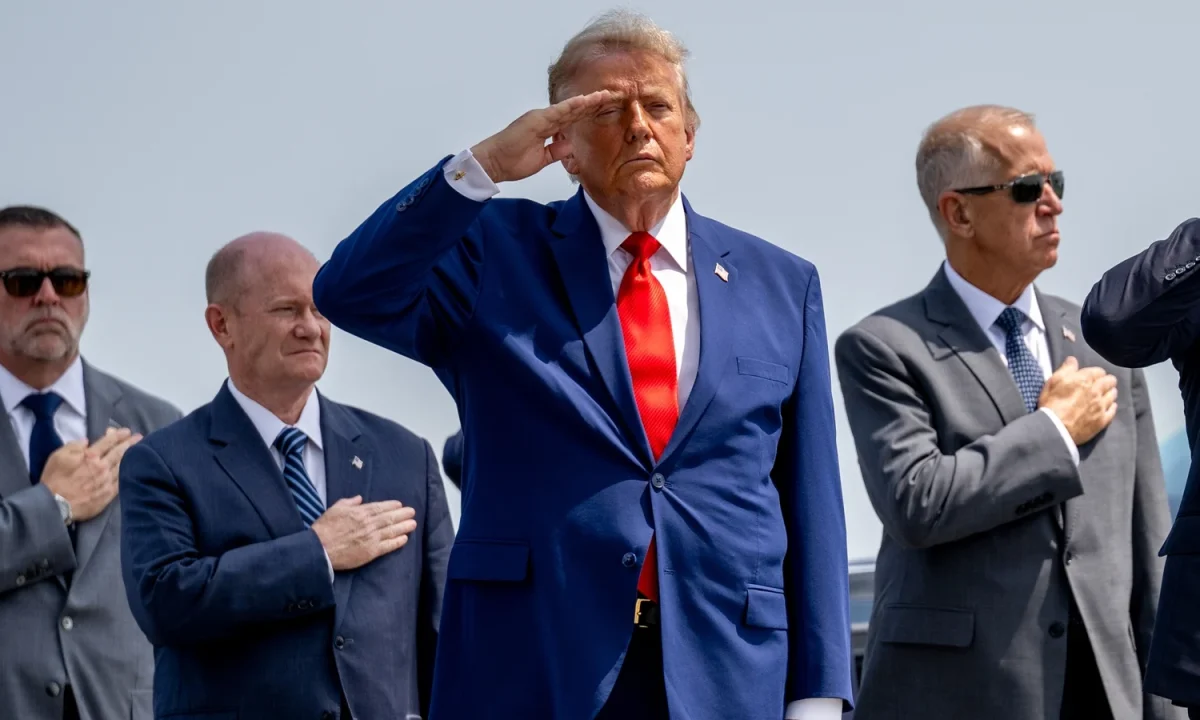
President Trump travelled today to Dover Air Force Base in Delaware for a ceremony honouring four US troops killed in Iranian attacks on military bases in recent days – three in Jordan and one in Iraq.
“For me it’s one of the hardest things to do as a president. But it has to be done,” he said before departing for the event.
A senior Iranian official said earlier this week that mediators had delivered Tehran a proposal for a 10-day ceasefire.
The proposal is intended to preserve an interim truce agreement reached by Washington and Tehran last month.
Iran’s Interior Minister Eskandar Momeni travelled to Pakistan this week and urged Islamabad to keep up its mediation efforts.
Pakistan said it would continue, while stressing that the safety of shipping must be guaranteed.
People on the streets in the Iranian capital, Tehran
Iran has said it will retain the control over the Strait of Hormuz that it established during the war, which the US and Israel launched on 28 February.
US Secretary of State Marco Rubio said allowing Iran to maintain such control would create a dangerous precedent globally, including in Southeast Asia, where several countries are locked in territorial disputes with China in the South China Sea.
He added that Iran was not approaching negotiations seriously.
“If they’re serious, we’re serious. If they’re not, then we will do what’s necessary to protect our interests, and also the interests of our allies,” he told reporters during a meeting of Southeast Asian foreign ministers in the Philippines.
Latest Middle East stories
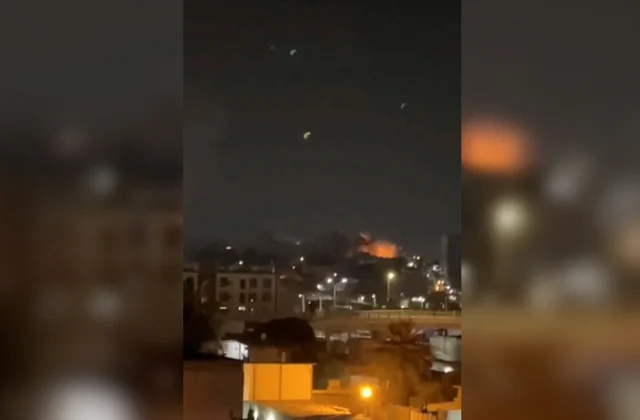
As the US bombing campaign against Iran entered its 11th consecutive night, residents of Tehran reported explosions in the early hours of today as air defences were activated over the capital, Iran’s semi-official Fars news agency said.
An official told the state news agency IRNA that three sites in Bushehr province, which is home to Iran’s only nuclear power plant, were struck, including an electricity post near the facility.
Iranian media also reported that the US hit locations in central Hamadan province, without providing details.
Iran’s army said it had attacked accommodation and storage facilities at the US Al Azraq Air Base in Jordan, struck warehouses and aircraft maintenance hangars at Sheikh Isa Air Base in Bahrain and targeted Camp Doha in Kuwait.
Jordan, Kuwait and Bahrain all said they had intercepted Iranian attacks.