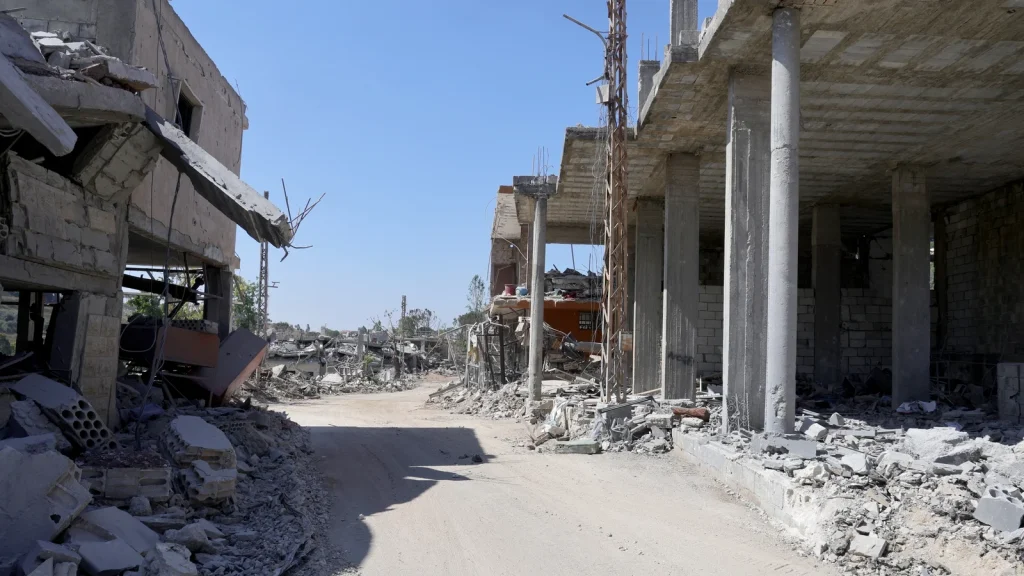
With diplomacy back in motion and gunfire still claiming lives, Hezbollah chief Naim Qassem has called for Israeli troops to leave south Lebanon on schedule after Lebanese authorities said Israeli fire killed two people there despite the recent lull in combat.
As a fifth round of Israel-Lebanon talks opened in Washington, Lebanese President Joseph Aoun again denounced Israel’s presence in the south and rejected outside meddling in Lebanon’s affairs — a pointed reference to Hezbollah’s Iranian patron.
- Advertisement -
Yesterday, mediators Pakistan and Qatar said Tehran and Washington had agreed in Switzerland to establish a “de-confliction cell” aimed at containing flare-ups in Lebanon as part of talks on ending the broader Middle East war, which Tehran has tied to stopping the parallel conflict in Lebanon.
“We now have a ceasefire. The withdrawal must take place according to a timetable. Israel has no choice but to fully withdraw from all Lebanese territory, without retaining an inch,” Qassem said in a televised speech.
Hostilities in Lebanon have been largely on hold since Saturday evening.
“Israel withdraws and the Lebanese army deploys exclusively south of the Litani River,” Qassem said, referring to the waterway roughly 30 kilometres (some 20 miles) from the Israeli border.
Latest Middle East stories
‘Deadly breach’
Lebanon’s National News Agency (NNA) said two men were killed today after Israeli soldiers fired machine-guns “while they were standing near an excavator that was unblocking a road” in Nabatieh al-Fawqa.
The health ministry later confirmed the fatalities.
Hezbollah condemned the incident as a “blatant” violation of the truce and a “treacherous attack”.
Israel’s military said its troops first fired warning shots at four suspected Hezbollah militants on a bulldozer and a motorcycle after they entered an Israeli-declared “security zone” extending around 10 kilometres (six miles) into Lebanon, and that “additional fire was conducted in order to remove the threat”.
In a separate statement, the military said its forces also “identified a cell of armed terrorists operating” near soldiers in the zone and “struck the terrorists … to remove the threat”.
The NNA also reported that “an enemy drone targeted a parked car” on the outskirts of Baraasheet, though it did not immediately mention any casualties.
Earlier today, the UN peacekeeping mission in Lebanon, UNIFIL, said it had seen no launches, strikes or interceptions “since Sunday, marking more than two days without such activity”.
‘Sovereignty at stake’
Under pressure from the United States, Lebanese officials began direct talks with Israel in Washington in April, while Beirut has sought to keep those negotiations separate from the US-Iran deal.
“We accept nothing less than an end to the Israeli occupation and at the same time, the fall of foreign tutelage,” Mr Aoun said, according to his office.
The Lebanese president has previously accused Iran of treating his country as a “bargaining chip”.
He said he hoped the latest round of talks would prove “decisive” in securing “the full restoration of Lebanon’s sovereignty”.
Mr Aoun’s office also said he spoke by phone with French President Emmanuel Macron, and the two discussed the situation “in light of the results of the US-Iran negotiations”.
Parliament speaker Nabih Berri, a Hezbollah ally who serves as an intermediary for the group, also held a call with Mr Macron, his office said, stressing “the importance of consolidating the ceasefire” and securing Israel’s withdrawal.
Hezbollah pulled Lebanon into the Middle East war on 2 March by launching rockets at Israel in retaliation for the killing of Iran’s supreme leader in US-Israeli strikes.
Israel answered with airstrikes and a ground offensive that Lebanon says have killed more than 4,100 people.
Yesterday, Israeli Prime Minister Benjamin Netanyahu said Israeli forces in Lebanon still had “full freedom of action to thwart any direct or developing threat”.